.png) 20 hours ago
11
20 hours ago
11
Key events

Pablo Iglesias Maurer
Argentina head coach Lionel Scaloni, captain Lionel Messi and goalkeeper Emiliano “Dibu” Martinez met with the media on Friday in New York City, two days ahead of Argentina’s second consecutive World Cup final appearance.
Few considered Argentina – who are built around an aging core and led by a 39-year-old talisman – to make it this far. Yet the team has put together a string of heart-stopping, chaotic performances, capped off by a memorable and unexpected semi-final win over England, to set a date with Spain on Sunday.
In Spain, El Albiceleste will face a team that is in some ways the anti-Argentina. There is very little chaos in their style of play, which is centered around possession and a tightly organized defensive setup that rarely errs. If Argentina’s path to the final has been pure chaos, Spain’s has been the polar opposite, almost entirely devoid of chaos and a bit boring.
Yet Scaloni does not delude himself. In Spain, the Argentines will face their tallest test yet, a team that made tidy work of the World Cup favorites in the semi-finals.
“If Spain leaves the hotel, I am already concerned,” said Scaloni. “Once they are on the bus and they leave the hotel, I am concerned. They are a great team. Everything concerns me about Spain.”
Tom Lutz and I spent the early hours of thes morning engaged in a ferocious straw-drawing competition. I lost and will be covering the actual football. He won and will be covering everything but.
But first! We’ll have a closing ceremony starting 90 minutes before kickoff, starring streamer IShowSpeed and various celebrities who were last cutting edge at least 25 years ago, including Nicole Scherzinger; Robbie Williams and Tom Cruise. There is a 90% chance Cruise will jump off something high (Gianni’s forehead?).
This is Argentina’s seventh World Cup final – and their sixth in the last 13 tournaments, which is a helluva hit rate. No other team has reached as many finals since the admittedly arbitary cut-off point of 1978.
-
1930 Uruguay 4-2 Argentina
-
1978 Argentina 3-1 Netherlands (aet)
-
1986 Argentina 3-2 West Germany
-
1990 West Germany 1-0 Argentina
-
2014 Germany 1-0 Argentina (aet)
-
2022 Argentina 3-3 France (aet; 4-2 pens)
Spain have appeared in only one final before this competition. You know the one, it was barely yesterday.
-
2010 Spain 1-0 Netherlands (aet)
There’s plenty of live sport to follow on the site, including the climax of The Open and a record-breaking runfest at Lord’s.

Sid Lowe
Luis de la Fuente says he will not man-mark Lionel Messi in the World Cup final, even though the Argentina captain has scored eight times and provided four assists and the Spain coach’s own experience suggests it might not be a bad idea.
In the buildup to Sunday’s final in New Jersey, De la Fuente told the story of the first time he encountered Messi, 22 years ago, when the Argentinian was a 16-year-old coming through at Barcelona, he was the youth-team coach at Sevilla and the under-19 cup draw brought them together in the last 16 in May 2004 at the Miniestadi.
“I’m going to tell you something funny about Messi,” De la Fuente said. “Look, I met Lionel Messi when I was coaching at Sevilla in division de honour [the national under-19 league] and we played a Copa del Rey game against Barcelona. We went to Barcelona. They had spoken very well about a boy called Messi. So, we put a man-marker on him. In the 70th minute it was 0-0. When they gave a yellow card to the player who was marking him, I took him off. And in 15 minutes, Messi scored four goals.”

Matt Hughes
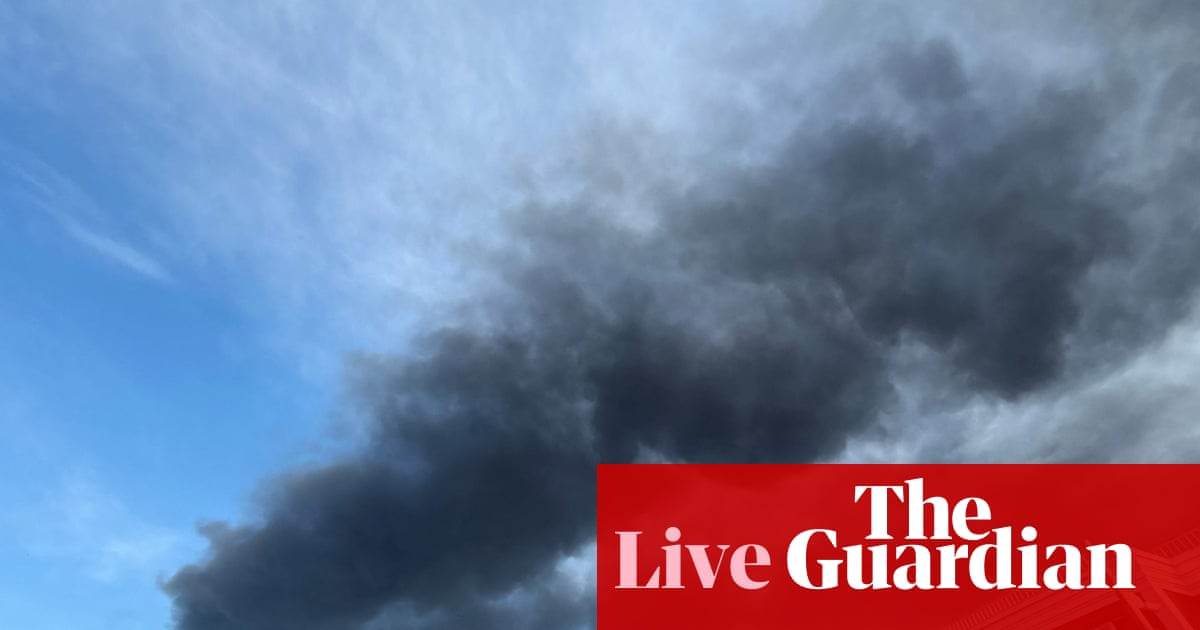
The thick smoke that has engulfed New York and much of the eastern seaboard over the past few days has drawn wry smiles in Dallas and Los Angeles, where locals will watch on with a sense of schadenfreude when the World Cup final takes place in the New York New Jersey Stadium (usually known as the MetLife Stadium in New Jersey) on Sunday.
The Dallas and Los Angeles stadiums, which were passed over when Fifa awarded the final in February 2024, are more impressive venues without the same climatic risks as New York, which was chosen because of its global appeal and favourable timezone for European television audiences.

Argentina's route to the final
-
Group J Algeria 3-0, Austria 2-0, Jordan 3-1
-
Last 32 Cape Verde 3-2 (AET)
-
Last 16 Egypt 3-2
-
Quarter-final Switzerland 3-1 (AET)
-
Semi-final England 2-1
Spain's route to the final
-
Group H Cape Verde 0-0, Saudi Arabia 4-0, Uruguay 1-0
-
Last 32 Austria 3-0
-
Last 16 Portugal 1-0
-
Quarter-final Belgium 2-1
-
Semi-final France 2-0
You can also follow the build up on our news blog, which contains photographtic proof that things are livening up in NYC
“One of the big questions for those of us in the UK is how to watch the final,” writes David Wall. “For all that has been made about ITV’s coverage with their New York studio and one of two excellent pundits, I think their coverage has been less than the sum of its parts, as usual. They’ve not had people other than the commentators in the stadiums so all that studio showed was that it was quite windy in New York sometimes.
“We’ve not even seen them out and about seeing what the fan culture was like on the ground in the city. And the pundits have been hampered by adverts and over-use of VTs as always. What is the point of hiring Emma Hayes and Gary Neville if you barely give them any time to discuss tactics?
“One of the most interesting bits of coverage I saw through the whole tournament was at half-time in the Netherlands v Sweden game when Thomas Frank, Ellen White and Micah Richards spent the full break dissecting and discussing the fluctuating 45 minutes that we’d all watched. It didn’t matter that they were in a studio in Salford.
“Plus, the BBC have Joe Hart who is turning out to be an increasingly interesting pundit (albeit I wouldn’t want to watch a match with him, from the clips they’ve shown of him pacing around and shouting he must be the most irritating of watchers). So I’ll be tuned to the Beeb tonight (as well as following the MBM of course).”

Richard Partington
It’s almost all over. No more hydration breaks, no more obligatory pans of the TV cameras to Hollywood A-listers, or dread of the crushing inevitability of English disappointment. The Fifa World Cup 2026 is at an end, after another month of planet-straddling drama laced with significance and symbolism, both on and off the pitch.
Before the kick-off between Spain and Argentina on Sunday evening, the result is already clear: football’s greatest prize is more than a sporting event; it is a geopolitically charged economic juggernaut.
After a month of fixtures, billions of dollars have been spent in an extravaganza of consumerism and corporate largesse, fuelled by advertising spend, ticket sales, merchandise, gambling, travel and hospitality. Fifa estimates that the tournament will add $40.9bn (£30.4bn) to global GDP, with the US – ahead of Canada and Mexico as the leading economy

Philipp Lahm
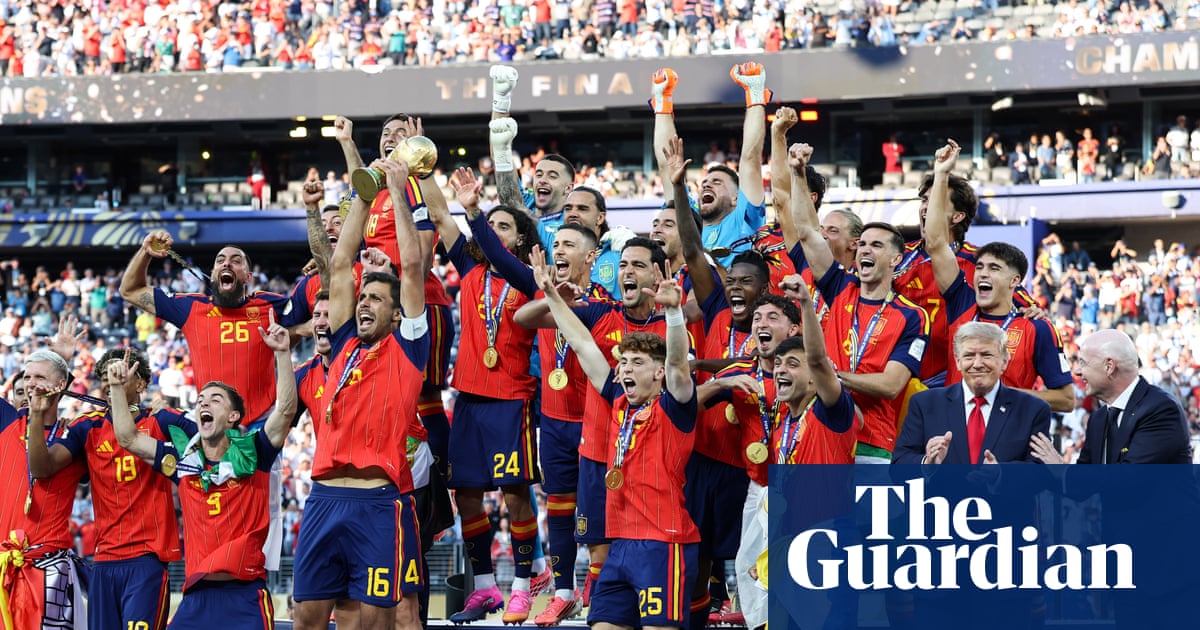
Two countries are generating powerful, cross-border momentum in football. Spain represent the leading footballing culture, radiating their influence across the globe. Argentina possess a distinct identity that shapes the South American continent. Consequently, the World Cup is witnessing the perfect final.
The architect of Spain’s vision is Johan Cruyff. He brought the 4-3-3 formation and a specific ideology to Barcelona. A cadre of tactical purists, such as Pep Guardiola and Unai Emery, refined his approach into a philosophy that has defined the playing style of the entire league, all youth squads and the national team for nearly two decades.
Its principles include ball-oriented defending, clearly defined positions and roles, a high level of organisation, and technical, combination-based football. Eleven players operate as a unit, moving like a swarm.
Alex Reid
Every World Cup produces cult heroes, icons who make it possible for us to sit back and start misty-eyed recollections by saying: “Do you remember Roger Milla/Saeed Al-Owairan/Keisuke Honda/Paul the Octopus?” Well, the Geopolitics World Cup has not let us down! Here are 10 cult heroes who’ve emerged from this tournament.

Marcela Mora y Araujo
After scoring the goal that secured Argentina’s place in the World Cup final, Lautaro Martínez burst into convulsive sobs during the touchline interview. He spoke of the first pair of trainers his father bought him and of how his mother kept making his bed when he moved to a club pension house in another city as a teenager. Every single day. Martínez said that mattered to him more than any goal, any cup.
Argentina’s head coach, Lionel Scaloni, said he was a bit worried after England’s goal but never stopped believing in his players. “They grew up in environments where they were afraid of nothing, in which they’ve always been the best at what they do,” he said. “As small children they competed and everyone expected so much of them; responsibility doesn’t weigh them down.”

Jonathan Wilson
In the 37 minutes between England going ahead against Argentina and falling behind, they had 12% possession. It’s fair to assume that in the World Cup final Spain will provide a rather different challenge. They do not suffer the Mafeking tendency of the English, seeking to re-enact some famous siege every time they take the lead. The finalists have averaged 64% possession so far in the tournament. Spain could hardly be more different to England: their way is not of panic but of process.
There is a clearly defined Spanish style, as there has been since Vicente del Bosque replaced Luis Aragonés as Spain manager in 2008, and arguably before. In that, perhaps, there is hope for England. Spain once were even greater underachievers but Aragonés inspired the revolution against the furia roja orthodoxy. The result has been three Euros and a World Cup in the past two decades, with perhaps another to come on Sunday.
The patience and emphasis on ball retention can at times become predictable – no system or style is ever without flaw – but Luis de la Fuente has reinvigorated the juego de posición model. A view of the alternative in Atlanta on Wednesday, a team pathologically unable even to attempt to retain possession, is instructive of how valuable can be the capacity not to lose the ball.
Early team news/speculation
It’s hard to see Spain changing much after such a comprehensive semi-final win over France. Lamine Yamal and Pedro Porro missed training as a precaution but are expected to be fit.
Argentina were more impressive against England when Rodrigo De Paul and Nicolas Gonzalez came onto the field. It won’t be a surprise if De Paul starts in place of Giuliano Simeone.
Sixty years or hurt never stopped us dreaming that Spain and Argentina would meet again at the World Cup.
Preamble
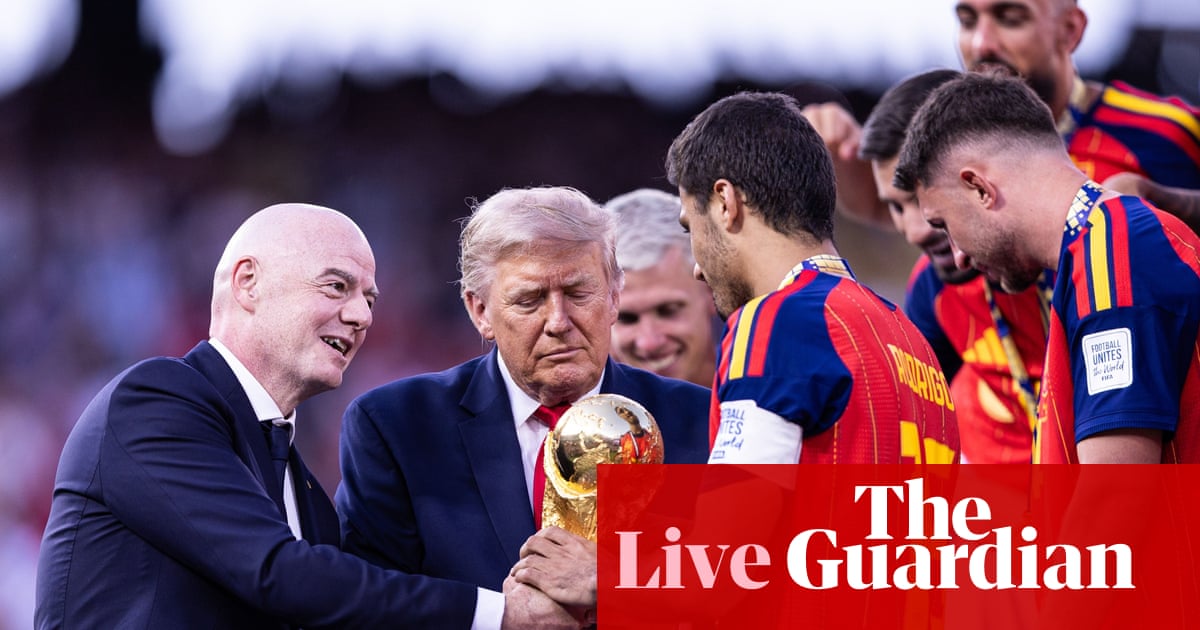
The surprise is that it took so long. For the champions of Europe and South America to meet in a World Cup final; for Spain and Argentina to meet in a knockout game; and, if we must, for tactics expert Donald Trump to attend a match at the 2026 World Cup. All three will happen for the first time today.
It’s exciting enough that this is the first World Cup final between the champions of Europe and South America*. The fact Argentina are world champions makes it even more mouthwatering, especially as they look about as willing to surrender their title as Tony Montana did his life. They are tantalisingly close to becoming the first team to retain the men’s World Cup since Brazil in 1962.
Argentina have a little friend too. This time four years ago, Lionel Messi was 35 years old and had never scored a goal in a World Cup knockout game. If there was an asterisk against his goat-ness, it has long gone. Messi’s ice-cold destruction of England on Wednesday was the latest in a series of mind-blowing World Cup performances.
Messi is up against an old acquaintance today. We’ve all seen the picture of him cradling a six-month-old Lamine Yamal, and it’s kind of bonkers that they will now meet in a World Cup final. Yamal hasn’t dominated the tournament like Messi, in deed or hype, though that’s partly a reflection of the identities of each team.
Spain, like the European club champions Paris Saint-Germain, are a triumph for teamwork in the age of the galactico – a point they made quite emphatically against France on Tuesday. Argentina are a hybrid model: the other 10 players serve an ageless genius who has redefined the concept of walking football. The success of both models is proof that there’s more than one way to shape a golden age.
Few of us saw Spain’s renaissance coming. From 2014 to 2022, they left almost no trace at major tournaments. Even at Euro 2020, when they were arguably the best team in the competition, they won only two of their six games. But Luis de la Fuente has built a joyous team who are the antidote to so many of football’s ills.
Their win at Euro 2024, in which they beat and outplayed the holders Italy, the hosts Germany and the pre-tournament favourites France and England, has a case for being the impressive European Championship win of all. They haven’t quite hit those heights in America – or rather they hadn’t until they taught France a lesson in the semi-final.
Spain have had tougher fixtures en route to the final; Argentina have had the closer shaves. In different ways, both have earned the right to feel invincible – and not just during this tournament. Spain are unbeaten in 37 games; Argentina have won 14 in a row and 31 of the last 37.
Never mind the despair of losing a World Cup final; the losers face some hellish cognitive dissonance.
Kick off 3pm EST/8pm BST/5am AEST
* Since you asked, Uruguay, not Brazil, were South American champions in 1970. Brazil withdrew from the 1967 South American Championship, but that is literally another story.