
.png) 2 months ago
60
2 months ago
60
The International Skating Union (ISU) has defended the integrity of Olympic ice dance judging after a single judge’s scoring gap became central to the outcome of the gold medal contest, insisting variations across panels are expected and that safeguards exist to prevent bias from determining results.
In a statement released Friday, the governing body rejected suggestions that the judging system failed during the competition, which saw France’s Laurence Fournier Beaudry and Guillaume Cizeron narrowly defeat Americans Madison Chock and Evan Bates in one of the closest and most disputed finishes of the Milano Cortina Games.
“It is normal for there to be a range of scores given by different judges in any panel and a number of mechanisms are used to mitigate these variations,” an ISU spokesperson said. “The ISU has full confidence in the scores given and remains completely committed to fairness.”
The reassurance comes as scrutiny focuses on the scoring submitted by the French judge on the nine-member panel. In the free dance, the judge awarded the French pair nearly eight points more than the American team – a margin large enough that, had that score been excluded, Chock and Bates would have moved into the gold medal position.
Under current rules, teams have limited avenues to challenge results unless the ISU itself elects to review judging conduct. There has been no indication that such a review is forthcoming.
The controversy has renewed debate about subjectivity in figure skating scoring. An online petition calling for the ISU and International Olympic Committee (IOC) to investigate the judging approached nearly 15,000 signatures by Friday afternoon, reflecting widespread unease among viewers and some within the sport.
Chock and Bates have largely avoided direct criticism of the judging panel, instead emphasizing their pride in their performance and gratitude for fan support. The Americans, who delivered what they described as the strongest skate of their careers, produced a season-best performance and finished with 224.39 points – fewer than two points behind the French champions’ season-high total of 225.82.
“We felt like we delivered our absolute best performance that we could have,” Bates said after the event. “It was our Olympic moment. It felt like a winning skate to us and that’s what we’re going to hold on to.”
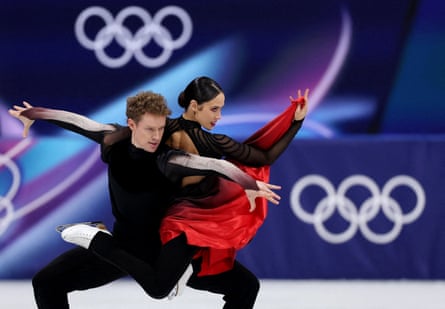
The couple – who had been unbeaten over the past three seasons in all but one competition, when they finished second to 2026 Olympic bronze medalists Piper Gilles and Paul Poirier of Canada – said they had not analyzed the scoring in detail but acknowledged hearing about the petition circulating online.
“It means a lot that people are voicing their opinions on our behalf,” Bates added.
Chock said the wave of public support helped soften the disappointment of finishing second after years of chasing an individual Olympic podium in ice dance. The silver medal completed a milestone achievement for the pair, who finally secured the Olympic ice dance medal that had eluded them in three previous Games, in addition to their team event gold medals earlier in the week.
Still, she warned that opaque judging outcomes risk damaging the sport’s connection with fans.
“Any time the public is confused by results, it does a disservice to our sport,” Chock said. “People need to understand what they’re cheering for and feel confident in the sport they’re supporting.”
The French victory also drew attention because the partnership is relatively new at the highest level of international competition. Fournier Beaudry switched national representation to France and debuted internationally with Cizeron only last autumn, in the wake of assault and abuse allegations involving each of their former partners. The pair quickly established themselves as contenders by winning the European Championships earlier this season.
The judging debate also revived memories of one of the sport’s most infamous Olympic controversies, when allegations of vote-trading at the 2002 Salt Lake City Games triggered investigations and eventually led to the awarding of duplicate gold medals in pairs skating. That scandal prompted the ISU to abandon the longstanding 6.0 system in favor of the current judging structure, which combines element-based technical scores with program component marks evaluating performance quality, skating skills and choreography.
While the newer system was designed to reduce the impact of individual judges, critics have long argued that it remains difficult for casual audiences to understand, reduces the sport to a jumping contest and still allows room for subjectivity.
The latest dispute has amplified those concerns. Analysts noted that while five of the nine judges placed Chock and Bates ahead of the French team, the larger margin from the French judge ultimately shaped the final standings.
The scoring debate has also centered on the performance details. Fournier Beaudry and Cizeron produced a technically strong program but were perceived by some observers to have benefited despite visible errors, including a noticeable mistake during a twizzle sequence. Meanwhile, the Americans delivered a nearly flawless skate, intensifying questions about how component scores were evaluated.
For Chock and Bates, however, the emotional toll of the Olympic schedule – which included four performances across team and individual events in less than a week – left little time to dwell on controversy.
“We haven’t fully processed everything that’s happened,” Bates said. “It took all of our mental and physical energy just to stay locked in.”
Chock echoed that sentiment, framing the Olympic experience as larger than a single result.
“A medal is a medal,” she said. “The Olympic dream is something that lives inside you. That’s what drives you.”