.png) 7 hours ago
8
7 hours ago
8
Russians are going to the polls to elect a new State Duma in a tightly controlled vote stripped of meaningful competition and with little doubt about the result.
Vladimir Putin’s United Russia is expected to extend the grip on parliament it has held for 23 years, alongside a handful of nominal opposition parties that reliably vote with the Kremlin on the issues that matter. The three-day vote begins on Friday, with results expected after polls close on Sunday.
For all the predictability of the outcome, the first Duma election since the full-scale invasion of Ukraine in 2022 is taking place against the backdrop of a war that, once distant for many Russians, is increasingly intruding into everyday life.
Swarms of Ukrainian drones have struck oil refineries, factories and logistics hubs across Russia over the summer, while polling has pointed to growing anxiety about the course of the fighting and what may still lie ahead.
Against that backdrop, the Kremlin has tightened its grip further.
Last month, the authorities barred Yabloko, the liberal anti-war party, from the ballot, removing the only political force remaining in Russia that was openly challenging the invasion of Ukraine.
That leaves a handful of other parties, from the Communists to the far-right Liberal Democrats, which together form what is known in Russia as the “systemic opposition”: groups permitted to criticise the authorities at the margins, but which fall into line with United Russia on issues that matter to the Kremlin.
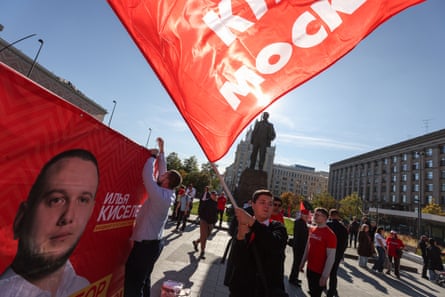
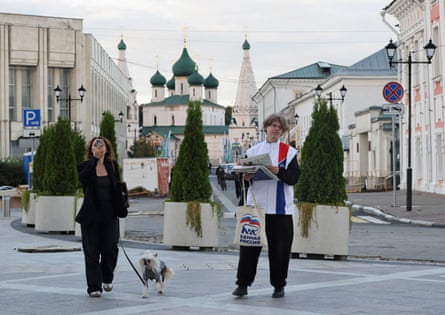
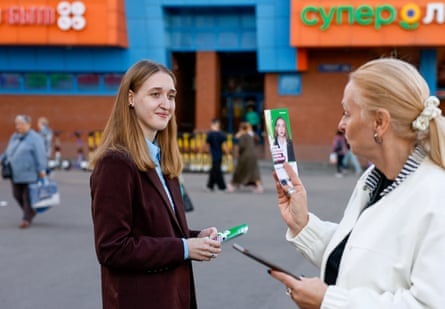
For years, they have served as a political safety valve, giving voters somewhere to register discontent without posing a serious threat to the ruling party’s dominance. But even by the diminished standards of Russian politics, these parliamentary campaigns have been strikingly lifeless.
“In most elections, candidates compete for attention. In Russia this year, many are doing the opposite,” said Farida Rustamova, a political analyst and founder of the independent Vlast newsletter. “No one wants to come into the spotlight or discuss anything sensitive.”
Most candidates have barely campaigned at all, she noted.
Televised debates have at times taken place in half-empty studios because politicians failed to turn up, producing awkward clips that quickly became memes online.
United Russia’s campaign videos have leaned heavily on low-budget AI, with few memorable slogans or promises. None of the parties has dared to address the growing questions surrounding the continuing war that increasingly dominate private conversations.
“The Kremlin is deliberately keeping the election low-key, as greater interest would not benefit them. They don’t want to discuss difficult issues and just [want to] get it over with,” said a person close to the Kremlin, speaking on condition of anonymity.
after newsletter promotion
By keeping the election subdued, Moscow hoped to depress turnout among disaffected and independent-minded voters while ensuring its own supporters made it to the polls, said Rustamova.
Yabloko’s exclusion followed the same logic.
Several observers believe that officials had initially expected the party to receive a negligible result, demonstrating how little support remained for an explicitly anti-war platform. But when polling instead suggested growing support for the party, the authorities removed it from the ballot rather than risk an unscripted result.
Vladimir Gelman, a professor of Russian politics at the University of Helsinki, said another purpose of the elections was to provide the Kremlin with a continuing source of legitimacy and reinforce the impression that there was broad public consent behind the political system and the war.
“Even though these elections are neither free nor fair, they are still the only source of legitimacy,” he said.
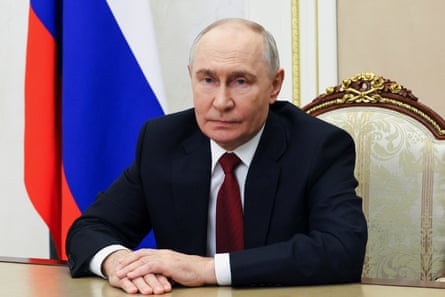
In a televised address before the vote this week, Putin explicitly linked participation in the election to the war in Ukraine, presenting voting as a demonstration of unity in the face of outside pressure.
“Your choice and your will will once again demonstrate that millions of people stand behind our soldiers, that we are a united people bound together by shared values, historical memory and love for our homeland,” Putin said.
Putin himself secured another six-year term in the 2024 presidential election, with genuine opposition barred from the ballot, extending his rule until at least 2030.
For many Russians, however, the election’s greater significance lies not in the result, but in what follows.
With Moscow’s troops making little progress at high cost in Ukraine, rumours of another large-scale mobilisation have spread across the country. The fear is that once the election is safely out of the way and a compliant new Duma is installed, the Kremlin will have greater freedom to pursue unpopular measures it has so far avoided.
The anxiety has already prompted some young men to leave the country, hoping to wait out any new mobilisation – scenes that carry echoes of September 2022, when hundreds of thousands of Russians fled after Putin announced the first wartime draft.
The person close to the Kremlin said several friends had sent their sons abroad in recent weeks, a sign, he said, that even among those with access to the system, few are certain what will happen after the voting.
Putin has sought to calm those fears. In recent weeks, he has twice dismissed suggestions that a new mobilisation is imminent.
But those reassurances have not been enough for some men, including Dmitry, who flew to Yerevan, Armenia last week. “I’ll just wait a few weeks after the elections,” he said, adding that he felt the risk of a new mobilisation was too high to ignore. “Let’s see if anything changes after the vote.”