.png) 6 hours ago
8
6 hours ago
8
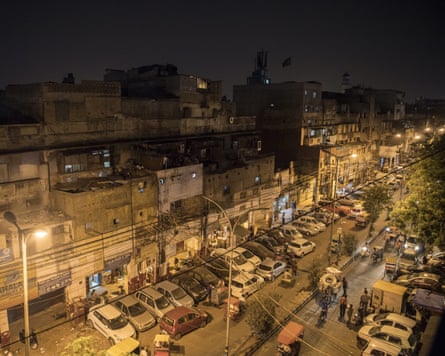
Rows of hardware and car-part shops line Garstin Bastion Road, with faded signs crammed together above their shutters. By day, the street is one of Old Delhi’s busiest commercial thoroughfares. But as dusk falls, GB Road, as it is known locally, transforms into one of the city’s most notorious red-light districts.
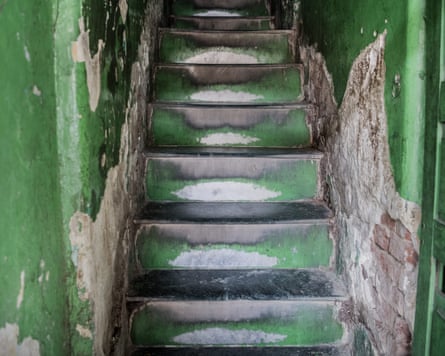
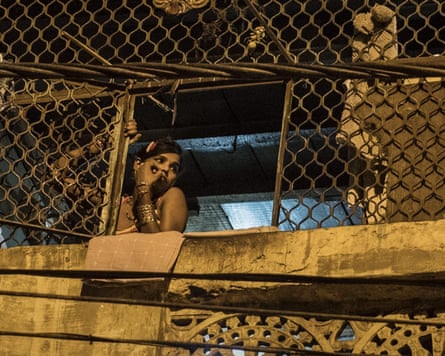
An estimated 2,800 sex workers live and work in brothels that occupy the upper floors of the dilapidated buildings, their entrances tucked behind narrow stairways and unmarked doors. Women sit on plastic stools beneath the stairways, calling out to men passing on the street, while others watch from windows above, their eyes following the movement below before customers are directed upstairs.
The challenges the women of GB Road face are numerous and well documented – from health risks to abuse, debt to poor sanitation. Now they face a new struggle: India’s controversial electoral reform process. The Election Commission’s special intensive revision, or SIR, is a nationwide exercise in which electoral rolls have shrunk by more than 58 million voters across the 13 states covered in the first two of three main phases. In Delhi, covered in the third phase, the scale of exclusion is the highest recorded as a percentage: 4.76 million names – 33% of the city’s previous electorate – do not appear on the city’s draft roll published on 31 August.
The government says SIR is meant to “purify” the electoral rolls by removing ineligible voters, including alleged undocumented migrants, but critics have accused Narendra Modi’s government of using it to target minority voters and reshape electoral rolls in ways that could benefit his Bharatiya Janata party (BJP).
On GB Road, the proportion of those excluded is even higher. Data shared by officials overseeing about 1,300 voters in the area show that about 650 were sex workers on the previous electoral roll. Of these, at least 500 have either been marked as “shifted”, meaning they have moved home or location, or have been unable to establish their eligibility because of missing documentation – more than three-quarters of the sex workers on the local roll.
One of them is 36-year-old Beauty*, who has lived on GB Road for more than two decades. She got her first voter ID in 2008. At the time, the address where she lived and worked as a sex worker and verification by a government official called a booth-level officer (BLO) were enough to put her on the electoral roll. She voted in previous elections.
But under the new rules, voters had to establish eligibility by proving their link to the relevant previous electoral roll or by producing prescribed documents such as a passport, birth or education certificate – a paper trail Beauty struggled to reconstruct. Trafficked at 16 and brought to the brothels of GB Road, she has no contact with her family. She does have an Aadhaar card, India’s biometric identity document used widely to establish identity and access government services, with her GB Road address. But Aadhaar is not proof of citizenship and does not, by itself, establish eligibility to vote under the SIR process.
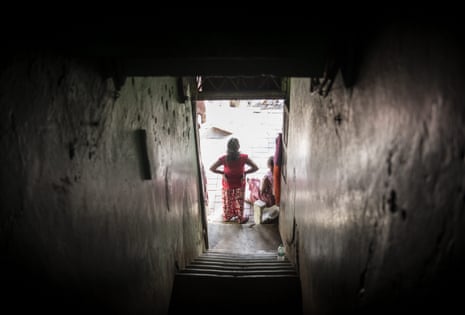
She tried to get a copy of her matriculation certificate, which is evidence of schooling, from the village in Rajasthan where she grew up. One of her regular customers of the past 10 years – a man she refers to as her husband, agreed to help track down the old record but failed.
“If I had the papers to show my father’s birth certificate, or even my own matriculation certificate, then I could prove who I am,” she says. “But how can I go back to my village to ask for these things when my trafficking has brought so much shame to my family that they no longer accept me?”
Now Beauty has lost hope – and, for now, her vote. Her name was left out of Delhi’s recent draft electoral roll. For her, the voter ID had meant more than a piece of identification. Sex workers, she says, are accustomed to being treated as immoral, degraded and less worthy than others.
“We all shit. That is what makes us equal as human beings. Voting is the same in the realm of rights. When I stand in that queue, nobody is more or less than me. It reminds me that whatever people think about my work, I am still equal to everyone else.”
Beauty is not alone in struggling to prove her eligibility. The SIR requirements have exposed the precarious paper trails of women across GB Road, a roughly 1.5km stretch running between two of Delhi’s historic landmarks, Ajmeri Gate and Lahori Gate.
Of the nine sex workers interviewed for this story, none had successfully completed the SIR process: six said they had never received the enumeration form distributed by BLOs to verify voters’ details and collect information for the electoral-roll revision, while the remaining three were unable to meet the documentation requirements.
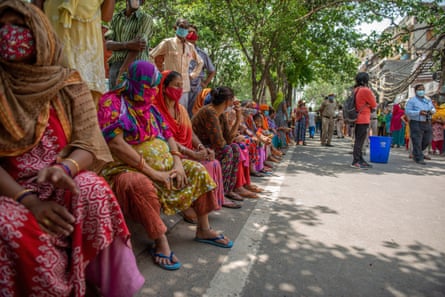
According to Kiran Deshmukh, a sex worker and coordinator at the National Network of Sex Workers (NNSW), many have spent years, even decades, in Delhi but possess few documents establishing their family histories or links to earlier electoral rolls. “Some were trafficked as children and lost contact with their families; others never attended school or have moved between rooms and brothels without leaving a stable documentary trail,” says Deshmukh. “It is impossible in such circumstances to prove such rigid eligibility requirements under SIR.”
The process is so cumbersome that even people who are literate and have institutional and organisational support can struggle to establish their eligibility. “The process of receiving the enumeration form, knowing when you have not received it, reaching out, then trying to create a paper trail is so daunting that the entire burden of proving your eligibility is placed on the citizen to protect their own constitutional right,” says Deshmukh.
Sagrika Rajora, a researcher and member of Voter Adhikar Manch, a citizens’ collective, argues that the burden falls particularly heavily on people whose lives do not fit neatly into the categories used by the verification process. “To identify people of such marginality is a tedious task. These categories of ‘shifted’ become an easy way forward for booth-level officers, when finding people on the ground is already time-consuming.”
after newsletter promotion
BLOs are often drawn from occupations such as auxiliary nurses or health workers, adding electoral duties to already demanding jobs. Some have raised concerns about the workload and unrealistic timelines of the exercise. Yet, Rajora says, there has been little effort to streamline the process to ensure that “no eligible citizen is left out”, the aim outlined by the Delhi chief electoral officer, Ashok Kumar.
“There is so much discretion vested in one BLO. Even if you leave citizenship aside and talk only about voter rights, the entire process of delivering and collecting these forms depends on that one person. There are no grounds for entrusting one person with such a huge responsibility without any accountability at all,” Rajora says.
“It is not surprising that sex workers are among those being excluded. When people have lives that are so complex and mobile, you are going to be untraceable, absent from the system. These are the people for whom such a verification system is simply not designed to work.”
The gaps also cause problems for workers’ children when they reach adulthood. “Children may not possess documents establishing parentage in the manner expected for verification. Some are raised by relatives, guardians or members of the community, while others grow up in institutional care, making conventional family records difficult to establish,” says Deshmukh.
For 23-year-old Dinesh*, whose mother was a sex worker, the problem is not abstract. His mother died three years ago, but she never had a birth certificate. Without one, obtaining her death certificate became nearly impossible, leaving Dinesh with little documentation through which to establish his maternal lineage.
When Dinesh submitted his enumeration form, he relied on his matriculation certificate as proof of his identity. But the booth-level officer pointed out that it did not have his father’s name. “If my mother gave birth to me, why do I need a man’s name on any official certificate?” he asks.
Dinesh says his name is missing from the draft electoral roll. He is still unsure why, but suspects the absence of his father’s name may have been a factor.
The NNSW has written to the chief electoral officer seeking special measures to ensure that sex workers and their children are not excluded from the SIR. But the joint chief electoral officer, Balram Meena, told The Hindu there was no separate process for sex workers. “If their mapping can’t be done and there are no documents either, their names will be removed as per the process.”
The fear of losing the vote is not only about voting rights. In West Bengal, where the SIR has already been completed, the BJP government has used lists of voters deleted during the exercise to scrutinise eligibility for welfare schemes. The BJP chief minister, Suvendu Adhikari, says welfare programmes will continue under a “transparent process”, but adds: “No deceased person, illegal infiltrator, or non-Indian individual will be allowed to avail benefits meant for citizens of the state.” The government has excluded about 3 million beneficiaries from its new Annapurna Bhandar welfare for women scheme, using SIR deletion data in its verification process.
In Delhi, the next stage of the SIR process – issuing notices to those whose eligibility or previous electoral-roll details could not be established or matched, and dealing with claims and objections – has now begun and will continue until 29 October. Those excluded from the draft roll can challenge their omission. But Dinesh says he does not intend to.
After years of being asked to produce documents that his family never had, he is unsure what more he can submit to prove that he exists.
“Even if my mother were alive today, I don’t think that would be enough to prove anything. She never had the documents they are asking for. So how am I supposed to get those documents now, especially after her death?”
* Names have been changed. Workers and residents did not permit any photography during the Guardian’s visit