.png) 3 hours ago
7
3 hours ago
7
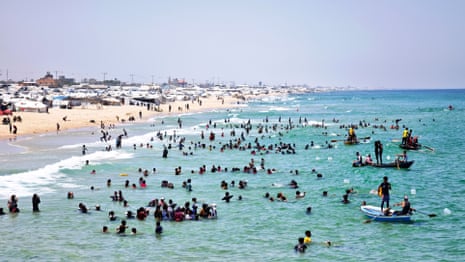
Swimming classes have started again in Gaza after three years of war, with hundreds of children learning to float, doggy paddle and take their first strokes in five makeshift sea pools built from sandbags and rubble.
The lessons allow a few hundred girls and boys to reclaim their childhood for a few hours in a place where there are no playgrounds, no formal education and children live in fear of continuing Israeli attacks. A UN survey in March found that 96% of children felt death was imminent.
-
Activity on the Gaza seafront
“Swimming gives me a chance to escape the war, and the worries I live with,” said Alma Shabat, 13, who saw her mother killed in an Israeli strike in May.
After three weeks of classes, her favourite stroke is freestyle, she has made new friends and she is no longer afraid of the waves and open sea. “Coming to the beach is a beautiful and enjoyable experience,” she said.
Amjed Tantesh, who founded Gaza’s first swimming academy more than two decades ago, has mobilised dozens of volunteers this summer to create the string of pools on the beaches of central Gaza, with tarpaulins providing some shade from the fierce Mediterranean sun.
There is very little heavy machinery left in Gaza so they did everything by hand, moving tonnes of rubble and filling sandbags to build walls, then excavating sand to deepen the pools.
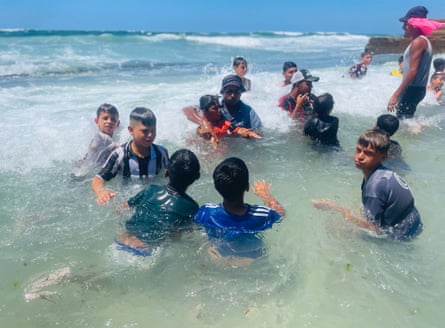
-
Children take part in a swimming class
In the morning they hold free classes for children whose parents were killed in Israeli attacks. In the afternoon, the pools are open to everyone and constantly filled with delighted children splashing in the warm water.
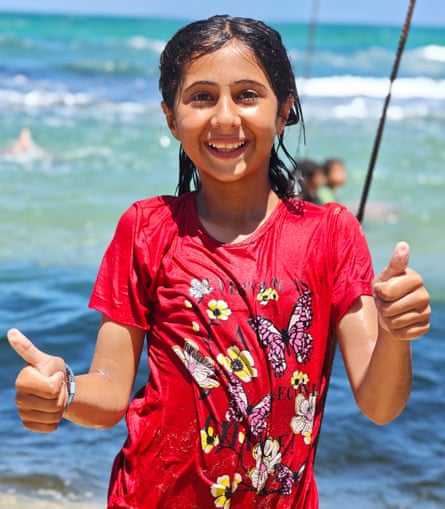
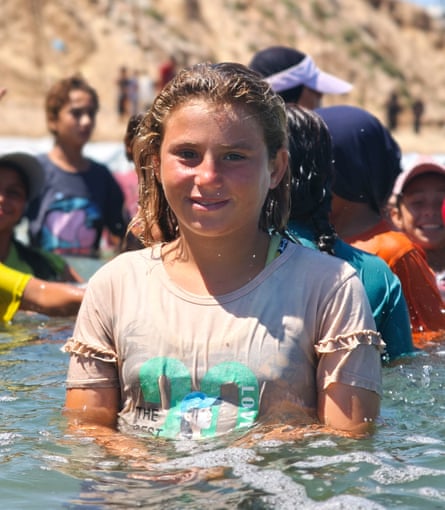
-
Tulin Al-Othmaneh, 10, and Aseel Al-Kafarna
“Its a rare chance to enjoy, relax and reclaim part of their stolen childhood,” said Tantesh, who has also worked as a journalist for the Guardian and other outlets. His niece, Seham Tantesh, reports for the Guardian from Gaza. “The pools attract children from all along the beach like huge magnets”.
Most Palestinian children have endured years of extreme trauma. There is the loss and maiming of loved ones, with one in ten of the prewar population killed or injured in Israeli attacks. Thousands more are thought to be buried under the rubble.
-
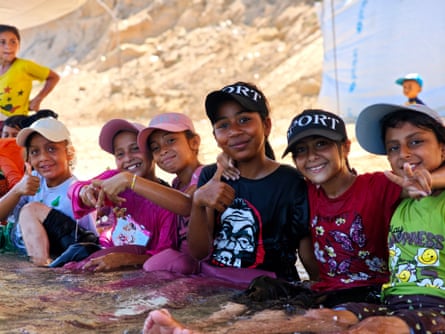
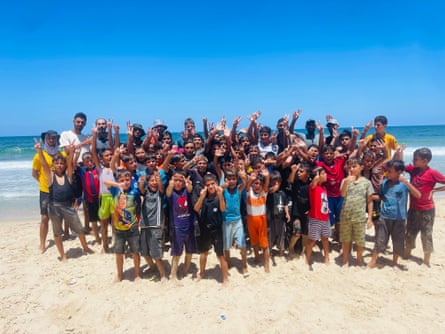
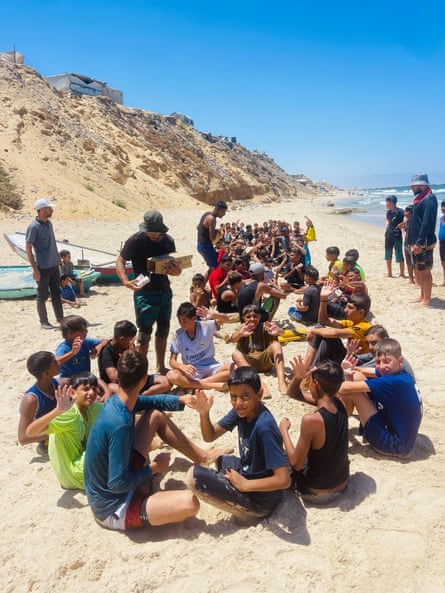
A big group of the children pose for a photo on the beach
-
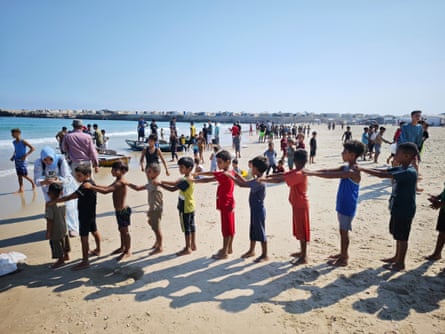
Children form a chain before getting into the water
Gaza has the highest concentration of child amputees in the world. “Disability among Palestinian children has ceased to be an individual medical condition and has now become a defining demographic reality,” a UN commission said in a report on Israel’s targeting of Palestinian children.
The human-made famine caused by Israel’s siege last year will leave some children with lifelong mental and physical stunting.
-
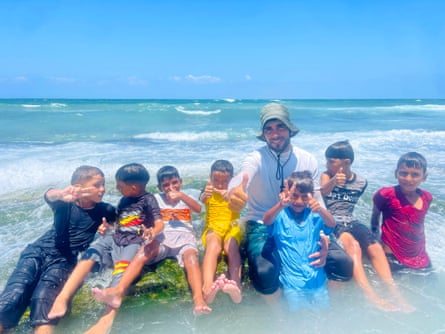
Instructor Ali Al-Attar with a group of the children
There has been no formal schooling for three years, and almost all school buildings have been damaged or destroyed. There are nearly 700,000 school-age children in Gaza, and only a minority have access to the makeshift tent schools run by aid groups.
Survivors are crammed into crowded, hot and noisy tent camps in just a third of the prewar Gaza without adequate water or sanitation.
-
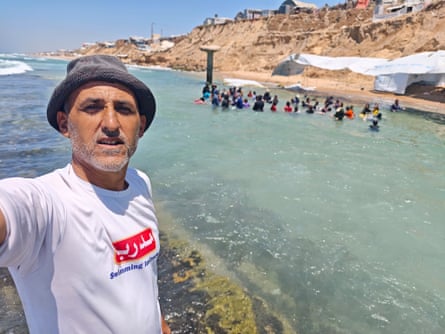
Amjed Tantesh takes a selfie while a swimming class takes place behind him
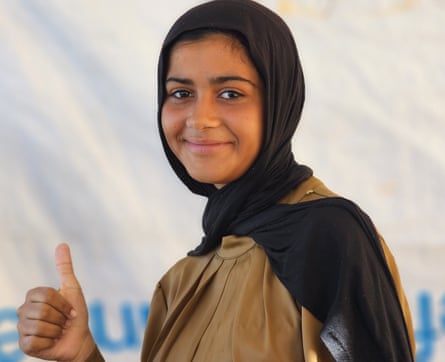
Swimming classes are a desperately needed escape from this grim reality, physically and mentally. “Being here allows me to train, play and breath fresh air, away from the tents,” said Maryam al Musri, 10, who lost her father in the war.
Laila Qahman, 14, who lost her seven-year-old brother when a mosque near where he was playing was bombed and who dreams of becoming a pharmacist, said swimming gave her the chance to relax, cool down and forget about life in a tent.
-
Laila Qahman
“I come here every other day because it makes me feel like I’m living my life and enjoying my time, instead of staying in the tent listening to the sounds of shelling and living with fear and sadness,” she said.
“Before I learned how to swim, I was a little afraid of the sea and did not have the courage to go into the water. Now, I feel much more confident and no longer feel afraid when I swim.”
So far 700 children have attended six weeks of classes, and Tantesh hopes to teach thousands more over the summer if he can get funding to pay teachers, who are currently all working for free, and cover other basic expenses.
The joy of these young swimmers has been healing for him as well, as he mourns his older brother Bahjat, a karate champion killed in an Israeli attack last year as the brothers fled their family home under Israeli evacuation orders.
“Bahjat was the one that taught me swimming in the first place, then inspired me to pursue sporting excellence as a young man,” he said. “To have him die in my arms was the worst thing imaginable.”
-
A group of children sitting on the beach after their swimming class
The original academy was inspired in equal measure by hope and tragedy. Palestine made its Olympic debut at the Atlanta Games in 1996, giving athletes from Gaza the first chance to compete on the world’s biggest stage, and Tantesh a new mission.
“I wanted to be at the Olympics, but I started as a professional swimmer at a very late age. So I decided to achieve my dream through a new generation,” he said.
Closer to home, each summer brought deaths by drowning at sea. Families would flock to the beach to relax, splash around and cool off but few people could swim and there were no lifeguards at his local beach. Swimming lessons would make children safer and they could train future lifeguards, he decided.
-
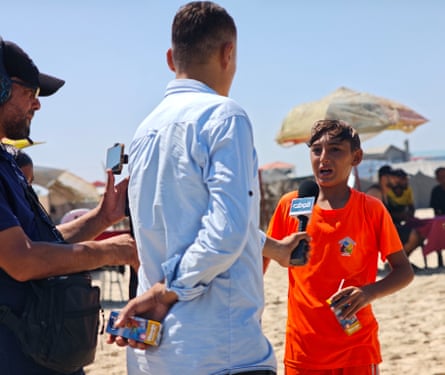
Kamal Taha, 12, being interviewed by a local TV channel
His biggest challenge when the classes first launched was persuading parents to sign up their children. “People were terrified by water, the sea looked like a monster to them as it consumed dozens of people annually,” he said.
For the first few years children learned to swim in Gaza’s port, where breakwaters protected children from the waves. Then he constructed a series of pools along the coast for classes, where about 11,000 people learned to swim.
The biggest, built with rubble from homes bombed by Israel in 2014, was more than 1,000 square metres. Israeli attacks since 2023 razed all the pools, killed tens of swimming students and at least six coaches, and injured countless more.
Restarting classes seemed almost impossible. “I only had the sea, but the sea is dangerous even during summer. You have jellyfish, you have high waves, strong currents, rocks,” he said.
So he came up with the plan for new pools, for the sake of Gaza’s children and as a tribute to his brother. Seeing the children leave the horrors of war behind for a brief period, when they dive into the sea, has also been healing for him.
“Actually the first person I helped with this project was myself,” he said. “It has given me a great feeling of happiness and recovery. I am alive again.”
You can find more about the swimming pool project here