.png) 3 hours ago
6
3 hours ago
6
Everyone knows how dumb it is to be this person: the one who mourns the film adaptation of a favourite text because it misses out this scene, or misreads that particularly beloved character, or has a slightly “inauthentic” take on some detail. Of course I’m talking about Christopher Nolan’s film adaptation of the Odyssey, a poem I have loved since I was a teenager. I enjoyed the movie, in common with a huge number of other people. It seems remarkable, even dizzying, that the adaptation of a nearly 3,000-year-old poem took $264m (£196m) at the box office over its opening weekend, has sent translations of the Odyssey surging up the bestseller charts, and is sold out (for instance) at London’s BFI Imax screen deep into September. We are living in an Odyssey time, amid an Odyssey frenzy.
There is no point trying to be a purist about a beloved classic text. Whoever reads the Odyssey, including Nolan, inescapably does so through the prism of their prejudices, informed by the conditions of their own place and time. Since the Odyssey is the result of decades, maybe centuries, of non-literate oral poets working with memory and improvisation, there’s no precise “original” place or time to return to, anyway. But what I can’t help doing is observe the choices Nolan has made and think about their consequences – because there are always divides in the road, paths not taken by any adapter.
Nolan is brilliant at recreating one aspect of the original poem: its complicated structure. The poem tells the story of the decade-long return journey from the siege of Troy of its hero, Odysseus: the adventures he has along the way and how he reinstates himself as the head of his household once he’s home. There are monsters and witches and magic and storms at sea. And then he must infiltrate himself into his home disguised as a beggar, before a Tarantino-esque bloodbath of revenge. It is a story told not in sequence, but through parallel timelines and flashbacks. Nolan, as I had hoped of the creator of Inception, Memento and The Prestige, follows the spirit of the original poem’s twisted, coiling structure with his own complex design.
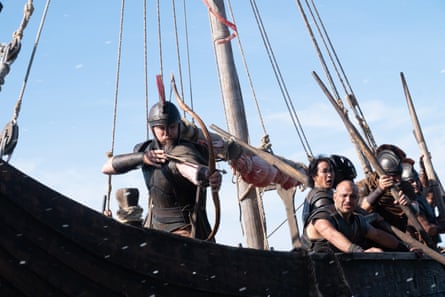
But his Odysseus, as filtered through Matt Damon’s performance, is a grim and agonised figure, not the loquacious, rhetorically able, charming liar that I see in the poem. Cinema is a visual medium – not a genre for wordy speeches – but nevertheless, Nolan’s hero is a notably laconic figure. He is also guilt-stricken and conscience-laden in a way that speaks more of a Judeo-Christian inheritance and Nolan’s sense of a war-weary world than anything in Homer. Where the poem has Odysseus inducting his son Telemachus into the life of a warrior, the pair fighting their domestic enemies together, the film finds a way to release the younger man from the burdens of a killer’s life.
The Odyssey, though, is not an anti-war poem, though it is a post-war poem. Homer’s Odysseus is placed in a genealogy of warriors stretching back from the great veteran fighter Nestor and beyond (Nestor is absent from the film, so this layer of inheritance is lost) and forward to the next generation. War is, for the Odyssey, a fact of life – albeit one that is grievous and destructive. But the idea that Odysseus bears a moral burden for the destruction of Troy is pure Nolan. He has swamped the poem with his own preoccupations and anxieties, as all readers do in the end, and created an adaptation that is tamed and tuned to modern sensibilities. Had he cleaved closer to the source material, I’m not sure the movie accountants would be now totting up the money so gleefully. Would modern cinemagoers really queue up to see a row of enslaved women hanged, like doves caught in a trap (says the poem) their feet twitching as they are killed?
Nolan has added, but of course he has also subtracted. He has removed not just dark and horrific moments like the hanging of the slaves, but also, by contrast, the epic’s lightness and wit. This is especially apparent in his treatment of female characters. Nolan’s resentful Helen, played by the excellent Lupita Nyong’o, is literally and metaphorically scarred, rather than poised and gleaming and elegant. His Circe is magnificent and strange (and given an extraordinary performance by Samantha Morton), but not funny or enticing. Because he has removed the Olympian gods from any meaningful role in the film, we miss a blissful moment in which the divine Calypso (played by Charlize Theron) rails to the god Hermes against the sexual double standard (it’s OK for gods to have sex with mortal women, she complains, but not for goddesses to sleep with men). The relationship between Zendaya’s Athena and Damon’s Odysseus lacks the flirtatious spark that’s so enjoyable in the poem.
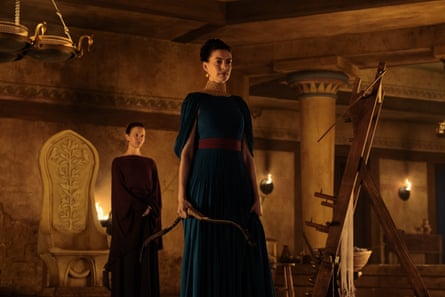
There is no nervous young Nausicaa finding Odysseus battered and naked on the beach (a delicious scene), because Nolan has eradicated Nausicaa, and her enigmatic mother, Arete, too. Odysseus’s mother is also cut – and I would argue, his wife, Penelope (Anne Hathaway), is also short of a couple of layers of complexity, her strange obliqueness gone. More or less removing the gods is an understandable decision, if you want to focus on human motivations and choices. It’s easier to imagine gods in a poem than to have them quivering awkwardly on a cloud in a film. I was reminded of novelist Colm Tóibín telling me why there were no gods in his story House of Names, which also inhabits the world of the Trojan war: the novel is a deeply human form, he said, and the gods have no business in it. And for Nolan, at least, so is cinema. But why lose the sexual spark? I had a sneaking suspicion that by damping down Odysseus’s extramarital sexual adventures (and also Penelope’s ambivalence towards the men who are competing to marry her on Ithaca), Nolan has found another way to tame the Odyssey into modern moral acceptability.
Read the poem. You won’t regret it. (If it feels forbidding, Mary Beard and I have a podcast series for this.) And preorder Alice Oswald’s book Rhapsody: a Manifesto, which comes out in September and superbly draws out the qualities of Homer’s liquidness, the full wonder of his stories within stories, those Odyssean tales that peel back like layers of an onion to reveal further tales. She will show you the way the poem’s similes and apparently formulaic descriptions of characters are a form of time travel in which different, incompatible realities can coexist in a shimmering haze of poetic temporality that cinema, or at least this kind of cinema, cannot replicate.
after newsletter promotion
Such things you will experience only if you engulf yourself in the poem. What you will learn in the film is about ourselves: about Nolan’s preoccupations, and about what modern sensibilities can stomach. Reading the poem turns the gaze outward – towards another reality that we recognise, but is at the same time foreign and wild and strange and delicious and disturbing and so different from our own. Watch the film, yes. Then open the pages of a book and disappear into a another world that no Imax cameras could ever summon.
-
Charlotte Higgins is the Guardian’s chief culture writer