.png) 7 hours ago
5
7 hours ago
5
More than $4bn (£3bn) is to be spent upgrading the US government’s military and spy bases in the UK, according to official documents that shed light on the UK’s apparent role as a secretive site for American nuclear weapons.
The construction plans include building new bunkers in Suffolk, which will seemingly be used to store nuclear weapons, and modernising facilities to help covert units run secret operations.
The US military is also planning to upgrade its base in Gloucestershire, from which waves of powerful bombers attacked Iran earlier this year on the orders of Donald Trump.
The plans highlight the breadth of the US military and security establishment’s footprint in the UK, where more than 12,000 US military personnel are spread around at least 15 bases and facilities.
There are questions about whether Britain should continue to host the US installations on its soil.
For more than seven decades, successive governments have seen the bases as a foundation of the UK’s military partnership with the US.
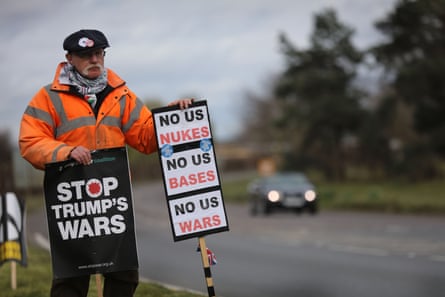

But the alliance has been jeopardised by Trump’s repeated criticisms of the UK government for failing to support his war on Iran. He has threatened to reduce the numbers of US aircraft and warships stationed throughout Europe, but has not proposed any specific changes to American bases in the UK.
The US modernisation plans were outlined in papers presented at a military engineering conference earlier this year and documents submitted to the US Congress detailing Pentagon expenditure.
Members of a Pentagon unit responsible for overseeing the construction of military projects, the Air Force Installation and Mission Support Center, gave the presentation to the conference in March.
Their slides said the value of the current “planning, design and construction” projects at the American bases in the UK was $4.2bn, with an additional $1.3bn characterised as in “draft status”.
A spokesperson for the Air Force Installation and Mission Support Center said some of this total included money from a Nato fund that finances military construction projects, adding that the exact amount had yet to be determined.
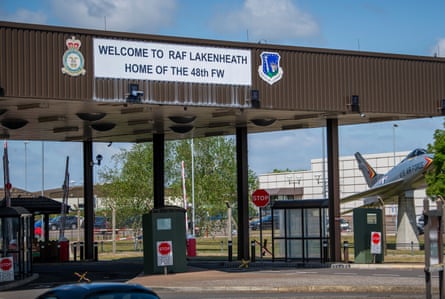
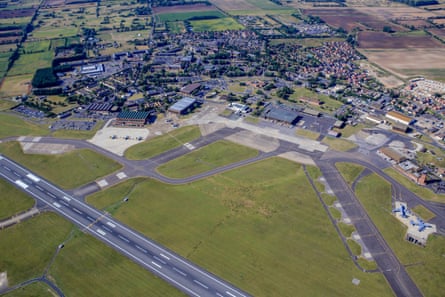
The largest portion of funding – more than $1.6bn – is due to be spent at RAF Lakenheath in Suffolk, the largest American base in the UK and home to 6,000 military personnel.
The documents suggest this expenditure includes new infrastructure to house a nuclear arsenal, which is returning to the base after nearly two decades. During the cold war, the US stored potentially devastating nuclear weapons there, which could quickly be dropped on the Soviet Union. It is believed they were removed in 2008.
Pentagon documents suggest that new facilities, which include reinforced shelters, beefed-up security and accommodation for extra personnel, will be used to store the latest generation of nuclear bombs.
The US and UK governments have a longstanding policy of neither confirming nor denying the presence of nuclear weapons at any specific location. Nevertheless, anti-nuclear campaigners have pointed to evidence suggesting a nuclear presence at Lakenheath, and have mounted regular protests at the base.
Another $1.1bn is earmarked for Mildenhall airbase in Suffolk, at which about 4,000 American military personnel are stationed. During this year’s US-Israeli war on Iran, the base played an important part in facilitating bombing missions. Huge planes flew from the base to the Mediterranean to refuel other airborne aircraft flying to and from Iran.

Less visible are the covert forces based at Mildenhall. They are tasked with flying special operatives into what they call “hostile, denied and/or politically sensitive territories” across Europe and Africa.
An unspecified portion of the $1.1bn earmarked for Mildenhall will fund the construction of purpose-built facilities, to enable these special forces to house their aircraft in one place. This, according to the Pentagon, will enable the forces to react more rapidly in a crisis.
Nearly $500m is to be spent at RAF Fairford in Gloucestershire, which played a vital role in US bombing raids on Iran this year.
Show more
The base has a very long runway, at almost 2 miles, and is reinforced to withstand heavy bombers, such as the B-1 and B-52, which can carry huge payloads, including the so-called “bunker buster” bombs.
This enabled the bombers to take off from Fairford instead of the US, cutting out thousands of miles.
The Pentagon is funding the completion of a new large hangar complex at the Cotswolds base and the renovation of houses to accommodate a significant influx of aircrew.
The most secretive US base in the UK is Menwith Hill in the Yorkshire Dales. It is part of a network of electronic spying stations run by the US government, allowing it to eavesdrop on large parts of the globe.
Large white “golf balls” – which can be seen for miles – house powerful equipment that enable the Americans to capture communications as far away as the Middle East. The US is spending $163m at Menwith Hill, according to one of the documents. It did not elaborate on what this sum of money would be funding.
The Air Force Installation and Mission Support Center spokesperson added: “The United States routinely upgrades its military facilities in allied nations. Unclassified administrative budget documents often accompany such activities. These documents are not predictive of, nor are they intended to disclose any specific posture or basing details.”