.png) 2 hours ago
7
2 hours ago
7
Nigel Farage’s behaviour increasingly resembles that of Schrödinger’s MP: simultaneously present and absent, committed and uncommitted, depending entirely on the demands of his personal political theatre. His latest trick – resigning his seat only to stand again in a byelection of his own making – is a striking example of this paradox. It allows him to claim the mantle of democratic renewal while sidestepping the basic expectation that an MP should simply get on with the job they were elected to do.
Constituents deserve stability, not a revolving door of self‑generated electoral drama. Parliament is not supposed to be a pantomime; nor should it be treated as a backdrop for perpetual campaigning. When an MP prioritises spectacle over service, the public is left with representation that exists in name only.
An MP should be present, accountable and focused on the people who elected them, not on creating opportunities for publicity. If Mr Farage wishes to run a permanent campaign, he should be candid about it. He should not treat parliamentary duty as optional.
Bee Hall
Corwen, Denbighshire
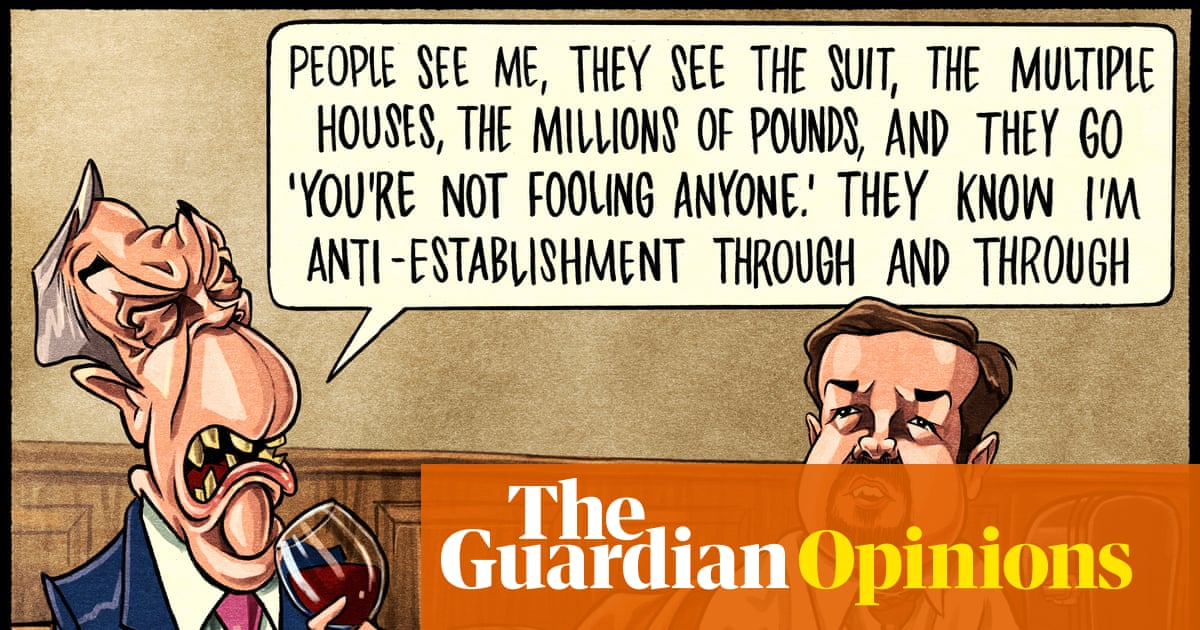
Nigel Farage and friends love defining themselves as the “anti-establishment” against a domineering establishment. May I help them in defining the difference between the two?
The establishment includes those who believe that rules matter. The anti-establishment believe that rules should be got round whenever possible.
The establishment recognises that government involves hard choices, and that politics therefore requires careful debate. The anti-establishment denies that government is complicated, and believes that gut instincts are better than informed debate as a guide.
The establishment includes business leaders, the mainstream media, the civil service, the academic and thinktank world, and more. The anti-establishment consists of wealthy men who claim a unique understanding of ordinary people but do not share any of their wealth with them.
William Wallace
Liberal Democrat, House of Lords
Nigel Farage says the byelection he’s precipitated will be “the people versus the establishment”. With a public-school-educated millionaire and former stockbroker, reputed to own five houses, on one side, who’s going to represent the people?
Griff Everett
Milford, Derbyshire
Other political parties have announced that they will take no part in the pantomime election occasioned by Nigel Farage. Could I suggest that the Guardian and other media outlets do the same? It could be argued that the current situation has been reached due to an excess of media attention over many years.
John Kilcoyne
Loughborough
Re John Harris’s article (I’m rich – defend me, be happy for me, says Farage to poor voters in Clacton. They are just his collateral damage, 7 July), there could be a significant gain for the residents of Clacton and the rest of the country if a serious independent candidate with either a local or national profile stood. This happened when the journalist Martin Bell successfully defeated Neil Hamilton in Tatton, and with all the major parties declining to stand a candidate in Clacton, a real opportunity exists to defeat Nigel Farage.
Dr Clive Sellick
Barton Turf, Norfolk
In his last election campaign, Count Binface’s slogan was “Makerfield Great Again”. As the only other candidate in Clacton, I suggest a new campaign slogan of “Make Your Vote Count”. With any luck, maybe it will.
Graham Spry
Teddington, Gloucestershire
Don’t assume a novelty candidate can’t beat Nigel Farage. Hartlepool United’s mascot, H’Angus, won the town’s 2002 mayoral election against all odds, dressed as monkey. Forgoing his costume, Stuart Drummond became a popular and effective mayor who was re-elected for two more terms. Clacton, another deprived coastal town, could do much worse.
Derek Long
Rainhill, Merseyside
If only Nigel Farage would put a bin on his head too.
Susan Treagus
Manchester