.png) 8 hours ago
4
8 hours ago
4
The aerial view of Wakelyns matches the experience of visiting it at ground level: in a region dominated by prairie fields of industrial agriculture, here lies a vivid green lung of land. Its sounds and sights in summer – the sleepy purr of the turtle dove, the vivid pink flash of a bullfinch – have vanished from most of the British countryside.
But Wakelyns is not a nature reserve – it is a thriving farm, a “living laboratory” for agroforestry and a hub for innovation and business. It is also under threat, and its owners must raise £1.2m to turn it into a charitable community benefit society.
The 56-acre former pig farm in Suffolk was bought by Martin and Ann Wolfe in 1992. Martin was a government plant pathologist who wanted to do more innovative research than his employers had allowed. Seeking to farm crops with fewer pesticides, herbicides and fertilisers, he created one of the first agroforestry schemes in Europe.
Turning productive cereal-growing fields into 56 narrow “alleys” of farmed land between rows of planted trees had been “widely regarded as mad”, said their son, David Wolfe, an environmental lawyer who now runs Wakelyns with his wife, Amanda Illing. “The farmer who sold the land to them said: ‘You’ve ruined a perfectly good wheat field’.”
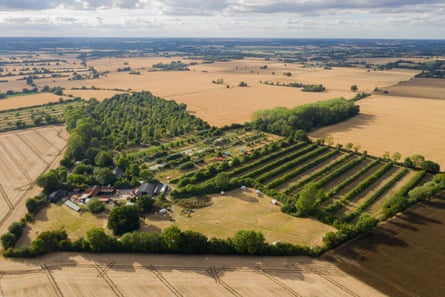
Today, Wakelyns is an inspirational example of agroforestry, which has become official government policy. The government’s carbon delivery plan wants to turn 10% of farmland into agroforestry by 2050, with financial incentives to encourage more farmers to transition into something like Wakelyns.
The lush trees that divide the alleys are all crops. After more than 30 years, some are tall trees for timber, while others provide apples, cherries and plums. The most lucrative tree crop is hazel, which is coppiced on a seven-year cycle to produce high-quality hazel stakes for traditional hedgelayers. Each stake is sold for £1.40 and Wakelyns cannot grow enough.
The alleys between the trees are planted with an organic rotation of wheat, lentils and hemp, followed by a fertility-building lay (a fallow season). Vegetables including potatoes, squash and courgettes are also grown.
The farm’s motto is “resilience through diversity”. It pioneered the first commercial lentil growing in the UK, and is still the country’s only commercial black lentil grower. “If Britain is serious about wanting to feed itself, we should stop growing oilseed rape for biodiesel and grow pulses,” said Wolfe.
Wakelyns’ diversity encompasses a uniquely genetically diverse population of wheat and multiple varieties of apple tree. When big orchards, which typically grow a narrow range of apple varieties, complain of a terrible harvest, a mixed orchard such as Wakelyns’ is fine, because every year some varieties thrive. Monocultural farmers, says Wolfe, “put it all on red or black”.
Wolfe and Illing took over the farm in 2020 after Wolfe’s parents died. To the innovative farming principles, they added “enterprise stacking”, bringing people back to the land via a series of symbiotic relationships.
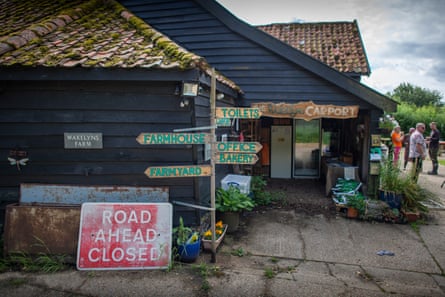
“We’ve added the complexity of people,” said Wolfe. “It’s almost a political project about land use – maximising the sustainable productivity of the land. There is no carbon sequestration in most farms around here, no biodiversity, no visitors and no children. Nobody is living on the land. Hardly anyone works there. No wellbeing is being generated. And farmers don’t even make money out of farming. I’m not pointing my fingers at my neighbours – it’s the whole of industrially farmed Suffolk. We are exploring how we can use the land to give us turtle doves and food and wellbeing and visitors and fun.”
Ten “micro” enterprises include a bakery, an educational charity and a honeybee operation, but Wakelyns is far more than just a farmyard turned business park. “Our model is a collaborative version of that – these businesses are all interacting,” said Wolfe. All are directly involved in the farm’s production.
The challenge for Wakelyns is to secure the farm in perpetuity. Wolfe is willing to donate his half of the farm to the community benefit society but his brother needs to sell his half, and so £1.2m must be raised to buy it. Wolfe hopes enough people will take up a community share offer to provide Wakelyns with a secure, and democratic, future. If they do not, the farm will have to be sold on the open market.
after newsletter promotion
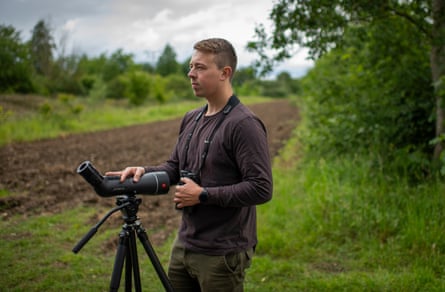
Those who are already collaborating with Wakelyns are desperate for it to continue. Harry Read, a professional ornithologist who grew up on a farm in the area, runs nature tours at Wakelyns, where three restored farm ponds are full of dragonflies, while birds such as hobby, whitethroat, linnet and yellowhammer are unusually abundant. “I’ve grown up surrounded by arable monocultures. Everyone uses the word ‘oasis’ for Wakelyns. It fills up my cup. We get a lot of farmers on the walks here. The younger farmers in particular love learning and listening.” Recent visitors include farmers from the Netherlands and Ireland.
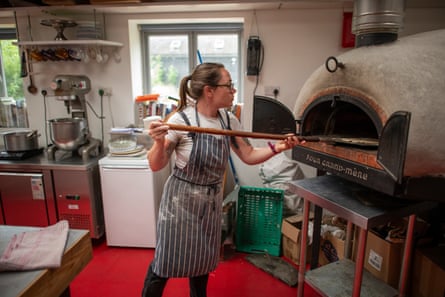
Chloe Webb works in the farm’s Silva kitchen and bakery. “As a chef and someone who is passionate about sustainability, the fact we’re making plum jam today from the agroforestry is connecting all the dots,” she said. In the farm shop, the jam’s “food miles” are 200 metres.
Silva caters for a thriving market in events and away days held at the farm, which offers up to 30 beds in the farmhouse and en suite camping pods. The pods move to whichever alley has the herbal lay on rotation, so “we’re not compromising our farming,” said Wolfe.
Claire O’Sullivan and Kitty Wilson Brown run Contemporary Hempery, seeking to revive a natural fabric widely grown in Suffolk in Tudor times to make sails for England’s naval fleet. They use Wakelyn’s annual hemp crop to make textiles and run a hemp textiles festival where visitors camp, bring in the harvest and share textile skills and stories. They pay nothing in rent; instead, Wakelyns earns income from the festival. “Last year we had the best hemp crop in the UK,” said Wilson Brown. That productivity “has got to be some of the Wakelyns magic for sure”.
Wilson Brown said Wakelyns gave young artists such as herself new opportunities. “Bringing people on to the land to work in this way is so beneficial. Most of us don’t get a chance to do that. People are running sustainable businesses here and doing really well – it proves it does work. It would be really sad if that was to disappear.”
Carrie Phoenix, the executive director of Natural Habitat, a charity that brings schoolchildren to the farm, said: “Being able to share Wakelyns with children is incredible. It’s very different to what most people associate with farming but it makes so much sense to them. They say: ‘Why isn’t every farm like this?’ Wakelyns is an incredibly rare living laboratory. From a research perspective, it’s only 30 years old. It’s going to get more useful. If it goes, it will be such a loss.”
“We want people to own something together,” said Wolfe, who is 61 and eager to secure the community-based succession for Wakelyns. “We are trying to avoid it being one or two people’s private project and give it resilience. I hope in the future I can be in my care home feeling happy it’s carrying on.”