.png) 7 hours ago
6
7 hours ago
6
Carl Maria von Weber was a great opera composer with a minimal ability to find the right libretto writers. He never made a good choice in any of the three pieces for which he’s still known.

Oberon was his final work. He wrote it in London 200 years ago for Covent Garden theatre and died of tuberculosis shortly after its premiere in 1826, aged only 39. He was buried in the cemetery just north of the Barbican, although his grave today is in Dresden. Some 18 years after his death, Wagner – who adored, and was inspired by, the older composer (there could not have been Lohengrin without Weber’s earlier opera Euryanthe) – raised the money to repatriate his body. A large crowd met the coach at the gates of Dresden and processed through the rain to the city’s old Catholic cemetery where a second funeral was held and Wagner’s specially composed fantasia for wind band based on themes from Euryanthe was performed.
German audiences did not doubt Weber’s worth, but only in the past few years have Weber’s three great operas – Der Freischütz, Euryanthe and Oberon – begun to be treasured more widely. I conducted Euryanthe at Glyndebourne in 2002 and loved every minute. It’s the most wonderful piece of dramatic music, saddled with a terrible libretto. Der Freischütz was a sensation on its Berlin premiere in 1821: Weber had written a new kind of German national romantic opera, an everyday story of country folk (with apologies to the Archers) but it’s hard to get a staging right today and it is little performed outside Germany – everybody just laughs at the plot’s daft mix of supernatural and silly. Yet its music is exuberantly inventive, full of colour and beauty, and – as with Weber’s other two grand operas – deserves to be heard.
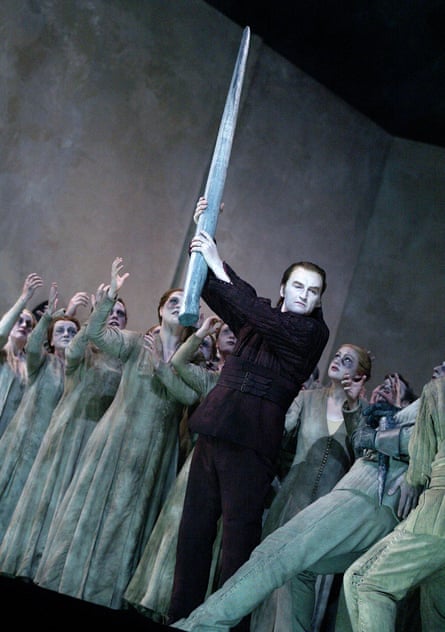
Oberon’s libretto is best described as a phantasmagoria. It’s by James Robinson Planché, a prolific commercial dramatist who wrote well over 100 theatre shows involving exuberant opulence and fantastical stories. The work’s sprawling tale of fairyland, desert islands, pirates, crusaders and an imaginary Arabia would have been completely acceptable in the 1820s, but now seems very far away. There are elements of Mozart’s Magic Flute (two couples, trials, magic) and James Bond movies (escapism, effortless flitting between exotic locations), while Ivor Novello is a useful comparison point. Novello’s musicals are full of wonderful tunes. However, the shows themselves – King’s Rhapsody, Glamorous Night and such like – are wild extravaganzas that haven’t aged well.
To stage, or even semi-stage Oberon, its text needs to be rewritten, and for our Proms performance, author Timothy Knapman has created a new single narrative that respects the original but blows the dust off it. His witty version, narrated by Tamsin Greig, will entertain today’s audiences just as Londoners were entertained in 1826.
The music needs not a jot of revision: it has an immediacy and daring that still startles. Full of panache and confidence, this is the work of a showman at the top of his powers. Weber’s heart lay in the theatre and he understood how to write for it.
From the first notes of the overture you know you’re in the hands of a master. It begins with stillness and a sense of something coming. Perhaps we’re in a forest on a summer afternoon. The harmony is gentle and serene, leading us into a dreamy world where anything can happen. There are three notes, long-short-long, on a horn. These, we later learn, are the call Oberon gives to one of his mortal charges: if you’re in trouble, blast those three notes and I will save you. And then, suddenly, some manic fairy energy breaks in and you don’t quite know what’s hit you. You hear lots of different characters and tunes; it’s brilliant and fast.
Nobody had really done anything quite like this before. Mendelssohn had that same lightness of spirit in his A Midsummer Night’s Dream concert overture, written in the same year as Oberon.
The period instruments of the Orchestre Révolutionnaire et Romantique, with the players so expert in this kind of repertoire, will bring a suitable litheness. There might be three trombones but the sound has to be lively, not ever fat. Weber’s orchestral palette is full of colours and reflects the characters on stage and the different settings; he writes particularly beautifully for woodwind. You can almost feel him thinking: “Ah, this moment has got a bit of melancholy … we need to make sure this is clear. Let’s bring the clarinet in as well as the strings, to give another yearning quality.”
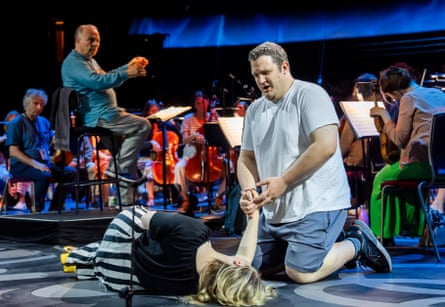
The overture aside, the act one finale is also a great favourite of mine. It’s a substantial piece in different sections. We’re just getting to know Reiza, the heroine. She has been told in a dream that Sir Huon will rescue her from a forced marriage, and she calls out to him, saying please don’t delay. She and her servant Fatima sing this brilliant little duet, and then, suddenly, we hear a march that represents the harem guard closing things up for the night. There’s a tiny extra wind orchestra and percussion, which I’m going to put at the top of the stage, separate from the other musicians. This is my last chance, Reiza says, I’ve got to escape before they close the gates…
Skilled in understanding the voice, Weber gives his singers amazing opportunities to shine. The leading role of Sir Huon needs an Olympic heldentenor: nimble and athletic. We’ve got John Findon, a really terrific tenor who is going to make a big impact. (And I always say it’s like Wimbledon. You have to get your first serve in when you sing this sort of music.) The chorus, the superb Monteverdi Choir, also have their work cut out – they’ve got to be fairies, elves, slaves, courtiers and even mermaids.
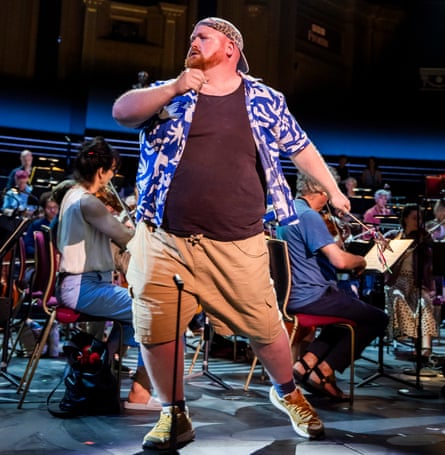
Listen out too for Reiza’s showstopper aria Ocean, Thou Mighty Monster in act two. By now she and Huon have been shipwrecked on a desert island. Despairing, she spots a sail and waves like mad hoping to be rescued – but it’s pirates, who kidnap her and leave Huon tied up on the shore. Luckily, he’s still just able to sound his magic horn to summon help. (Not for nothing does Grove’s dictionary of music describe Planché’s libretto as “a picaresque farrago of nonsense”.)
I have known and loved Oberon all my life – I played it as a bassoonist in a university orchestra decades ago. To be performing it is a dream come true. The music is such fun to conduct – it has an immediacy and an originality; it was made for the theatre. You can’t just beat through it, you’ve got to bring it alive.
Two hundred years is a long time to wait for a Proms premiere. This might be a first for the opera, but the overture has been a festival staple, such a favourite that in 1902’s Proms concerts it was played six times! While that might be too much to hope for Oberon, if we can create a performance that’s lively, risky and full of physicality as well as beautiful music-making and so give this work the life it deserves I will be happy.