.png) 5 hours ago
7
5 hours ago
7
Keith David’s voice precedes him. Deep and resonant, with mellifluous notes that hark back to his boys’ choir days, it has spent decades inhabiting warriors, gods, rogues, fathers and a welter of cartoon oddballs. Before David appears in a Zoom window from his Los Angeles home office, his voice reverberates through my tinny laptop speakers like a foghorn. “Can you see me now?” he booms once our connection is established after fits and starts. “OK. Outside of technology, you know I’m … OK.”
He fizzes about the project he just wrapped: a dark buddy comedy called My Friend Jim, in which he stars opposite Rob Lowe. It’s the latest entry in a seemingly unstinting slew of productions that have kept him booked and busy since the late 1970s, from The Thing to Platoon to There’s Something About Mary to Nope.
“I went to see it last night,” says David, who generally avoids watching his on-screen performances once he’s given them. “I’ll go to a cast and crew screening, and that’s usually the first and last time I’ll see something. Every once in a while if I do something that comes on television that I haven’t seen in a long time, I’ll watch it. Sometimes I’ll look back on a choice I made in a particular scene and go, What the hell was I thinking …?”
In an era that venerates stardom, David has made a life’s work of being more recognizable than famous, a character actor nonpareil. The past five decades have seen him amass more than 400 credits – enough to make him a ubiquitous presence in popular culture, even if many people couldn’t place the name behind the voice or the familiar profile – the glasses, the stately bearing and that mischievous grin. His résumé stretches from action movies to animation, Shakespeare to sitcoms; from Ken Burns documentaries to Call of Duty video games.
At 70, David remains as in demand as ever, popping up in live-action series like the Ethan Hawke-led noir The Lowdown and Will Ferrell golf comedy The Hawk while his velvet baritone echoes everywhere from the Rick and Morty universe to a straight-to-streaming documentary on the Gettysburg Address. He caught up with the Guardian just before bolting off to San Diego Comic-Con to promote President Curtis, the Rick and Morty spinoff that marks the first standalone lead role of his remarkable career.
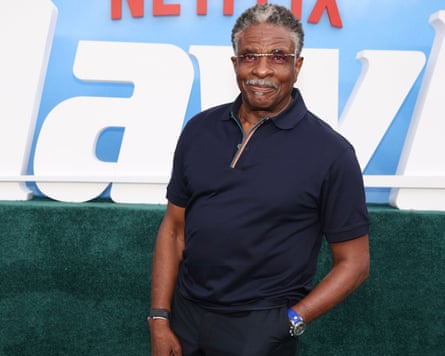
He’s in no mood to slow down either, despite recent evidence to the contrary. At his Hollywood Walk of Fame induction in June – on his birthday, incidentally – David was photographed with his right arm in a sling, the result of a workout gone sideways. “I was in the gym fighting with a Bosu ball,” he says of the muscle injury – a line that could have been lifted from one of his animation scripts. “But I’m on the mend. I’m starting some light exercises right now. I keep in shape for whatever role happens to come along.”
Work is what keeps him leaping out of bed every morning, thankful that he’s managed to stay in the game this long. If family history is a guide, he reckons he has a fair few productive years still ahead of him. “My grandmothers lived into their 80s and 90s,” he says. “My father is about to be 90. I feel like I’m in good company. There was a time in my life when the men in my family did not live that long. I had some fear of that in the back of my mind – but, you know, you wind up shortening your life, worrying about how long it’s going to be rather than how well you’re going to live.”
David knew he wanted to captivate an audience before he knew how or where. The Harlem native might have become a preacher if he hadn’t taken so quickly to a citywide boys’ choir, where that voice first set him apart. By the time the 1970s rolled around and he got started at the High School of Performing Arts – a veritable Xavier Institute for New York City theater kids, where David overlapped with Ben Vereen, Glynn Turman and others – a life in the arts felt more like an inevitability.
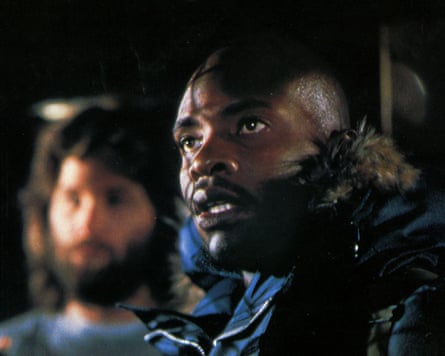
From there it was on to Juilliard, where he turned a school production of Romeo and Juliet into full-contact sport, tussling with future Tony winner Boyd Gaines. The duel wasn’t quite as drawn out as David’s much-memed back-alley brawl with Rowdy Roddy Piper in the 1988 cult classic They Live – but it did earn him and Gaines fight certifications. Two years after barnstorming the country with John Houseman for productions of A Midsummer Night’s Dream and Waiting for Godot, David found himself up for his first ever film part – a sci-fi horror starring Kurt Russell.
The role was between David and another Black actor named Roger Mosley, who wound up booking Magnum, PI. The Thing, of course, is sci-fi canon now, a film that has only become more influential over time. But when the John Carpenter film arrived in 1982, David recalls, “it didn’t get the popular vote. It was overshadowed by ET and Poltergeist. Critics didn’t like it. I thought, well, I got an honorable mention [in the reviews]. Maybe I’m not going to have a life in the movies.”
Four years passed before Hollywood called on David again. In between auditions, acting company gigs and a side hustle as a speech teacher, he worked as a shiatsu masseur, charging fellow ensemble members $30 for a session. “The thing with putting out a shingle is that you have to work for anybody who’s got 30 bucks,” he says. “And I didn’t necessarily want to do that. It took me a long time to learn how to work on people’s energy without absorbing it myself. I did it for a while, but I was real selective.”
In hindsight, those lean years were teaching David the very discipline that has served him so well over the course of his staggering career: selectiveness.
It’s why David has pulled off the ultimate Hollywood sleight of hand: a body of work defined by both quantity and quality. As a young Black actor navigating Hollywood in the 80s and 90s, David understood how easily he could be pigeonholed – into the thug, the soldier, the sidekick, the stereotype. His solution wasn’t to avoid those roles, but to find the humanity within them. “I’ve played hustlers and pimps and all that,” he says. “My criteria is, I need to know why he made those choices so the audience understands the man. I want you to understand Black men as full-scope human beings. I try to go for that as much as possible.”
David has a way of lending every character a measure of gravitas, as if the protagonists are interrupting his story. It doesn’t matter if he’s playing the chairman of the joint chiefs of staff in Armageddon, a shady DC alderman in the Chris Rock comedy Head of State or the world-weary Vietnam soldier King in Platoon – the Oliver Stone film that broke David’s four-year slump and set him on a path of near-constant work. But even Platoon could have nearly left him a footnote in a much bigger story.
Charlie Sheen credits David with saving his life during a helicopter scene that nearly turned deadly. It’s the rare story David refuses to embellish. “We were circling back to the set-up point,” he says, “and the chopper tilted at a slightly different angle than before. I just sort of noticed, imperceptibly, he was sliding toward the open door. He didn’t seem to notice it himself, but I’m watching him inch toward that door and I just grabbed him instinctually – or maybe selfishly, because the truth of the matter is I didn’t want to think about what I should have done for the rest of my life. How close did it actually come? I don’t know. We’ll never know. But, praise God, it didn’t happen, and we live to tell the tale.”
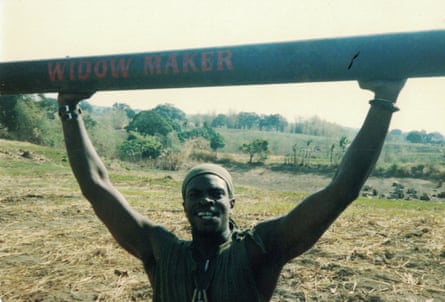
Interviewing David is a bit like trying to tour the Smithsonian during a lunch break. There’s no getting to everything, let alone all the highlights. But who could skip Mister Rogers’ Neighborhood? After The Thing, David booked a nine-episode arc on the children’s program as Keith, the neighborhood carpenter. The experience – a masterclass in captivating an audience, delivered by a Presbyterian minister no less – is one David still recalls with obvious affection.
“One of the ladies in the cast, I believe, now you would say her son had autism,” David says. “He was a wonderful kid, but, you know, he could be all over the place. On set, they had a living room space where the TV was. And when Mr Rogers came on, Brian would sit in front of that television, riveted. He would shush you if you came into the room and made noise. It was really something to see the effect he had on children, on people. It was moving. It was a lesson.”
Not every stop in the journey leaves a lasting mark. The Big House – the ill-fated 2004 sitcom that flipped The Fresh Prince’s rags-to-riches conceit and featured Kevin Hart and Leslie Odom Jr in their first on-screen roles – barely registers any more. David doesn’t spend much time dwelling on the misses. The best he can remember is telling himself, “Something else will come along.” And that something else was the 2000 sci-fi sleeper hit Pitch Black.
His show business role models were people like Orson Welles, James Earl Jones and Ossie Davis – actors whose voices were instruments unto themselves. “What they were able to do in the realm of voiceover was just fascinating to me,” David says. “I wanted to be able to do that too, just by the voice, take you on a journey.”
David had little sense of where that journey would take him when he booked a job on the ensemble sitcom Community. Dan Harmon, the creator and showrunner, called him in to narrate an episode in the elevated style of his Ken Burns collaborations and was blown away by the comedic potential in David’s gravitas and his ability to give fully committed, dead-serious performances in one take. “We had big fun with it,” he says.
David was just as game to play around on camera as Elroy Patashnik, Community’s resident IT guy. When that job ended, David quickly found another on Greenleaf, a prestige drama about a Black church in Memphis. More than a starring role as Bishop James Greenleaf, his first true dramatic showcase at the center of a series, it was a prime opportunity on Oprah Winfrey’s young OWN network where he would share the screen with Winfrey, who played his barmaid sister.
Did he feel the pressure? “You know, you always have some kind of awareness that that’s true,” David says. “But while she’s sitting at the table read or we’re in the episode, she’s not my boss. There’s no intimidation factor.”
But Harmon wasn’t finished with David. During a much-publicized hiatus from Community, Harmon developed Rick and Morty, an animated series about a mad scientist and his grandson tearing through space-time and alternate realities. He brought David on almost immediately – first for a one-off role as a parasite giraffe; then as President Curtis, whose access to the government’s deepest secrets puts him on equal footing with Rick Sanchez himself.
Together, Harmon and David found a singularity in Rick and Morty’s cosmic playground, where pop culture and chaos theory collide: a genuine breakout character. “The one thing about working with Dan is it can be wacky and crazy, but it’s always smart. It’s the kind of stuff you can laugh at for days after you’ve seen it. Every time you think about a particular moment, you can just break out laughing. It resonates on more than one level.”
President Curtis doesn’t just extend the joke. It unleashes the full range of David’s voice: speechifying through White House press room addresses, singing in the shower, one-lining through fight scenes. It’s a first lead role, one where he gets to bring pieces of every bit part he’s played along the way into a single character. Most of all, it’s a handsome reward for sticking it out, for trusting his voice. “You never know in this business. It’s a very funny business. But you gotta be in it. One thing I always say is: don’t quit before the blessing. You never know what it’s gonna take, or what’s in front of you.”
-
President Curtis airs on Adult Swim on Sundays and will be available on HBO Max