.png) 2 hours ago
7
2 hours ago
7
The final episode of Kabul pointedly soundtracks its opening scene with a speech given by George W Bush when America invaded Afghanistan in 2001. “The oppressed people of Afghanistan will know the generosity of America and our allies,” Bush’s teleprompter tells him to say. “The United States of America is a friend to the Afghan people.”
This taut six-part thriller, a pan-European co-production, is set in Afghanistan’s capital in August 2021, at the end of a 20-year western intervention that has, ultimately, not delivered the stated goal of freeing the country’s people from the fundamentalist authoritarianism of the Taliban regime. To the contrary, the Taliban are ready to install a more fearsome version of their old government as soon as the scheduled withdrawal of the Americans and their European allies takes place.
The series sketches how, for the vast majority of ordinary Afghans, living under oppressive terror is now their only possible future: the foreigners who arrived in the wake of President Bush’s announcement are about to become absent friends, if indeed friends is what they ever were. But for the purposes of the drama, we are with the fortunate few who have a ticket out. Their connection to the visitors from Nato has given them the paperwork necessary to be evacuated to new lives in the west.
Kabul’s first episode starkly captures the slow-dawning realisation, among citizens and the last few diplomats in the French and Italian embassies, that those visas might just be one final batch of broken promises. The Taliban have entered the city and are not sticking to the agreed timetable: a piece of paper will offer no protection from being imprisoned, killed or just physically prevented from accessing the increasingly besieged airport.
The drama uses the old but powerful trick of focusing on a single family, headed by matriarch Zahara (Darina Al Joundi). Her work as a prosecutor has seen her imprison countless Taliban fighters as terrorists, so she will be shot on sight if recognised by the forces storming into Kabul. Her husband Baqir (Vassilis Koukalani) is in the middle of trying to persuade her she should leave everything behind immediately when he is proven right by gunfire on their street. A wrenching, terrifying scene sees Zahara abandon a beloved elderly colleague who isn’t fit enough to dash to the French embassy. Everywhere, impossible decisions are hurriedly being made.
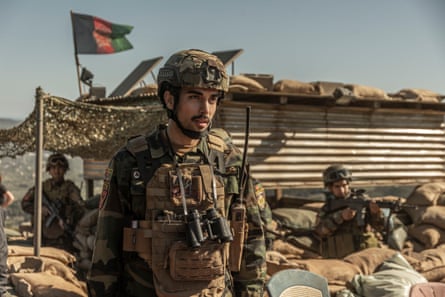
As Zahara and Baqir flee, they are forever on the phone to their adult children, neither of whom can be trusted to prioritise their own safety. We meet Fazal (Shervin Alenabi) as he mans a rural checkpoint on behalf of the Afghan army. Having been forced to abandon it by the Taliban’s overwhelming numbers, instead of heading to the city he moves further out into the country in search of his old CIA handlers; thus becoming our way of seeing the situation in the nation outside Kabul, and assessing the role of the last remaining Americans.
Providing an insight into what dealing with the Taliban close-up is like, meanwhile, is the family’s daughter Amina (Hannah Abdoh), a hospital doctor for whom starting again in Europe holds no appeal. She has trained to help sick and injured Afghans and is determined to keep doing that. But when the Taliban enter the hospital, she (and we) see that their psychopathic aggression and stupid dogma cannot be reasoned with or resisted. One is reminded of Margaret Atwood’s warning that everything in The Handmaid’s Tale has already happened, somewhere.
The Taliban immediately set about building a crude cinder-block wall to split the hospital building in two, enforcing their strict separation of men and women with no regard for patients’ health. On the ward, Amina has bonded with a girl of primary-school age who benefits greatly from the calming distraction of songs on her iPod - until a Taliban soldier charges in and rips the device from the girl’s hands, because “music is haram”.
Will Zahara’s family be reunited, and can the good-hearted westerners – including Giovanni (Gianmarco Saurino), a hesitant, nerdy administrator who suddenly becomes the Italian consul and has to rapidly transform himself into a steely and proactive diplomat – save all the people they promised to protect? The answer to the latter question is a doom-laden no, but as Kabul establishes itself as an efficient, empathic drama, infused with political rage without being slowed down by it, we care about the struggle.
It’s not perfect – it has weaknesses for speechified dialogue, and for characters’ journeys converging in unlikely ways – but its thriller tropes, of a race against time and of risks taken under the gaze of an implacable enemy, are utilised effectively to make the story as compelling as it is appalling. August 2021 in Kabul was an awful, shameful moment in history; this show vividly re-lives it.
-
Kabul aired on BBC Four and is available on iPlayer in the UK and on SBS On Demand in Australia