.png) 2 hours ago
5
2 hours ago
5
I bumped into an old acquaintance the other day. Updating me on his children’s ages, he said, with an eyeroll of resignation: “My daughter’s 15 now; just found a cannabis vape in her room.” It’s an increasingly common and concerning situation for parents – with no way of telling if a vape does in fact contain weed (which comes with its own risks, just like vaping tobacco) or something much worse.
Instead of the natural cannabinoids THC or CBD, these vapes can contain a much cheaper substitute: the “prison drug” spice. Last year scientists from the University of Bath analysed 1,923 vapes that had been confiscated from children in 114 schools in England, and found that 13% contained spice. In London and Lancashire it was 25%. And this is among vapes of all kinds, nicotine included, not just those that purported to contain cannabis. As for vapes labelled as containing THC, CBD or cannabis, when the drug-testing service Wedinos (part of Public Health Wales) examined 297 samples received in the year up to March 2025, it found that 39% contained spice.
Chris Pudney, professor of applied biochemistry at the University of Bath, said researchers also found that these vapes are “overtly and blatantly available on the major social media platforms”, which hold huge sway over young people. A recent report for ITV’s Good Morning Britain featured a boy who was incredulous that, at the age of 12, he had become addicted to spice vapes advertised on social media as THC – which he “bought for a tenner” – and ended up in a coma with a collapsed lung.

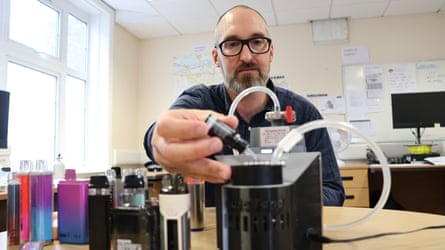
Scientists aren’t allowed to buy drugs from dealers to test them, so to get an idea of how many supposedly THC products advertised on social media contain spice, Pudney used his experience with testing vapes seized by schools to “visually triage” them (more on how to spot a spice-containing vape later) and estimated that 68% of those bought via TikTok contained spice, compared with 12% bought via Facebook.
If, as a concerned adult, you look up spice on the internet, it’s hard not to panic. You will find a heartbreaking BBC News clip about the drug turning users in north Wales into “zombies”, along with reports of it causing deaths among homeless and prison populations. “It’s not considered a drug like heroin that causes a lot of death,” says Pudney, and is not to be confused with the mass killer fentanyl and other, even stronger, emerging synthetic opioids. But, he says, “it can have acute health outcomes, depending on dosage”.
Spice has a dissociative affect, “so it makes you feel like you’re not in your body – which is why you can imagine people who are in prison or homeless like it – but it can also make you psychotic and potentially make you aggressive and give you a hypertensive crisis. At the worst end, it can give you seizures or cause a cardiac arrest.” There’s also a risk of serious accidents arising as a result of being incapacitated, which can easily happen because the effects can come on fast and strong.
Spice isn’t one drug – it’s a catch-all name for a range of chemicals that are often referred to as synthetic cannabinoids. “I think over 250 have now been recorded,” says Pudney. New variations were developed in quick succession as existing versions were made illegal, “in the same way we’re seeing with synthetic opioids at the moment, that are changing all the time,” he says. “The Psychoactive Substances Act [2016] was there to stop that sort of whack-a-mole. We now ban things based on a whole class of molecules, so all synthetic cannabinoid receptor agonists fall under the Psychoactive Substances Act.”
Cannabis itself was often viewed as a fairly harmless entry-level illegal drug in the 1990s. But in this century, a type of high-potency cannabis called skunk became the norm. Cultivated for a very high concentration of THC (the chemical that makes you feel stoned and potentially paranoid), it has barely any of the more calming CBD. Smoking lots of skunk in adolescence can increase the risk of psychotic illness fivefold, according to a paper in the BMJ.
It’s wrong, says Pudney, to view spice as synthetic cannabis. Where the THC in natural cannabis partially binds to certain receptors in cells, spice binds much more strongly to them. “It’s what’s called a full agonist, so it has a much stronger effect, and the structure of the molecule is completely different.” How does it compare to high-dose THC as found in skunk? “There is no comparison,” he says. “It’s vastly more harmful than cannabis.” In 2015, the Global Drugs Survey found that the risk of needing emergency medical treatment when using spice was 30 times greater than when using skunk.
“There are relatively regular media reports of children collapsing in school after vaping spice,” says Pudney. Spice is also addictive. “When you’re addicted to a really strong drug like spice, you simply don’t have any choices left in your life,” says Pudney. “Kids start stealing from their parents. When you’re addicted to a drug like that, it puts you in the pocket of the drug dealer. So my real concern is that spice is so remarkably addictive that it places people, young people who are already vulnerable, in very risky situations.” As with most poor health outcomes, those affected by poverty, trauma and lack of family support are at far greater risk.
Spice flew through the prison system because it was easily smuggled in, soaked on to paper that could then be smoked without incriminating odours. Similarly, it can be vaped in school without detection. “When we’re speaking to schools about it, they’ve got absolutely no idea if this is just a normal vape or a spice vape,” says Annabelle Johnson, of the health and social care charity Change Grow Live. “That’s one of the reasons why we’re finding so much of it in school.”
Jack Spicer, senior lecturer in criminology at University of Bath, has been speaking to young people who use spice as part of his own research. “The spice vapes have no real smell,” he says. “This makes it easier for children to use them and become addicted.” Spicer says this cautiously, “not wanting to overstate it and whip up a moral panic around it. But, at the same time, there are legitimate reasons to be concerned.”
Spice is cheap and easy to produce, and there is serious money to be made from it. Most forms in the UK are made from one of two molecules, says Pudney, and kits containing the components for these can be bought from China. Approximately £1,000 to £1,500 will get you enough to make a kilogram of spice – “but if you can sell it all in vape liquid, it will be worth about £1m”.

It’s in the last three to five years that vape devices have become “the new method of consumption” for children, says Chris Henniker, children and young people’s cluster manager for Change Grow Live. Originally, he’d hear of THC vapes being bought for £30 to £40. “Then we started to hear more and more young people saying they were buying ‘THC vapes’ for £10, £15. And then we started to hear these anecdotal adverse reactions, people being hospitalised.”
Once it became clear that these supposed THC vapes were spice vapes, usage died down among young people, “because there was a lot of stigma attached to spice use,” says Henniker. More recently, however, he says that young people haven’t seemed as concerned about the stigma. “They were willing to throw caution to the wind and see what happens. A number of them will try to ensure that it is THC they’re using, buying from what they have classed as trusted sources, but we also know there are a significant number of young people who are just buying whatever is being sold, with the hope it’s THC, but if it’s not, it’s not: ‘And we’re still going to use it anyway.’”
Some concerned teens buy cheap urine tests online that claim to identify spice once you’ve taken it. However, Pudney, who first developed his test for prison use, says “there’s no urine test you can buy on the market that’s going to be accurate for picking up spice.” Vape testing can’t be carried out locally, says Henniker. The only way to define what’s inside vapes is to send them for laboratory testing.
Having tested so many at the University of Bath, Pudney has some guidelines for recognising spice v cannabis in a vape in the first instance. Along with the often telltale pricing mentioned above, “you can know very easily whether it’s a THC vape because it will stink of cannabis, whereas spice vapes don’t smell of anything other than vape liquid,” he says.
Much of what’s sold on social media comes in unlabelled vape liquid refill bottles, and there’s a “high chance” that what you’re buying is spice, says Pudney. His analysis found that spice doesn’t tend to get mixed with genuine THC; it’s usually one or the other.
Dealers will often post menus of cannabis vape options alongside their other products. Spicer says you often see branded vapes “mimicking the legitimate ones that are being sold in jurisdictions where they are legal, in the US and Canada. Most young people are pretty alive to the fact that they probably aren’t legit, but still, in some way, buy into the branding. There’s some sort of materialism around it.”
Clarissa (not her real name), 21, from the north-west of England, who vapes THC in the evening because she feels it helps manage her panic attacks, says she can tell the difference by the effect of the drug. “With normal THC, you get the munchies and you’re still aware of what’s going on. But with the synthetic ones, it makes you very zombie-ish. It makes it very easy to fall asleep and it can take away your appetite.” In the past, she disposed of these, but recently she has been keeping them, to use if she can’t sleep. “I don’t use them on nights when I know I’ve got work the next day. I only use it on the weekends when I’m really struggling to sleep, and I use the THC on weeknights.” She works full-time and says she’s never had problems with spice: “But I know I’m taking a risk, whereas kids don’t know that they’re buying that.”
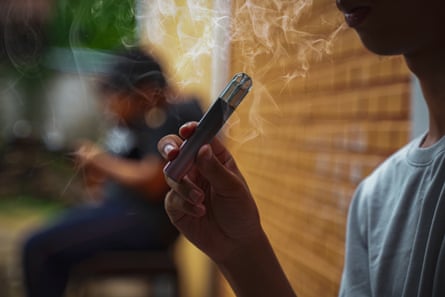
She has friends who knowingly use spice vapes more frequently and “struggle with tiredness”. When one went cold turkey, she vomited for days “and she had headaches”, Clarissa says.
Spice is so lucrative that dealers will always find ways to reach children, but Pudney is campaigning for more action to be taken about the presence of vapes on social media. Under the Online Safety Act, tech firms are required to tackle this themselves, but drug content still slips through the net. Pudney and his colleagues presented their findings to MPs in November 2025 during Evidence Week – an event set up eight years ago in Westminster to discuss how evidence is used and scrutinised – but gaining traction for further action is frustratingly slow. He has called for Ofcom to penalise social media firms for failing to uphold their duty. “If the regulator won’t enforce the law, we end up in the situation we’re in at the moment,” he says. “They haven’t found the evidence we’ve provided sufficient to warrant them taking any action. So we’re having a continuous dialogue with them.”
Meta – the owner of platforms including Facebook and Instagram – didn’t respond to the Guardian’s invitation to comment, but according to TikTok, 99.8% of all the videos removed from the platform for violating its “policies on regulated goods and services” were taken down before anyone had reported them. An Ofcom spokesperson said: “We’ve been pressing tech firms on what they’re doing to comply with their duties, and we’ve shown we’ll take action where companies fall short. Insights from academics like Prof Pudney are crucial to our work in enforcing the act, and we remain open to receiving further evidence on this matter.”
Meanwhile, says Pudney, “very vulnerable young people are at risk.”