.png) 3 months ago
53
3 months ago
53
In Beirut’s Gemmayzeh neighbourhood a rented flat has been transformed into a film set: bright studio lights in a cosy living room. At its centre is Maria Elayan – though she is barely recognisable. Filming for the third season of Smatouha Minni (You Heard It From Me), a feminist series in Arabic, the actor is in a padded muscle suit, wearing a slicked-back black wig and beard.
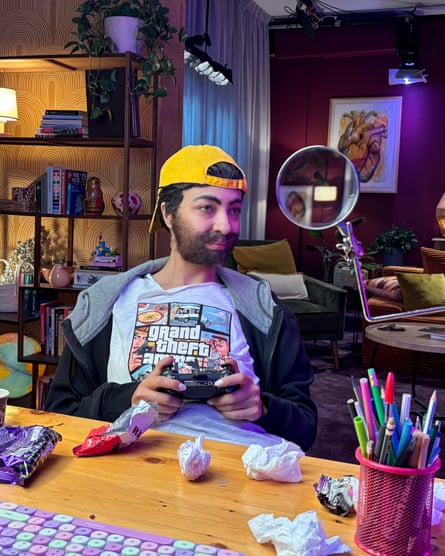
“If your wife asks you to change the diapers, you should change her,” the Palestinian-Jordanian barks, mimicking an aggrieved self-help podcaster. An hour later, she is slouched in a hoodie, shisha pipe in one hand and a gaming console in the other, shouting: “Mama, I’m hungry. Can you make me a sandwich?”
The sketches are parodies of a misogynist narrative gaining traction in the region. “Patriarchal attitudes have always existed,” says Amanda Abou Abdallah, the Lebanese founder, co-writer and director of Smatouha Minni. “But what we’re seeing now is a re-intensification – a backlash against women’s growing participation, independence and public voice, especially online.”
Chief among the ideologies circulating is the so-called “red pill” theory, popularised by figures such as Andrew Tate, whose influence in the region intensified after his conversion to Islam in late 2022. The doctrine frames men as victims of a feminist, “gynocentric” social order and urges them to reclaim power through dominance.
One podcaster, calling himself Dr Abdullah Mohammed, has 749,000 Instagram followers for a show called Be A Man, which promotes rigid gender roles, with videos suggesting that instead of helping his wife with domestic work, a man should marry a second wife so the women can assist one another. Others dispense advice on cheating discreetly or asserting dominance within marriage. Language used towards women is often dehumanising.
One point of contention among influencers is the fact that women are choosing to marry later in life. “They are blaming women for declining birthrates, changing social norms and the spectre of ‘family breakdown’,” says Abou Abdallah.
“We wanted to poke fun at misogynistic subcultures,” she says, “the podcasters who fixate on women ‘refusing’ to marry young, yet their own behaviour is the very reason many women want nothing to do with them.”
Abou Abdallah says the Smatouha Minni series began in 2020 “out of necessity”.
“There was an extreme lack of feminist literature and media in the region. We wanted to create something culture-specific,” she says.
At the Gemmayzeh apartment, Elayan says she has been aware of the absence of such content since her childhood. “When I was younger there was a lot of secrecy surrounding taboo subjects, especially those that affected women. Everything, from sexual and reproductive health to harassment, consent, domestic violence and the pressures around marriage, were treated as taboo.
“These are issues that shape young women’s lives. Yet they remained unspoken, wrapped in shame or treated as moral failings rather than social realities.”
If there was little to help in Arabic, English-language media did not suit either. “They would address the issues well, but I never felt like they truly applied to the position I was in,” she says. “One big difference is the fact that the Arab world is centred around collectivist culture – family, social structures and communal responsibility are key. Western feminist models are often incredibly individualist, so they do not map neatly on to our local reality.”
Abou Abdallah founded Khateera, the media house behind Smatouha Minni, with the support of Womanity, an NGO that invests in media solutions to gender inequality. Elayan, who had worked with her on the comedy platform YallaFeed, joined the project a few months later.
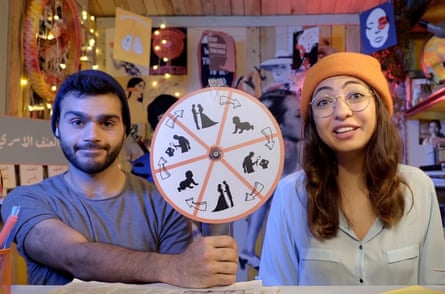
YouTube was the obvious platform for the series. “YouTube allows for longer-form, nuanced storytelling where satire, explanation and context can coexist,” says Abou Abdallah. It also enabled the show to reach young women.
The company was registered in Germany, allowing the creators to avoid local media censorship and the instability of Lebanon’s economy. The satirical shows are presented in Arabic with English subtitles.
“I think people would have found it condescending if we just lectured them on feminist values,” Abou Abdallah says. “The quips and caricatures help us critique society in an entertaining way. Once we make someone laugh, we have disarmed any potential defensiveness and can introduce new ideas.”
The first season sparked immediate engagement when it aired in June 2020. Viewers wrote in, describing how episodes shifted their perspectives and gave them the vocabulary to challenge harmful or conservative views.
Elayan says she is careful not to position herself as a counsellor. “I always make sure they know they’re not alone,” she tells me. “But whenever the issue is beyond what we can responsibly handle, we guide them toward people who are qualified to help.”
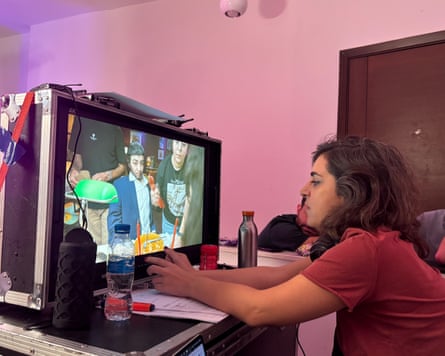
The second series cemented a fanbase. “Across the seasons, each episode on average has gained around 250,000 to 300,000 views,” Abou Abdallah says. The show has also attracted male viewers – about 24.9% of the audience.
Backlash came as well. “Hateful comments are often left on our videos,” Abou Abdallah says. “But we are not interested in extremes. We have already lost that battle. People on the fence are the ones I want to reach.”
The first four episodes of season three were filmed in November 2025, with a second set scheduled to be shot in April, but when the war in Iran spilled over into Lebanon, production was postponed. “The war impacted us a lot, mentally and professionally,” Abou Abdallah says. “We are waiting for a more stable ceasefire before continuing.”
However, the team decided to go ahead with the 22 April launch of the completed episodes of season three, which addresses the social norms and systems that place blame on women.
One of the episodes explores the relationship between mothers and daughters. “A mother who has lived as a victim of patriarchal systems often becomes the enforcer with her daughter,” says Abou Abdallah. “It’s not out of cruelty, but out of protection.” The episode offers advice on how to overcome this dynamic, encouraging women to redirect their focus to teaching their mothers what they have learned.
The long term goal is policy change. “To get there, you have to spark the conversation,” she says.