.png) 22 hours ago
10
22 hours ago
10
When I was about 12, I had my confirmation. I wore the same lacy white dress my terminally ill sister had worn two years earlier, with a red sash I had screen-printed at my Catholic school with a dove, symbolising the Holy Spirit.
Typically, a child picks a saint’s name as their confirmation name, someone they would most like to emulate. I was permitted to take the name of someone who was still alive, Lúcia of Fátima. Her cousin had been the one to see Mary, mother of God, before dying young and innocent. Lucia, on the other hand, had been condemned to live into old age. I could relate to Lucia. My sister, living with brain cancer, had always been the religious one.
This was the moment to publicly confirm my faith and commitment to the Catholic church. I had already begun to have my doubts by then; I crossed my fingers as I agreed with the priest’s creed.
As a child, I may not have been sure of the dogma that I would later leave behind but it was still an important moment in my emergence from childhood. I did it for my family; I did it for my sister, who wanted to be sure that I would join her in heaven. In that sense, my confirmation fulfilled its purpose – an opportunity for me to make a sacrifice for others.
When my daughter turned 12, I wanted an event that marked her transition, not so much from child to woman as from recipient to actor. She had always been a member of the community but I wanted her to think about this responsibility; what it means to co-create the world she wants to live in. So I worked with her to devise a coming-of-age ritual.
There are coming-of-age rituals across time and cultures. The Jewish rites of bar and batmitzvahs fulfil a similar role to my Catholic confirmation, in which children of about 12 or 13 commit to membership of their religious community. During a period known as Rumspringa, some Amish young people – usually aged about 16 – are encouraged to experience the world beyond their traditional lives. In this way, membership of their community is their choice, if they return and are baptised.
Some rituals involve a little more physical risk-taking than my Catholic pronouncement of faith. For example, in Vanuatu boys might throw themselves from a tower with a vine tied to their ankles. The Krobo people of Ghana stage a two-day Dipo ceremony for girls to mark the advent of puberty, which includes ritual bathing and dancing.
The sociologist and author of Religion in Human Evolution, Robert Bellah, theorises that rituals emerged in an evolutionary context for humankind. Bellah describes ritual as a space for meaningful social play, reinforcing the norms of the group, celebrating its solidarity and forming identity. Song and dance elements are crucial, stimulating the production of the brain chemicals associated with social connection, ecstasy and joy.
The theologian Karen Armstrong explains that stories can’t simply be told about a people; if they are going to stick, they have to be enacted. She offers the example of the Chinese philosopher Confucius, who emphasised li (ritual) as a critical element of maintaining social order.
Confucius provided instructions for public and private rituals, everything from everyday gestures of respect to how to serve tea to a visitor and how often the emperor should answer to heaven.
I wanted a ritual for Ellie which did not reinforce a single narrative about the world. I didn’t want her to have to cross her fingers. I wanted a ritual that confirmed possibility.
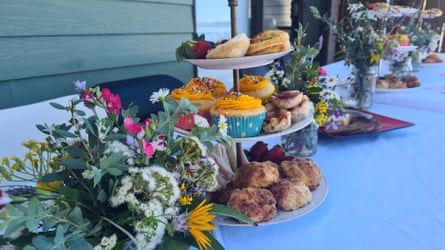
Ellie wanted a high tea. She asked for all her favourite foods set out on tiered cake platters holding fancy cheese, little sandwiches and cakes.
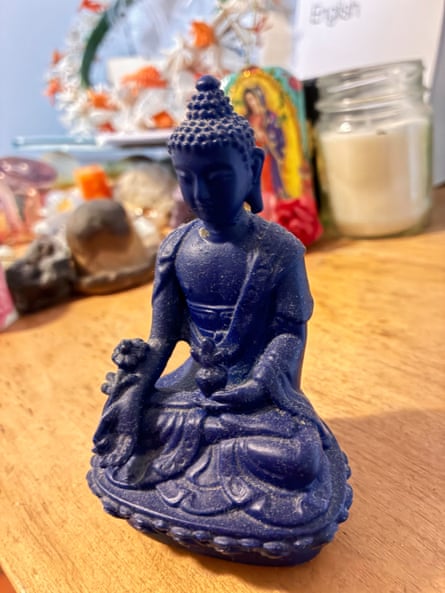
We picked a sunny afternoon in spring, not long before her 12th birthday, warm enough for the short-sleeved white dress she never otherwise got a chance to wear. We decorated the front veranda with bunting and set up a little altar. On it, I placed a bowl of water, a gum leaf, a candle and a handful of dirt to represent the elements. I put together a book of favourite prayers, along with a little icon of Mary, who is revered in the Catholic faith of my childhood, and Medicine Buddha, who is the patron Buddha on my mother’s side of the family.
I wanted Ellie to know that, even if she doesn’t adhere to these faiths, she still belongs to a long line of humans who have ritually, symbolically and physically participated in a sacred sense with the world.
At my Catholic confirmation, I had recited the words I had been told. I had written vows for Ellie but she read through them and handed them back to me. She wanted to write her own.
Ellie and I invited three of my female friends who had known her since she was little to be her god(less) mothers. I wanted her to have women in her life she could talk to if she didn’t want to talk to me.
My confirmation had been an hour-long mass in front of the parish but Ellie’s ceremony was brief and private, with just her family, her god(less)mothers and their kids. Ellie read her vows and the women read out their promises to Ellie, to provide her with safe harbour as she transitioned back and forth, between family and community, her internal and external worlds.
And then we celebrated. Our hominid ancestors once picnicked on raw meat, their safety from predators guaranteed by their commitment to watch out for each other.
The ham on the sandwiches was cured, the cheese pasteurised but the sentiment was the same. Ellie had promised to look out for the planet and her people, and we had promised to look out for her.
-
This is an edited extract from Jackie Bailey’s new book The Outrageous Good Fortune of Living published by HarperCollins, out now