.png) 6 hours ago
3
6 hours ago
3
On a warm spring day, Brooklyn’s century-old Paramount theatre has been transformed into a base camp for all things Zara Larsson. Stage techs scurry past entourage members, managers furiously tap smartphones and various figures patiently await their moment with the Swedish superstar.
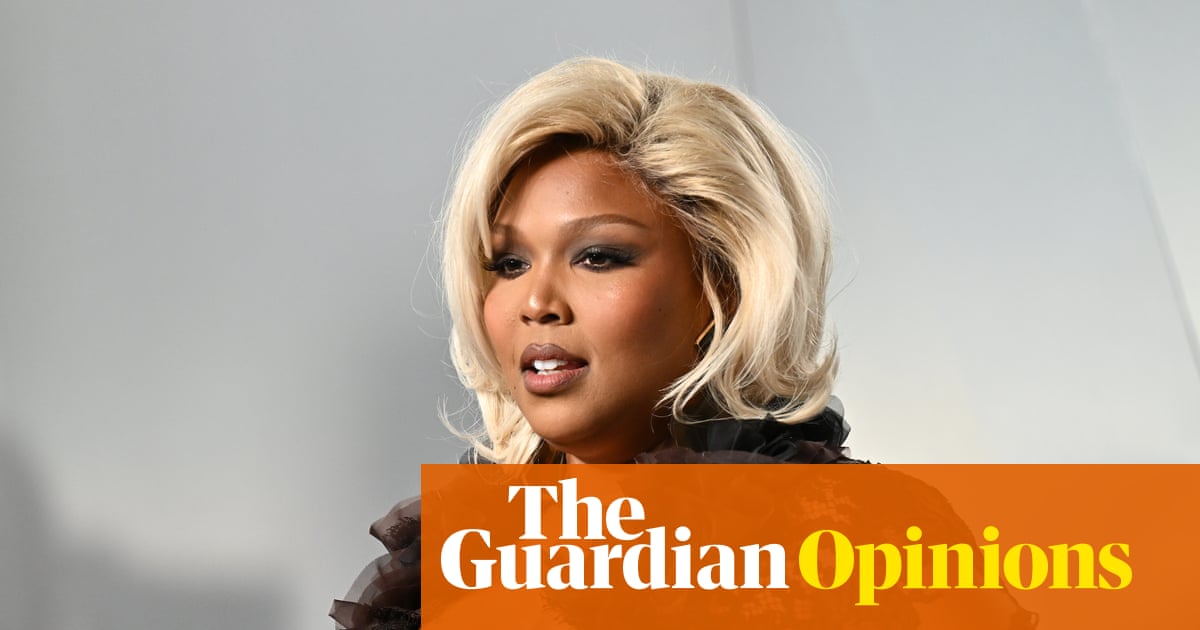
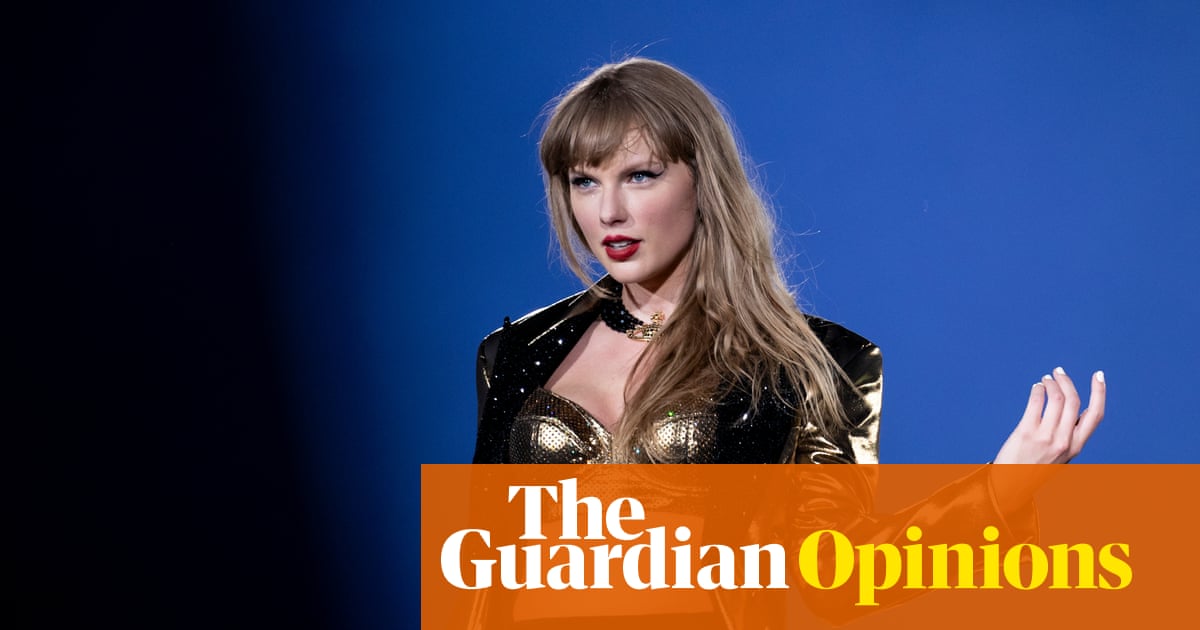
Down a plushly carpeted flight of stairs, Zara Larsson is on all fours, saying “puss puss” (Swedish for “kiss kiss”) into a camera. Despite all the craziness around her, she is locked in, wearing electric-blue stockings, tangerine booty shorts and a tiny blazer that makes her look like Malibu Barbie at graduation. A man powers up a leaf-blower, sending Larsson’s blond hair flying. After hitting a few poses, she tippy-taps over in maribou-trimmed stilettos and offers me a can of water. “Cheers!” she says as we clink.
Larsson’s career is moving at lightning speed and there’s not a moment to waste, or to indulge in much celebration beyond designer mineral water. In the week we meet, her irresistible spot on PinkPantheress’s Stateside has risen to No 1 on Billboard’s global charts after Olympic figure skater Alysa Liu’s viral routine to the track added fuel to what was already a white-hot six months for the Swedish star. At time of writing, Larsson has three songs in the US Hot 100 and is the fourth biggest female artist on global Spotify, behind only Taylor Swift, Olivia Dean and Raye.
Although she debuted aged 16 with the lovestruck ballad Uncover, everything changed for Larsson, now 28, with the release of September’s zeitgeist-hijacking album Midnight Sun. A flagrantly fun collision of brash electro-pop and drum’n’bass, the project reinvented her as a rave nymph: all dolphins and rainbows, rhinestones and lipgloss, tropical flowers and bare feet on fresh grass. Pop can seem like hard work in the age of chart gamification, “stan wars” and paparazzi-hounding, but Larsson makes it shimmer: a pop star who acts as if her duty is to provide joyful escape.
“I’m having the time of my life,” she beams as she kicks off her heels. She’s nearing the end of a six-week US theatre tour that goes viral nearly every night, thanks to her habit of inviting a fan on stage to dance to her 2015 single Lush Life (the song subsequently shot back up the charts). “The energy is amazing in these shows. But hopefully this is the last time I’ll do venues this size,” she says, arenas in her sights.
Part of what has made Midnight Sun so irresistible to fans – who call themselves Larssonists – is its genuine youthfulness: it is ultra-fun, uber-femme and whip-smart, evoking tan lines on chests, handprints on butts and skinny-dipping in the dark, all delivered in Larsson’s bright, startlingly powerful three-octave singing voice. “The change on Midnight Sun was my attitude,” she says. “I really evolved into a writer. People think personal songwriting is sad, on a guitar,” she says, making a “bleurgh” face. “But that’s not me.”
Midnight Sun embraces eurodance-pop, frenetic breakbeat and Baltimore club, as well as some fabulously cheesy accordion; the title track was nominated for best dance pop recording at this year’s Grammys. Larsson’s best lyrics have the immediacy of a voice note sent to a crush: “Look FaceTime / ’Cause my outfit so nice / And you say you love it ’cause it’s all see-through / Ooh!” At other moments, she is startlingly frank about her insecurities. Over stardust synths on Saturn’s Return, she reckons with her early ambitions hitting the skids. “Said by 20, I’d be filling up stadiums,” she sings. “Didn’t happen, so I changed the deadline / Might take another 20 years, and that’s fine.”
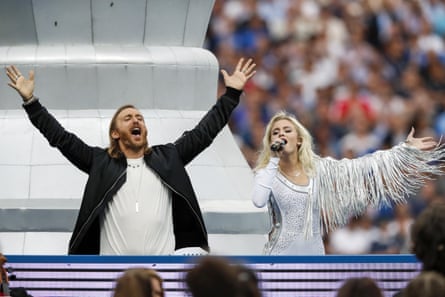
In the mid-2010s, Zara Larsson was a dependable B-list pop fixture, with a clutch of mega-streaming dance-pop collaborations with Clean Bandit, David Guetta and MNEK. These were stonking chunes that you could count on to get you through spin class, but which told you little about their big-voiced singer. Even recent albums – 2021’s Poster Girl and 2024’s Venus – did little to change that, feeling like overly focus-grouped grab-bags of trending sounds. In a scene in the recent documentary Zara Larsson: Up Close, the singer reflected on why her music was missing the mark. “A lot of people know the songs,” she said. “They don’t know I sing them. What the fuck is up with that? I’ve got the hits, but I’ve got no cultural relevance.”
“I think maybe I wasn’t an artist,” she tells me today. “I didn’t allow myself to do what I wanted to do in my soul. I don’t think I was allowing myself to even discover what that was, because I was so worried about whether radio would play it.”
She has since reconsidered her attitude, recognising that radio’s hit-making ability pales in comparison to the power of fans in the streaming era. “Who gives a fuck about radio?” she says. “I think radio at this time is just supporting what already exists.” It’s far more meaningful for Larsson as an artist – and as a brand – to see fans at her show wearing DIY spray-painted T-shirts and hibiscus flowers in tribute to her Midnight Sun look. That maximalism also finds Larsson barrelling closer towards the unapologetic camp of peers such as Chappell Roan and Sabrina Carpenter, with an accessible twist: you can find most of your Larsson cosplay essentials at Claire’s.
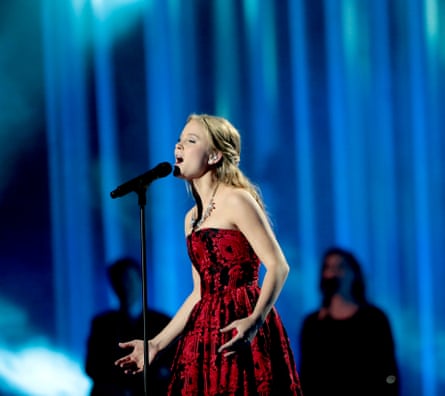
Born in Stockholm, Larsson grew up with “a longing to be famous” that found her performing in shopping centres and Ikea car parks as a kid. She loved to sing and was both terrifyingly precocious and practically minded. At 11 years old, frustrated that a record deal didn’t materialise after she won the Swedish TV talent show Talang, Larsson flew to Los Angeles to meet with Disney and Nickelodeon. “It was the only place that I could see a future,” she says of Hollywood. “Nobody took me seriously, but I was very serious.” In the meetings, she sang the Etta James classic All I Could Do Was Cry. “I had no business singing that song,” she says with a laugh. “Like: ‘My man is getting married to someone else’? They were like: ookaaayy.”
Today, Larsson mainly records in LA. The downside of the American dream is that her boyfriend can’t enter the US due to a drugs charge (for marijuana). “His visa keeps getting denied,” she says. “It’s a lot harder because of Trump.” They have been together for six years. “He’s a dancer,” she says, “so he’s flexible.” Um, good for you? “No, I mean with his time!” she protests, roaring with laughter. “Well, he’s flexible in that way, too.”
Larsson has always been vocal about sex positivity – in 2015, she busted the myth that some men claim to be “too big” for condoms by getting her entire leg inside one – as well as women’s rights and her support of Palestine. She says that the latter has got her dropped from brand deals and awards shows. In 2024, she declined to perform at Eurovision’s halftime show in protest at Israel’s inclusion. “The older I get, the less I care,” she says of the lost opportunities. After buying back her master recordings in 2022 for what she calls a “sickeningly good deal”, Larsson is financially stable. She’ll still take sponsorship – she just did an ad for soy milk purveyors Alpro – but she says she’s not greedy. “I have a really amazing home in Stockholm. I have a beautiful summer house. I travel and I can eat at whatever restaurant I want.” She looks at me as if to say: what else would a 28-year-old need?
“Maybe pop stars aren’t thought of as people taking a stand,” she continues. “But if you constantly go against your inner compass and morals, you lose yourself as well.” In January, she inflamed Maga with a post that read: “I love immigrants … I love socialism, I fucking hate ICE.” A few days later the White House posted a pathetic riposte on TikTok set to Larsson’s hit Lush Life: “We love America First, we love deportations … we love ICE and our law enforcement!” She says she missed out on another deal last month after joking about abortion with a fan on social media.. “I lost $3m, which is the biggest brand deal I’d been offered in my life,” she tells me without a lick of remorse. “I was genuinely like: OK, losers!”
Which brand dropped her? “I was wondering who was going to ask me that!” she exclaims, mischievously biting a French manicure tip. “What do you think, Derek?” she asks her publicist, who has the face of a man long past telling Larsson what to say. “I feel like there’s going to be a moment for that later,” she says with a sly smile, as if already hatching a plan. “I’ll call you.”
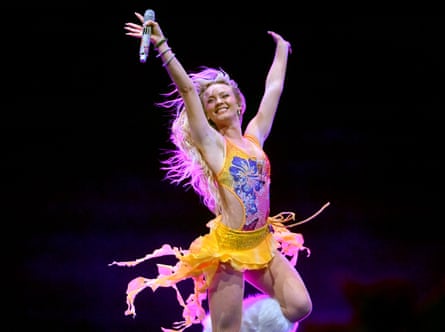
Larsson says that Midnight Sun’s cultural moment is a happy accident. It was a fan who paired her and Clean Bandit’s 2017 hit Symphony with kaleidoscopic dolphin art for a viral TikTok in 2024; Larsson just leaned into her marketing savvy to bring Y2K mermaid-core style to Midnight Sun. After fans started creating DIY versions of her airbrushed baby tees, she introduced a moment in her show where she spray-paints one for a lucky fan. Has she learned that her instincts are better than a record label’s? “Yes,” she replies instantly. “I get this weekly data update of my chart positions and monthly listeners from my label. And it’s not interesting to me to look at because that’s last week’s data. It’s already old. I want to ask, ‘What are we creating, what are we doing now?’”
She is putting the finishing touches to a Midnight Sun deluxe edition with all-women guest stars. Her label, Epic, “want me to release a new song before it drops to tease it”, she says. “And I’m like: it ruins the project and the specific rollout that I have planned.” It’s all a play for stats, which she finds depressing: “Playing the chart game is so dead to me. No one’s looking at the charts but industry people and maybe Taylor Swift fans.”
Sometimes fame can feel like a Faustian bargain, with scrutiny, sexism and presidential subtweets coming as part of the package. As her star has kept rising, Larsson has been wondering if there are limits to how much fame she can take. Could she handle it if she was as famous as, say, Chappell Roan, now in regular standoffs with the paparazzi? “The more people hate her, the more I love her,” says Larsson. “I don’t like how she’s being treated at all. When a woman has boundaries, I think people freak out. Men can do violent criminal things and people applaud them, but when a woman says, ‘Stop following me,’ it’s controversial? It’s like: you guys just hate women, actually.
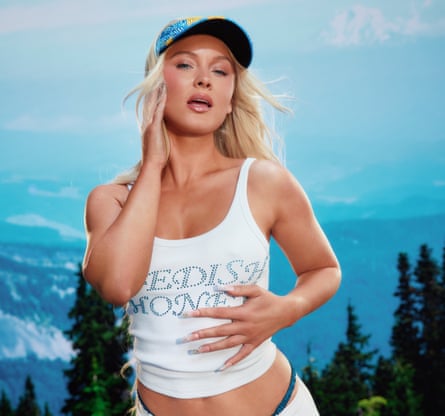
“But I kind of thrive on attention in all forms,” Larsson continues. “When I was younger, I was like: ‘Oh, I can’t wait till I have paparazzi outside my house.’” She feels a kinship with Addison Rae, who treats attention as a game and calls the paparazzi before heading to the petrol station. “I think we both realise that life is a performance.” The pair have become internet friends and have many real-life friends in common, including Rae’s producers, Elvira Anderfjärd and Luka Kloser. “They’re always like: ‘Fuck, you guys are so similar,’” she laughs, adding that she’s aiming to work with the Max Martin-affiliated duo on her next album.
Her fellow Swede Robyn is also an inspiration. Recently, Larsson was dismayed, if not altogether surprised, to see a backlash to the 46-year-old pop icon’s brilliantly libidinous, crotch-grabbing performances around her new album, Sexistential. “I think it’s [seen as] OK to be horny and 40 unless you look 40,” Larsson says. “But if you dare to show signs of ageing, then you’re discarded and put on a shelf and told you shouldn’t speak about sex. I think it’s so refreshing that Madonna is still out there, and Robyn is like: ‘This is me, this is what I look like, and I’m still hot.’”
Tonight in Brooklyn, Larsson’s live show is essentially a pop fan’s fever dream: Beyoncé hair flips, relentless choreography, a bedazzled microphone and an army of dancers that raise her over their heads as she hits the money note. The Larssonists are out in force, with their flower accessories and spray-painted shirts, but there is a noticeable variety in the crowd. Clearly, Larsson has moved beyond being a niche concern and into the orbit of mainstream music fans: you can’t rely on gay men alone to fill the US arenas she dreams of. “I’m so happy to be with you guys tonight,” she says between songs. “And we all know it’s going to be Madison Square Garden next time.”
She sees her current hot streak as an opportunity to build. “It’s not really about getting a No 1,” she tells me, sounding as impatient as the 11-year-old kid who flew halfway across the world with not much more than a voice and a dream. “It’s like: OK, we’ve done that. How can we keep creating? What other exciting opportunities are there now?”