.png) 5 hours ago
1
5 hours ago
1
You wait for ever for a visually electrifying Brazilian film featuring scenes in a gay cruising ground, then two come along at once. First, the Oscar-nominated The Secret Agent showed nocturnal trysts in Recife being violently interrupted by a rampaging disembodied leg. Now hedonists in the queer thriller Night Stage flock to a park in the southern city of Porto Alegre where they can openly make the beast with two or more backs. “It’s the year of gay Brazilian cruising!” says Marcio Reolon, mock-triumphantly.
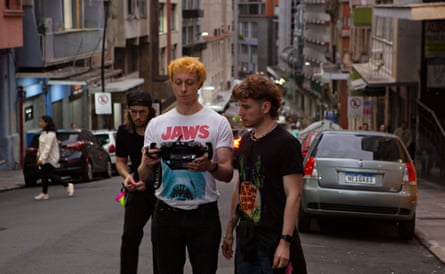
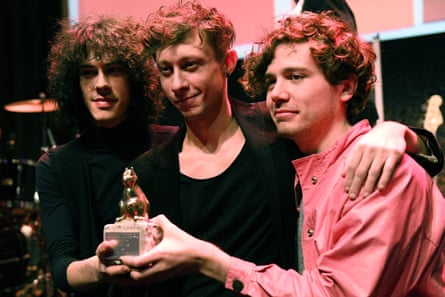
Reolon co-wrote and co-directed Night Stage with his partner, Filipe Matzembacher, who is seated beside him this morning in their Berlin apartment. The couple’s look is best described as exchange-student punk: studded bracelets, silver earrings thick as curtain rings. Reolon, who is 41 with sharp cheekbones and a cockatoo quiff, wears a padlock on a chain around his neck. The 37-year-old Matzembacher, cherubic and curly-haired, sports a barbed-wire tattoo on his left hand.
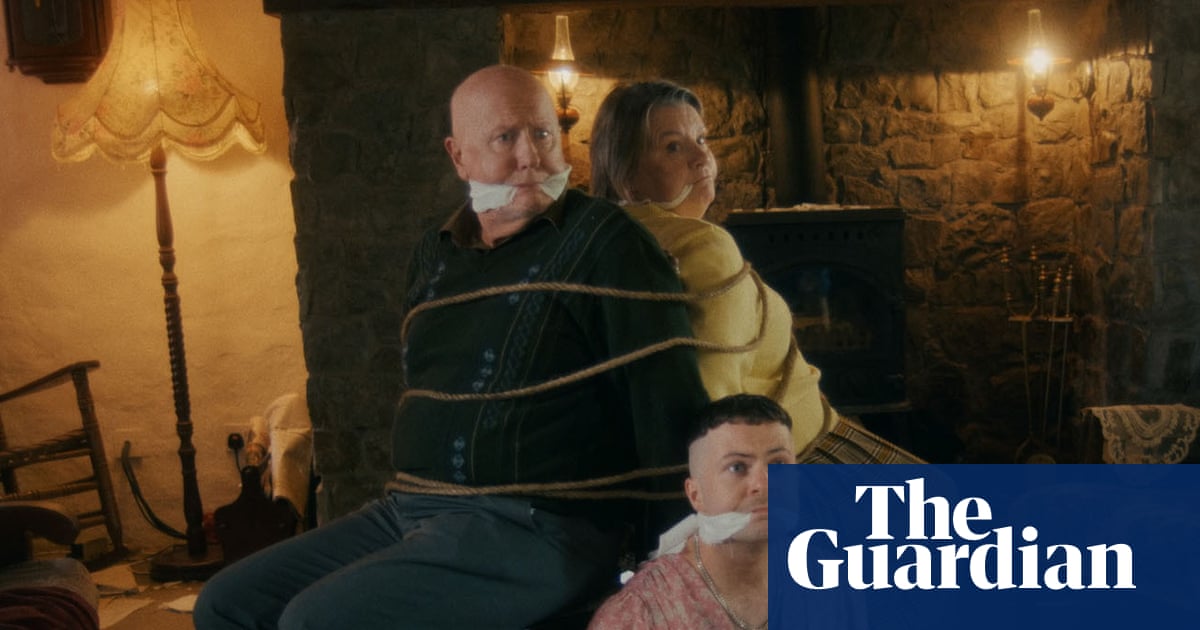
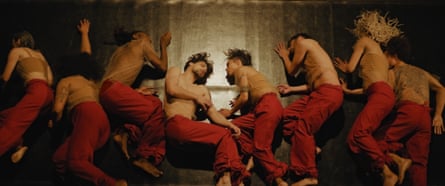
Night Stage, their third feature, concerns theatre actor Matias (Gabriel Faryas), who meets Rafael (Cirillo Luna), a mayoral candidate, via a hook-up app. The men discover a shared fetish for exhibitionism when, instead of drawing the curtains during sex, Rafael throws them wide open, making the room visible to the entire street.
The motif of curtains, at home and in the theatre, coupled with the idea of the “stage” – whether under the proscenium arch or in the central space of the city’s cruising ground – contributes to the film’s tension between performance and identity. How can these lovers truly be themselves when Matias’s new TV acting job demands discretion about his personal life, while Rafael’s team would prefer he kept his kinks, and his body, under wraps? Queers are accepted now, someone observes, but only “the ones who behave”.
It is all part of “the assimilation myth”, as Reolon puts it. “This lie that if we comply with the expectations of the dominant group, we will be absorbed. The truth is that as soon as we’re not profitable any more, we are the first ones to be discarded. This is the journey of the characters in Night Stage. They come to see how disposable they are.”
The movie is sexually charged, propulsive and often knowingly absurd. Its directors were inspired partly by reading Italo Calvino’s Six Memos for the Next Millennium. “Calvino speaks about how we can address heavy topics through lightness,” says Matzembacher. “He mentions Perseus defeating Medusa by confronting her in a mirror. So we thought: ‘OK, maybe genre could be our mirror to address these heavy topics.’”
It went so well that they are now developing a horror film and a western, though genre cinema has not traditionally been the preserve of queer film-makers. “It’s usually been very male and heterosexual,” says Reolon, “but I think this is shifting.” I mention the British thriller Femme, he offers Knife + Heart and I Saw the TV Glow, and before long we have programmed a mini-season between us.
One of Reolon’s hopes is that “people have fun watching Night Stage”. It would be hard not to. With its crash-zooms, split-screens and lurid use of colour, the movie has all the pizzazz of Brian De Palma. It also builds to the most deranged erotic climax since Cronenberg’s Crash. “We wanted a happy ending,” says Matzembacher. “Pun intended.”
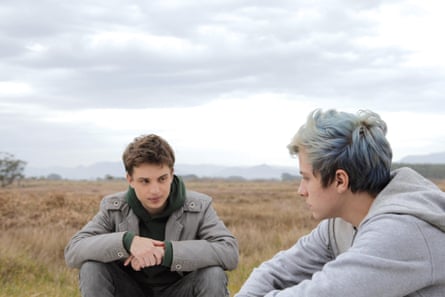
He and Reolon met at film school in Brazil 17 years ago. “We started to date and work together at the same time. So we don’t know how to separate that.” Reolon shrugs: “It’s one big messy thing. But for us it works.” They made their debut in 2015 with Seashore, an ethereal coming-of-age drama about two teenage gamers on holiday. The more confrontational Hard Paint, from 2018, follows a troubled online sex worker called NeonBoy. Its most striking quality is a tingling awareness of the audience’s presence right from the opening shot, which shows NeonBoy napping during a livestream while comments from his subscribers scroll past in the right-hand margin. “Did he come already?” asks one. “Yes,” replies another, “then he fell asleep and forgot the camera was on.”

Night Stage lends the themes of voyeurism and performance a new intensity. As preparation, the film-makers binged on Hitchcock, De Palma and Basic Instinct, then took their own radical new direction. “Usually the character in front of the camera is the object of the gaze,” says Matzembacher. “There’s no agency there. But we thought we could make a film that subverts this, so that they are aware they’re being watched.”
More than aware – they crave it. Screeching away from a beauty spot where they have just allowed themselves to be glimpsed having sex in their car, Matias and Rafael, still naked, whoop and holler as if making their escape after a heist. Getting into the spirit, the Rio cinema in east London is presenting the film in a one-night-only naturist screening. Patrons are advised to bring a towel, and not to mislay their hotdogs.
Noirish elements dominate Night Stage, and every noir needs its femme fatale. “Ours is Porto Alegre itself,” says Reolon. Both directors were born and brought up in the city, to which they still return during the winter months despite their complicated relationship with the place. “It used to be very punk,” explains Matzembacher. “Home to a lot of progressive leftwing movements. But something broke in the mid-2000s when it got more conservative and lost some of its charm.”
One of the characters in Hard Paint likens Porto Alegre to purgatory. “We were very angry with the city, and with the country, when we made that film,” says Reolon. “It was just after Brazil had suffered a coup d’état. We were watching the rise of the far right which led to Bolsanoro’s election in 2018. The city became like an antagonist.” That accounts for the shots of anonymous figures staring out of apartment windows while violence explodes in the streets below. “It’s like all the crimes against humanity happening today,” says Matzembacher. “People looking out of their windows then turning away and doing nothing.”
And now? “It’s not that we’ve made peace with those things in Night Stage,” says Reolon. “It is our femme fatale because it is seductive yet dangerous. It offers possibilities but it can also ruin the characters’ lives.”
They left Porto Alegre and moved to Berlin to take teaching jobs after becoming smitten with the city during visits to the Berlinale. The festival, in turn, was smitten with them, awarding Hard Paint its Teddy prize. They are well-placed, then, to comment on the Berlinale’s recent turmoil after this year’s jury president, the Palme d’Or-winning director Wim Wenders, insisted that film-makers “have to stay out of politics”.
“He might not have wanted to say exactly what he said,” Matzembacher concedes. “But he’s a very smart person so he had the tools to express it properly.” Reolon is less forgiving: “I think he knew exactly what he was saying. It was embarrassing to say the least.”
They were dismayed that Wenders squandered the chance to use his clout for good. “He is in a situation where he could have spoken out and not suffered any losses,” says Matzembacher. As the offspring of politically forthright families – Reolon’s father spent time in prison for attending Communist party meetings during Brazil’s military dictatorship, while Matzembacher’s took him to protests as a child – they are naturally principled. Rafael in Night Stage spells out their philosophy: “There are moments in our lives where we have to choose who we’ll be.” Matzembacher comes over a bit misty-eyed when I mention the line. “Wow, I didn’t connect that to our fathers until just now,” he says. I think he’ll be phoning his dad once our interview is done.
“The whole world is living this politically intense and radical moment,” he continues. “It’s a time to understand politics are part of everything.” Even cruising, which crosses boundaries such as age, class and race. “It’s a practice that puts mainly LGBT+ people in spaces that in the past were public but are now being privatised little by little. Cruising accepts everyone, even those who are closeted. You’re having interactions with people from very different backgrounds and circumstances, making connections you couldn’t make anywhere else.”
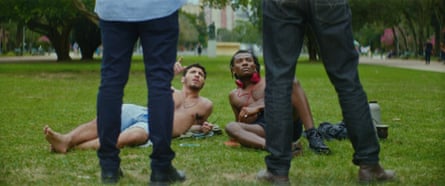
Like everything in the film, the cruising in Night Stage is heightened and stylised. “But we do have a cruising scene back in Porto Alegre,” Reolon points out. “And the park where we shot is the most popular area. Well, not exactly where we shot: we didn’t want to spoil people’s fun that night.”
Any happy memories of cruising there? “Funnily enough, we have never been cruising in Porto Alegre. We have in other places, but not there.” Matzembacher offers a possible reason for their reluctance: “Maybe we were scared to meet somebody we knew from way back. ‘Hey, long time! How’s life? How’s the family?’”