.png) 3 months ago
71
3 months ago
71
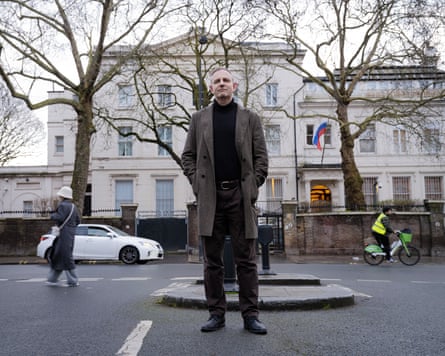
One morning in May 2025, I walked briskly down Bayswater Road along the northern edge of London’s Kensington Gardens until I reached the gates of the Russian embassy. Its formidable outer wall, already topped with razor wire, now had the additional protection of a crowd control barrier. But there was no crowd, just a lone man feebly protesting from the other side of the road. In the early days of the war, the embassy was besieged by angry protesters. Back then, you couldn’t walk down a British street without spotting the blue and yellow of the Ukrainian flag. That time was long gone.
Feeling uneasy, I was ushered inside by a guard who patted me down and checked the contents of my backpack before pointing the way inside. I knew this routine from my previous visits. Even the guard – a friendly Nepali man who knew about three words of Russian – hadn’t changed in years. I used to come here to renew my Russian passport and, on one noteworthy occasion, in March 2000, to vote in the Russian presidential elections. This time, I had an altogether different purpose: I was here to renounce my Russian citizenship.
I was born in 1980 to parents of Ukrainian descent, and grew up on the island of Sakhalin, in Russia’s far east. Anton Chekhov, who visited Sakhalin nearly a century earlier, described it as a “gloomy little world” with its forbidding cliffs overlooking the vast sea, the roar of the breaking waves and the dark skies that induced “oppressive thoughts and drunkenness” among the few inhabitants of what was then a remote penal colony of the Russian empire. The Sakhalin of my youth would have been recognisable to Chekhov: still forbidding and gloomy, and, like much of the Russian provincial rust belt, crumbling. Dilapidated Soviet-era apartment blocks mingled with ramshackle Japanese buildings, recalling the checkered history of occupation and re-occupation in this contested corner of the Russo-Asian borderlands.
When I reached 15, I secured a place on a US-funded exchange programme that took me to east Texas. Within weeks I had bought myself a pair of cowboy boots, and soon I was dropping “y’alls” right and left while “fixing” to do this and that. Small-town east Texas was a world away from small-town Sakhalin, but in one way it was the same: both felt like the ends of the earth.
The noble idea behind this exchange programme was to bring young Russians to live with American host families for a year, so they could learn something about the ways of freedom and democracy and – so the theory went – steer Russia in a more promising direction. Another of the early participants in the programme was Margarita Simonyan, who would go on to become editor-in-chief of Russia Today.
But, instead of returning to Russia (unlike Simonyan, who became one of Vladimir Putin’s most capable propagandists), after my year in Texas, I hopped from place to place, exploring different cultures, learning multiple languages, and feeling myself, quite comfortably, a piece of post-Soviet flotsam carried by the great currents of time. I wasn’t exactly sure who I was. But in a certain sense, I remained a Russian, tied to that vast homeland of mine, which I barely knew, not just by familial bonds but legally, through my passport.
In the early 2000s, I moved to the UK to study international relations at the London School of Economics (LSE). This was a period of optimism about globalisation, which seemed to herald more trade, more travel, more transnational ties. The LSE was a bastion of this worldview and I felt at home among all the would-be bankers, would-be McKinsey consultants, and would-be diplomats who surrounded me. What did it even mean to be a Russian in the increasingly borderless world, I sometimes wondered.
Unlike many Russians – oligarchs, dissidents and just ordinary people who made London their home – I didn’t stay. I couldn’t afford it, if truth be told. I was also restless. And so, I soon exchanged my crammed LSE accommodation for the rolling steppes and vast deserts of Mongolia. I spent many a night in quiet conversations with Mongolian herdsmen, sharing rock-hard aaruul (sun-dried curd) and a bowl of airag (fermented mare’s milk) – the nomad’s meagre diet. I, too, was recognisably a nomad. But although I wore a traditional deel (a flowing Mongolian garment), and even spoke Mongolian with fluency, I certainly did not become a Mongolian. To these wonderful people, I was still a gadaad hun (a “foreigner” or, literally, an “outsider”).
We all know the feeling of being an “outsider” but, I suppose, for most people, there is still that one place they genuinely belong, where they are on the “inside.” I struggled to find that place. I became a tumbleweed, blown about here and there, without ever planting roots.
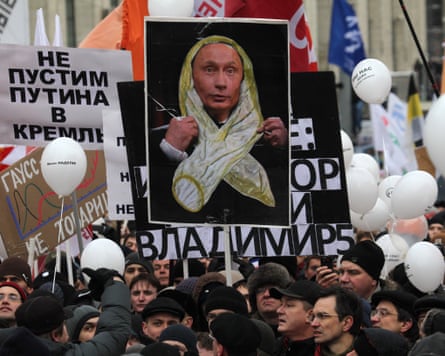
I was living in China – teaching at the University of Nottingham’s China campus – when mass protests erupted in Moscow following the parliamentary elections of December 2011, widely regarded as fraudulent. Demonstrations continued for months. The Kremlin cracked down, arresting hundreds of protesters, including former deputy prime minister Boris Nemtsov and the up-and-coming opposition leader Alexei Navalny. The brutal denouement became a turning point for the regime. Fearing a popular uprising, Putin tightened screws on dissent. Russia was rapidly sliding towards tyranny.
I took some interest in these developments, but I was a young academic, not an opposition activist. I didn’t even vote in any of the fraudulent elections: the nearest Russian consulate was too far away, and I had other interests. Still, Russia was a fixture in my universe, and I identified myself to curious Chinese taxi drivers simply as an “eluosiren” (a Russian). “Pujing hen hao!” (Putin is very good!) was the usual retort. As a rule, I did not argue.
I walked up the stairs and entered the embassy hallway. A heavy-set man in an ill-fitting suit greeted me unsmilingly at the desk. I was tense. The Kremlin is known for brutality towards those it regards as its enemies. Several activists, former intelligence officers and businessmen who found refuge in the UK have been poisoned or died under suspicious circumstances. I took comfort in my insignificance.
“Renouncing your citizenship?” the embassy official asked, adding, sardonically: “Ochen zhal” (what a pity). I mentally rolled my eyes.
I went to the booth and handed over a pile of documents. These had been very difficult to obtain. The Russians do not make it easy to renounce one’s citizenship. I was so desperate at times that I considered simply setting my passport on fire and tossing it over the brick wall of the Russian embassy: here, take it, you sons of bitches.
But in such moments of anger, I would recall Friedrich Nietzsche’s apt description of the state as “the coldest of all cold monsters”. Deaf to outbursts of emotion, the state deals in procedure and paperwork. It sets the rules of the game. Flouting these rules would have gotten me nowhere. So I pursued the legal route.
The correct procedure required collecting multiple spravkas – official notes from this or that government department proving that you have paid your taxes, that you have no unspent criminal convictions, and that you no longer live in Russia. The easiest way to obtain these spravkas is to travel to Russia, but this was not an option for me: I feared arrest. In Russia, it doesn’t take that much to be imprisoned for your political views: it’s enough, for instance, to call the war in Ukraine a “war”, or to criticise Russian brutalities. This is classed as “discrediting the armed forces” and could lead to 15 years in prison. Donating funds to Ukraine – which many Russians, including me, have done – is “treason” under Russian law and could lead to 25 years in prison.
My sins went further. I had repeatedly criticised the regime in the press. As an academic, I had lent my expertise to the British and US foreign and defence policy communities, in effect participating in the effort to defeat Russia. In June 2023, I even testified against Russia at the UN security council, accusing the country of my birth of conducting a “war of aggression,” and of “atrocities, including torture, rape and killing”. There was nothing radical about these claims, of course. I was merely calling a spade a spade. By my own back-of-the-envelope calculation – if Putin’s absurd laws are to be taken seriously – I have clocked up a couple of decades or more of forced labour in some remote colony in Russia’s arctic North.
Still, I was a scholar, not a dissident. I never felt like becoming a martyr. The last time I participated in anti-regime activity in person was in August 2019, when I marched through Moscow in what was called an “unsanctioned demonstration”. Thousands of Russians went “for a walk” to demonstrate their anger with another fraudulent election. The riot police – called “cosmonauts” for their black helmets and visors – were on hand to beat and arrest us. I escaped by darting into a sidestreet.
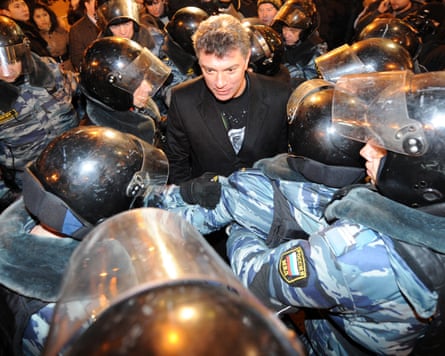
No, I wasn’t a hero. Aged 39 at the time, I had no desire for a close encounter with the riot police. I had family back in the UK. It wasn’t my revolution. I admired dissidents like Navalny who dared the authorities to put him behind bars, or my fellow Anglo-Russian Vladimir Kara-Murza, who bounced back with ever greater vigour from repeated poisoning attempts. I had admired Nemtsov, who was killed in full view of the Kremlin. But I wondered whether it was worth the trouble. For whom? For what? “For beautiful Russia of the future,” they would say. But how long would the wait be?
“We will let you know in six months,” the embassy receptionist told me. The documents would go to Moscow for approval. I nodded. I was asked to pay a fee of £150, in cash. The Russian embassy accepts only cash. I always believed that this was because they need cash to pay their spies. I paid and walked out in haste.
“Criminals!” shouted the solitary protester from the other side of the street, looking directly at me. “At least Judas hanged himself!”
“Is he talking about me?” I pondered. Who have I betrayed, exactly?
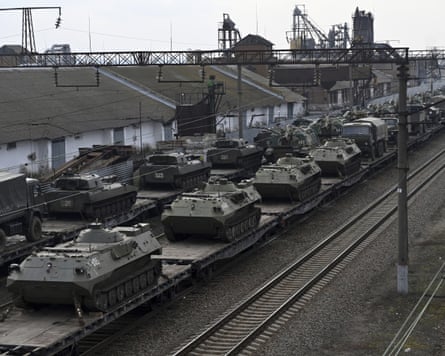
On 24 February 2022, I had woken up in a cold sweat and grabbed my iPhone. My heart sank. Over the ensuing weeks, news stories supplied a steady stream of images I never thought I would see: cities in ruins, dead civilians, desperate refugees pleading for help, blood everywhere.
In the run-up to Russia’s full-scale invasion, I had taken the easy route: refraining from making public comments for fear of undermining my reputation by making the wrong call. But the truth is that I had not seen it coming. I knew Putin was more than capable of committing hideous crimes, of course, but it takes a leap to go from dabbling in occasional murder to raising murder to the level of national policy. I misjudged how deeply he craved to be recognised as the tsar who restored the Great Empire, a reincarnation of Peter the Great. And that was a serious case of myopia for a historian who was then writing a fat book on how the Soviet leaders – ever insecure – had craved western recognition of their greatness.
This obsession with greatness at any cost was not just a trait peculiar to Putin. I knew that it was widely shared. Yes, some Russians sacrificed themselves for their opposition to the imperial narrative. But the vast majority were either indifferent or, often, quite attuned to Putin’s ideas. Suffering under tyrannical rule, they were not averse to imposing tyranny on others. Their unreformed chauvinism and mindless imperialism was reason enough for me to despise Russia as a political project.
By the time of the full-scale invasion, I was tired of Russia claiming me as its own, and of my claiming to be a part of a political community that seemed at once so intuitively mine and yet so incredibly alien. Added to my secret shame at having misjudged Putin, I felt a real sense of guilt. Here I was, enjoying my life as an academic, while in Ukraine, people were being tortured, raped and killed by the Russian invaders. Had I failed to do everything that I could have to avert this? Even more troubling: was I guilty by association? After all, there it was in my desk: the red passport with a double-headed eagle. These atrocities were being committed in my name.
On the day of the invasion, still reeling, I tweeted: “I feel like I woke up in a puddle of s**t and vomit, not quite sure what happened last night, but telling stern, reproachful observers all around: it’s not me, it’s not mine!” Three days later, I posted in Russian (which I had almost never done before): “I accept my share of the collective responsibility for the bloodbath unleashed by Putin’s regime.”
Like Rodion Raskolnikov, the main character of Dostoevsky’s novel Crime and Punishment, I had to kiss the ground and publicly accept responsibility. But I would be lying if I said that this statement was final and irrevocable acceptance of guilt. Once I recovered from the initial shock of the invasion, doubts began to creep in. Unlike Raskolnikov, I did not actually murder anyone. And wasn’t the whole idea of collective responsibility fundamentally illiberal, something that harked back to Europe’s dark experience with communism and fascism?
These questions of identity and responsibility were not merely philosophical. Around that time, I had to open a bank account in Italy. Everything went normally until the moment a bank official called me on my mobile. “Signore Radchenko?” she said. “Sì?” “You mentioned in your application that you were born in the Soviet Union.” “Sì?” “Ma quale parte (but which part)?”
I nearly burst out laughing. Yet it wasn’t a laughing matter. Russian citizens were being subjected to sanctions across Europe – even those who were regime opponents, those who had fled Russia because they risked arrest and imprisonment back home. It was thus that theoretical discussions about collective responsibility unexpectedly acquired a very practical dimension.
Wrestling with myself over these questions, I turned to philosophy. In 1946 German thinker Karl Jaspers published a famous polemic titled Die Schuldfrage (usually translated as On the Question of German Guilt). Jaspers, who had been dismissed from his university post in 1937 for being insufficiently enthusiastic about national socialism, and for having a Jewish wife, undertook to examine Germany’s – and, by extension, his own – responsibility for the horrors of the Third Reich.
In the book, he distinguished between different types of guilt. First was the straightforward criminal guilt that concerned only those who actively committed wartime atrocities. Then, there was political guilt, which, he wrote, “results in my having to bear the consequences of the deeds of the state whose power governs me and under whose order I live”. Added to this was moral guilt – supporting the regime through one’s actions or inaction. Finally, Jaspers also wrote about metaphysical guilt: the idea, which at some level I shared, that I was responsible for the death of innocent people because I had not risked my life to save them.
Jaspers fudged the question by failing to distinguish between guilt and responsibility the way Hannah Arendt did in her famous 1968 essay on collective responsibility. “Where all are guilty, no one is,” she argued. And yet she, too, found that you could be held responsible for acts you did not commit simply by virtue of belonging to a political community. Rejecting this responsibility was thus hypocritical on my part. After all, I did not grow up on a desert island, even if Sakhalin at times felt that way. I took the state for granted and availed myself of its benefits like any other citizen. I could not evade this responsibility. Or could I?
Unlike all but a tiny fraction of Russians, I had viable options. In 2020, after living and working in Britain for many years, I had acquired British nationality. I had settled in Wales with my Mongolian wife and my increasingly British children and became British in habits and outlook: complaining about the miserable weather and appalling public services, but in a loving sort of way. Having long before given up on voting in the Russian elections, I meticulously voted in the British ones. I drew the line at trying to understand cricket.
Even after acquiring British citizenship, I didn’t think too much about giving up my Russian passport. In his 2019 book Identity, Francis Fukuyama lashed out against the “questionable practice” of dual citizenship for its propensity to “engender potentially conflicting allegiances”. I read the book when it first appeared and underlined this passage with which I vehemently disagreed. I had always thought that having many passports was not just a convenience but also a political statement in support of an interconnected world. As a vaguely elitist intellectual with a global outlook, I resented the very idea of being pigeonholed. In my hubris, I neglected to properly consider the following warning from Fukuyama: “If the two countries of which one is a citizen go to war with each other, one’s loyalties are automatically in question.”
In the world we live in today, a war between Russia and the west is no longer an unthinkable scenario. Where would my loyalties be if a war were to break out? I was born in the Soviet Union and inherited my Russian citizenship by default, aged 11. It was bestowed on me from above, regardless of what I thought or did not think. By contrast, I pledged my allegiance to the British Crown as a 40-year-old. My home was in these isles, and, more broadly, in the west. And, yes, if I ever had to fight to protect my adopted homeland against the Russians, I would do my duty just like any other British citizen must. This was the reality.
And so, just a few months after the Russian invasion, I made the painful decision to come off the fence.
It required years of painstaking work. I worked through proxies in Russia to collect all the necessary spravkas. Some of them would expire before they reached me, and I’d have to start anew, frustrated but determined. I kept my friends apprised of my plans. Many thought it was all rather tragic and offered their condolences, not understanding that I regarded renouncing my Russian passport as a liberation, a bit like ridding oneself of a toxic relationship or having surgery to remove kidney stones.
Eventually, the time came to tell my parents. They reproached me for my decision. At times, it seemed they half-regretted that moment in 1995 when I first left Sakhalin to explore the world. Did they, too, in their still-Soviet worldview, see this as treason of a deeper kind? The lone protester’s voice rang in my ears: “At least Judas hanged himself.”
When my parents were growing up, the Soviet Union was still recovering from the brutalities of the second world war. Their parents were war veterans. They were brought up to take pride in the achievements of their motherland, in its greatness that was, supposedly, the envy of the west, which tirelessly schemed against it. They were great Soviet patriots and since the Soviet identity was but a hollow shell that masked associations of a deeper kind, they were also Russian patriots. In their eyes, Russia could do no wrong or, if it did, it wasn’t any worse than what anyone else was doing.
I inherited some of that outlook through my early upbringing: all that marching up and down the street under the red flags, all the war songs. Here we were defeating the Germans, there beating the Japanese. My primary school favourite was a song that went, in part: “My motherland is large / It has many forests, fields, and rivers / I don’t know any other country / Where one breathes so freely.” Forty years later, they are still singing these songs.
Do we owe something to political communities that nurture us? The Soviets thought so, and imposed punishing exit fees on would-be émigrés. They also stripped émigrés of their citizenship, a humiliating blow inflicted on Soviet dissidents. Putin’s regime doesn’t do that to you. Rather, it sees citizenship as a form of control. It even gives out Russian passports to (ideally Russian-speaking) foreign citizens in occupied territories such as Crimea and Abkhazia. Russian citizenship is what formally makes you a member of Putin’s Russkiy mir (the Russian world), and potentially a tool of the Kremlin’s subversion and influence operations in Russia’s immediate neighbourhood.
The underlying, if not quite articulated, idea behind Putin’s policy is that Russians remain Russians even if they have settled abroad, even if they have acquired other citizenships, and even if they hold dissenting views on the Kremlin’s policies. There is an implicit expectation of loyalty, if not to the current government, then at the very least to the idea of Russianness. You cannot escape who you are, so goes the logic, and here’s your passport to prove it.
While I was appalled by this logic, I also had to admit that it made sense. That was why I felt that giving up my citizenship was the right thing to do. I knew that no matter what I did, anyone I met might still think of me as Russian – whether because they concluded that my name definitely proved so, or because they detected a tinge of an accent in my speech. That was fine. But not the Russian government. They could not call me Russian and that was victory enough for me.
My parents worried that, after renouncing my passport, I’d never be able to travel to Russia again, even for their funerals. “You would not even be able to put flowers on my grave,” my mother told me with a sigh. I tried to convince her otherwise. Things would eventually improve, I said. But I knew that they wouldn’t. With or without a Russian passport, I just could not go back.
It is a strange feeling, which I probably share with any number of refugees from brutal dictatorships. What does it do to people when they are abruptly cut off from their roots? They can perhaps continue dreaming of a future return to their motherland. Many Russian exiles in Europe appeared to think in these terms. I didn’t. Maybe this was because, unlike these Russian exiles, I acquired genuine competing identities. I did not depend on Russia for my sense of who I was. It was a large country, just like that song claimed. But the world was much larger …
So, I persisted in my effort to renounce my Russian passport, and on 7 May 2025, I handed the entire package of documents over to the Russian embassy. The Russian Foreign Ministry has the responsibility for accepting or denying citizenship renunciation requests. My documents were forwarded to Moscow. I was left to wait. I expected a decision by November at the latest.
Then, in October 2025, for the first time since the war began, I went to Ukraine. It was an emotional moment. I felt like Luke Skywalker descending into that dark cave in The Empire Strikes Back, to face his own fears. Of what, exactly? I wasn’t sure. But it required a certain effort, a rethinking of who I was, of who I wanted to be. Earlier that autumn, I had made the decision to write a global history of the Russian invasion of Ukraine. It is a multi-year project that entails interviewing hundreds of policymakers in Ukraine, Europe, the United States, and the global south. I had spent the summer diligently studying Ukrainian and after a few months, I could speak it passably. And so, I went.
On the unseasonably cold evening of 3 October, after tea and a chat with colleagues at the Kyiv School of Economics, I took the metro to the Maidan Square, and stood for a long time in silence next to the makeshift memorial to Ukrainian soldiers killed in this war: thousands of fading pictures lost amid the fluttering blue-and-yellow of Ukrainian flags.
My phone buzzed. There was an email from the consular section of the Russian embassy in London. “Sergey Sergeyevich,” it began tersely, using my patronymic to highlight the seriousness of the matter. “In connection with your request to renounce Russian citizenship … we inform you that your request has been satisfied.” I lingered in the Maidan for a bit longer, listening to the flapping blue-and-yellow flags.
There was one more step to take. The Russian embassy wanted me to hand over my current, and all of my expired Russian passports, in exchange for an official spravka that my citizenship has been cancelled.
On 15 October, I brought a thick stack of Russian passports to the embassy. While waiting my turn, I flipped through them. The one I liked most was my very first passport. It was different from the rest. It did not have the Russian double-headed eagle but instead the Soviet coat of arms (despite being issued in 1995 – which says a lot about my home town’s disconnection from reality). Looking at me from the front page of that passport is a 15-year-old kid, with a funny hairdo. “Well,” I said to him. “You didn’t see this coming, did you?” He stared back with the solemn gaze of Soviet youth.
I picked up my very last Russian passport. I hadn’t used it in a while. Here I was, sporting a beard. While waiting my turn at the booth, I took out a pen and wrote a parting message across the first page: “Goodbye, and thanks for all the fish!”
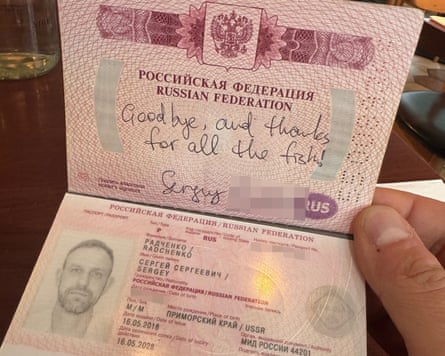
This last prank did not go down well. The official in charge – who, it seemed, had never read Douglas Adams – insisted that I reapply for a new Russian passport before renouncing my citizenship. I told her I had no intention of doing that. “Well,” she said. “Then you are in the grey zone.”
A few minutes later, I was walking down Bayswater Road, half seething, half laughing. “Yamar mangar yum be!,” my wife told me, using the Mongolian word for “idiotic.” “Come on,” I told her on the phone. “It was a joke.” But I recognised that I had gone overboard. I had worked for years to renounce my citizenship, only to sabotage the whole process at the last moment. And why? Because I wanted to poke the bear in the eye? I could see my wife’s point, and yet. I had poked the bear. Right in the eye. And I treasured this small act of provocation against that coldest of all cold monsters.
What ensued were several months of correspondence. The embassy at first refused to answer my inquiries. I wrote a scrupulously legalistic complaint to the Foreign Ministry in Moscow, not expecting a reply. But the trick worked. Finally, in January 2026, I was summoned back to the embassy.
On 28 January, I arrived at the entrance once again. The old Nepali guard patted me down and cursorily peeked into my backpack. “You know, I would really like to climb Everest,” I told him. “Qomolangma,” he corrected me sternly, using the Tibetan name for the world’s highest peak. “Qomolangma,” I conceded meekly. “Well,” he said with measured self-respect, “I also thought about doing it. But there is a huge gully there, which you must cross over a very, very narrow bridge. I thought I’d fall to my death.”
I went inside and sat down by the Russian tricolour, waiting my turn. My eyes paused on a book on the nearby table: it turned out to be a memoir by Maria Butina, the spy arrested in the US and deported to Russia in 2019. I flipped through the pages. A phrase jumped out at me: “No matter where our guys are, whatever happens to them, you can never break the strong, invisible bond that they have to the motherland.” Jesus, I thought. What a nauseating pile of garbage. I threw the book aside.
After a while I was called to the window. I was handed a piece of paper. “Spravka,” it read at the top. “On the cessation of Russian citizenship.” I skimmed the text. It had a stamp and a signature of a senior embassy official. “Thank you,” I said. “Do svidaniya” (see you again). Then I caught myself thinking: I am not seeing you again. For Christ’s sake, I am never – ever – seeing you again.
I dashed out of the building and waved goodbye to the Nepali guard. “Qomolangma!” I shouted. I had crossed the death gully, and here I was, as yet unscathed. I stood on the street taking in the bustle of London’s busy day. The sun had come out from behind the clouds. I still had to learn who I was. But at least I knew who I wasn’t.
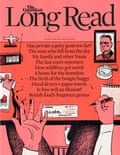
Discover a selection of the Guardian’s finest longform writing, in one beautifully illustrated magazine. In this issue, you’ll find stories about how private equity is plundering the world and what it’s like growing up in a family of Nazis. Plus: why do we think the perfect buggy will make us better parents? Order your copy here, delivery charges may apply