.png) 2 months ago
54
2 months ago
54
To be a Olympic-class skeleton racer requires extraordinary guts and impeccable nerve, as the corners loom and then whoosh past at frightening speed. So did anybody really believe that Ukraine’s Vladyslav Heraskevych would lose his when the world’s eyes were upon him?
Not the International Olympic Committee, who flipped between threats of expulsion and sweet talk over the last fortnight, without coming close to changing his mind. And certainly not those of us who have spoken and messaged Heraskevych, and found a man utterly prepared to sacrifice his dream of winning a Winter Olympic medal for a higher purpose.
In public and private his message was the same: he would not back down. And if the IOC barred from competing in his “helmet of memory”, which commemorates some of the 600 Ukrainian athletes and coaches killed by Russian bombs and bullets since 2022, he would accept his fate.
And when the moment came, shortly before 8.30am on Thursday, he met it with a powerful but resolute message: “This is price of our dignity,” alongside a photo of his helmet.
For the IOC it must have been like watching a public relations car crash from the passenger seat. One that everyone knew was going to happen – and nothing could be done about it.
Partly that was because Heraskevych’s messaging was so clever and precise. He didn’t focus on statements about Russian aggression. Instead he spoke powerfully of wanting to honour his fallen friends. That allowed him to claim his message didn’t violate the IOC’s rules banning political expression on the field of play. Did everyone believe it? No. But it was a deft sidestep.
Heraskevych also cut through with his claims that the IOC was being inconsistent in its application of its rules over athlete expression. At the opening ceremony, for instance, his fellow skeleton racer, Israel’s Jared Firestone, wore a commemorative kippah to remember the 11 victims of the Munich massacre at the 1972 Games, which said: “We remember. We endure. We rise.”
While this week the US skater Maxim Naumov, who lost his parents in the Potomac air collision last year, honoured them by showing a photograph after he competed. Why, Heraskevych pointed out, was his case any different? Especially as the IOC’s rules are supposed to be consistent, whether it is an opening ceremony or in competition.
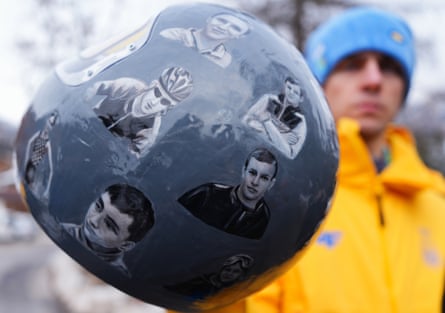
All that said, the IOC did at least try to avert one of the most controversial moments of recent Olympics coming to pass. Historically they have been utterly inflexible when it comes to allowing athlete expression. But they did allow Heraskevych to use his helmet in practice and even offered him the rare chance to wear a black armband in competition.
Most notably of all, the IOC president, Kirsty Coventry, went to Cortina in a last-ditch attempt to break the impasse. The fact she did so, and was in tears afterwards, said a lot about her compassion and leadership style.
This is not the IOC of her predecessor, Thomas Bach, who seemed to only smile in public when votes were needed at elections.
And this is certainly not the IOC of a generation or two ago. When Tommie Smith and John Carlos were kicked out for their black power salute at the 1968 Olympics it came at the urging of the then IOC president Avery Brundage – a man who repeatedly defended Nazi Germany before and after the 1936 Games when president of the US Olympic Committee.
Brundage was it again in 1972 in Munich when the American 400m athletes Vincent Matthews and Wayne Collett were given a lifetime ban from the Olympics after turning their backs to the US flag on the podium. “A disgusting display,” he called it.
So times have changed. But the problem the IOC has is that it clings to the old lie that sport and politics can be separated. Remember that it was only last week that the IOC – along with Fifa – was making noises about bringing Russia back into the sporting fold.
This is the same Russia that tried to hack the Milano Cortina website before these Games. That launched a sophisticated cyber-attack at the Winter Olympics opening ceremony in Pyeongchang. And, most famously of all, corrupted the 2014 Winter Games in Sochi by doping its athletes – with a scheme that involved using a mousehole to swap steroid-riddled urine samples with clean ones.
Russia has, according to Ukraine, also destroyed more than 800 sports facilities, including over 20 Olympic, Paralympic and Deaflympic training centres.
I am not convinced the IOC was doing Russia’s propaganda for them, as Heraskevych and the Global Athlete organisation has claimed. But it was certainly a terrible look to ban an athlete for wanting to pay homage to his friends, while his country is being hit with ballistic missiles and you have recently made cooing noises to Russia.
As the dust settled, many in Milan were asking if the IOC could have done anything differently. The key issue, it seemed, boiled down to its insistence that the field of play was sacrosanct and should be free of any political or social protest. Most wouldn’t completely disagree with that.
It is also the case that, as one insider put it to me, if the “helmet of memory” had been approved, the IOC could have potentially opened up Pandora’s box and set a precedent. Could you imagine the furore if the Iranian government forced its athletes to mourn the head of the revolutionary guard, say, after he was assassinated?
But perhaps there was a way. After all, if the IOC was able to set up an independent panel to decide whether Russians could compete as Authorised Neutral Athletes, why could they not have done the same for Heraskevych and other such cases? And maybe the IOC could have even looked the other way, and allowed Heraskevych to compete. It would have made a ripple, for sure. But a day later we would have been on to the next ski jumping penisgate or biathlete cheating on his girlfriend story. That’s how fast the Olympics news cycle moves.
But there is one thing we can say for certain: Heraskevych has got the horrors of the war in Ukraine back on the agenda, which was his aim all along.
The Russian team will be back at the Winter Paralympics later this month. And last week there were suggestions that the Olympic team would be reinstated this year. The latter decision has surely been pushed back now.
So while Heraskevych has lost his battle to compete, he has certainly won the public relations war.