.png) 5 hours ago
7
5 hours ago
7
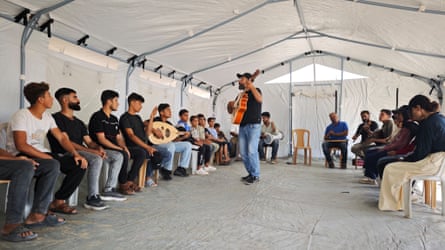
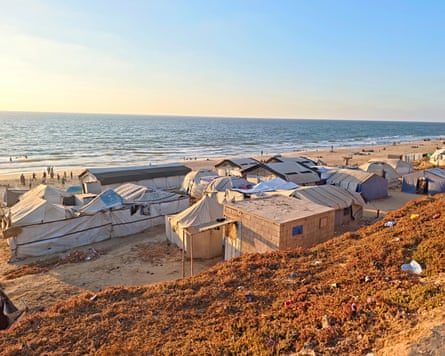
The three tents line a stretch of overcrowded, windswept sand, their windows open on to a view of the breaking waves of the Mediterranean. From inside comes the sound of singing, a strummed guitar, a violin and then a flute.
But if the music evokes calm and harmony, the surroundings do not: rows of crowded makeshift shelters swelter in Gaza’s summer heat, young children picking their way through rubble, battered cars and pony carts clogging a potholed road. Above, Israeli military drones hum and buzz.
The tents are the new home of the Gaza branch of Palestine’s national conservatory, dedicated to teaching classical, popular and traditional music. The institution, founded in 1993, once enjoyed well-equipped offices in Gaza City, three pianos and store rooms full of instruments and musical scores. Its alumni travelled the world to perform.
That was before the war. The classrooms, practice rooms and auditorium were all destroyed in the relentless Israeli offensive that laid waste much of Gaza between October 2023 and October 2025. So too were the instruments, and the conservatory’s extensive archives.
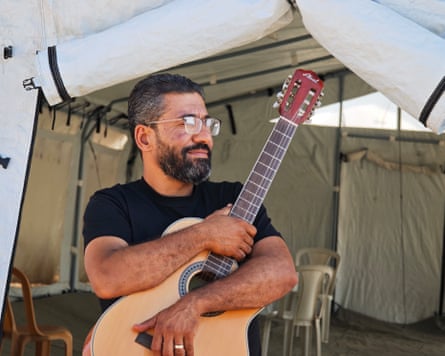
With a small group of former employees, Ahmed Abu Amsha, a musician and one of the teachers at the conservatory, is trying to rebuild the conservatory’s programmes. Originally from Beit Hanoun in the north of the Gaza and currently in the zone occupied by Israel, he now oversees activities in central Gaza, teaching guitar and supervising choirs.
“Once, back before the war, music for many people was a means of entertainment and personal development … Now music has become an important tool for psychological relief. We work with lots of children who suffer from trauma and psychological distress caused by the war,” said Amsha.
More than 72,000 Palestinians, mostly women and children, were killed during the Israeli offensive and another thousand have died in Israeli strikes since a ceasefire nine months ago. The war was triggered by a surprise Hamas raid from Gaza into Israel, which killed 1,200 people, mostly civilians, and took 250 people hostage. The territory remains divided, with 2.3 million Palestinians living under the rule of the militant Islamist movement in the roughly 40% now outside Israel’s control. Few have homes.
Almost all the teachers and students of the conservatory were displaced during the war, most many times, and some injured or killed.
“One of the most heartbreaking moments was the loss of one of my students, Yusuf Salman, who was one of the most disciplined, polite and talented students. He studied guitar with me … and was killed when a cafe was bombed. It was an extremely painful loss,” said Abu Amsha.
So far, almost no reconstruction has taken place since October because Israeli restrictions remain in place on what can enter Gaza, and a proposed second phase of the ceasefire is stalled as negotiations over the disarmament of Hamas continue. Many in Gaza still go hungry and there is an acute shortage of clean water, fuel and medical supplies.
Teachers from the conservatory face journeys of hours across rubble-filled roads to reach students such as Mohammad Khader, a 17-year-old who began learning the oud, the traditional Arabic instrument that is the ancestor of the guitar, at the conservatory 10 years ago.
Displaced from his home in the north, Khader lives in a tent with his family near the central town of Deir-al-Balah.
“Whenever I feel stressed or upset, I turn to music because it calms my nerves and gives me a sense of peace. I feel that I belong to music, just as music belongs to me, especially during this difficult period of our lives,” the teenager said.
Demand for music lessons is so high and there are very few teachers, so Khader now instructs new students.
“Before the war, education at the conservatory was more comprehensive and structured. We studied books and musical notation, and received both practical and theoretical classes. But now resources are very limited, and activities are mostly just focused on choirs and practical instrument training,” he said.
The conservatory, named after Edward Said, the Palestinian-US scholar, public intellectual and activist who was also a fine classical pianist, has its overall headquarters in the occupied West Bank but its local branch has long been a prominent feature of Gaza’s cultural scene.
Before the war, Israel sometimes granted the best students exit permits to travel outside Gaza to play in the Palestine Youth Orchestra, the conservatory’s touring ensemble. Others performed inside Gaza, giving concerts in both Arabic and western traditions.
Osama Jahjouh, a flute teacher at the conservatory since 2012, lost all his instruments during the war.
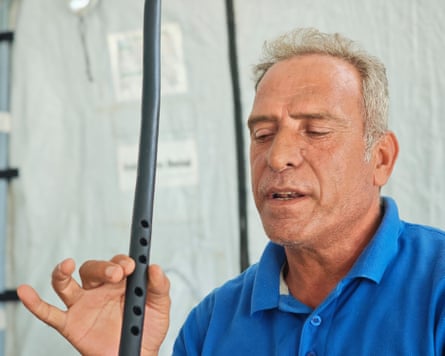
“When I was displaced after my home was destroyed, I lost three bags containing flutes and found myself without any musical instrument but I refused to give up. I returned once again to the idea of making a flute from plastic tubing, as I had done when a child. It was difficult, as flute making requires precise measurements for tone holes and placement but I managed to produce a playable instrument,” Jahjouh said.
In the largest of the three tents used by the conservatory, a dozen young people have gathered to sing, play and listen. The sound of a series of maqams – scales, melodies and musical modes traditional in the Arab world – filter out across the shelters around. Some are played on the plastic hose flutes, others on salvaged or repaired instruments.
Yara Abu Amsha has been learning the violin since moving to al-Mawasi about eight months ago.
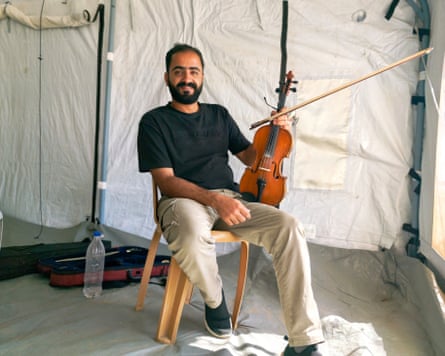
“I chose the violin because I felt it is closest to my personality and most expressive of my feelings. The violin is a deeply emotional instrument; its sound is calm and beautiful, and it has a great ability to convey emotions and feelings,” the 15-year-old said.
“Music means a lot to me. Before the war, I didn’t think about it in this way but during the war I discovered that it has become a real refuge for us. Even if only for a short while, music gives us a chance to escape reality.”