.png) 2 months ago
52
2 months ago
52
Suited and booted in a navy twinset tracksuit and colourful high-top trainers, Wang Runguo is hustling. Darting across the gleaming floors of his cavernous car showroom, the 45-year-old from one of China’s poorest provinces is closing on yet another deal. It is all in a day’s work for the man whose salary has more than doubled in the past year thanks to a well-timed pivot: from corn to cars; from China to Russia.
This time last year Wang was working for an agricultural company that grew corn and soya beans for the domestic market. Now he is a manager at Xingyun International Automobile Export, a company founded in August 2025 to cater to the booming new car export industry in Suifenhe, a small city in China’s north-east that borders Russia. “Recently, China and Russia have been moving closer together,” Wang says. “As we move closer, more and more cars are going there.”
A manager at Suifenhe Hengchi International Trade, one of the city’s biggest car dealerships, puts it more bluntly: “The Russia-Ukraine war … has been a good opportunity for our business.”
As Russia’s president, Vladimir Putin, visits China on Tuesday, Moscow may be hoping that Beijing continues to see the benefits of a cosy relationship.
And on China’s border with Russia, where the US is a distant concept but where Russians spend their money, local businesspeople say they are unconcerned by western sanctions.
China rejects western sanctions and says that they do not comply with international law. Earlier this month the Chinese embassy in the UK lodged “stern representations” with London over sanctions that were applied to Chinese companies accused of supplying drones and military goods to Russia. A Chinese government spokesperson said: “Normal exchanges and cooperation between Chinese and Russian enterprises should not be interfered with” by sanctions.
Ever since Russia launched its full-scale invasion of Ukraine in February 2022, weeks after Xi Jinping and Putin had declared a “no limits” partnership, ties between the two countries have deepened. Bilateral trade has soared to record highs, to the chagrin of western leaders who accuse Beijing of providing an economic lifeline to Moscow while it engages in a war of aggression.
Beijing has bought more than €316.5bn of Russian fossil fuels since the start of the full-scale invasion, according to data collected by the Centre for Research on Energy and Clean Air, far outstripping purchases by any other country. And Chinese companies have jumped to fill the gaps in the Russian market left by the retreat of western businesses. Last year exports to Russia from Heilongjiang, the province that includes Suifenhe, increased by 22%.
“The dependency is mutual, but asymmetric,” says Alexander Gabuev, the director of the Carnegie Russia Eurasia Center. China now buys nearly 30% of Russia’s exports, while only about 3% of China’s exports flow in the opposite direction.
But in certain industries, Russia plays a much bigger role in China’s economic fortunes. One such trade is cars, a sector which in China is struggling with oversupply and a lack of domestic demand. Vehicles are one of Suifenhe’s main exports.
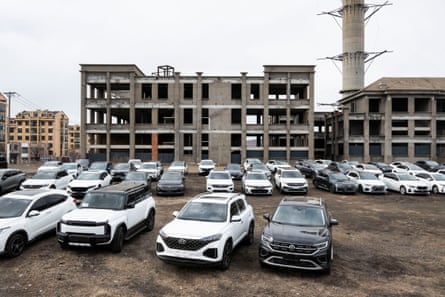
Between 2021 and 2024, Chinese brands’ share of the Russian car market increased from 7% to nearly 60%, according to data from the China Passenger Car Association. In 2024, China sold more than 1m vehicles to Russia, making it the biggest destination for Chinese vehicles, although it has since dropped to second place behind Mexico.
Further volumes have come from the export of China-made, foreign-branded vehicles. Despite sanctions on Russia, tens of thousands of cars from brands such as BMW, Honda and Volkswagen continue to be sold in Russia each year, via third-party Chinese dealerships.
Wang’s BMW, a used model, sold for 120,000 yuan (US$17,600). That is cheap compared with prices in Russia, says the buyer, a Russia-based businessman. And it is too expensive for Chinese consumers, Wang says. It’s win-win.
As much as China has kept the Russian economy afloat, Russian rubles are also sustaining many parts of China, where the economy is heavily reliant on exports and where domestic consumers are unwilling, or unable, to part with their cash.
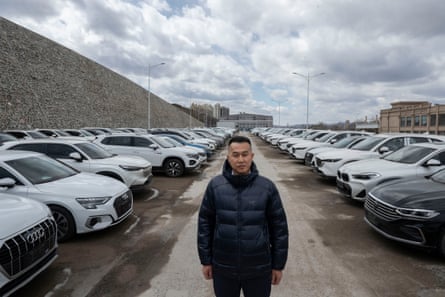
Gao Bin, the boss of Suifenhe Hengchi International Trade, says the company pivoted towards exporting cars to Russia three years ago. The first car they shipped across the border was a black Toyota Camry. “After the war started, there was demand in Russia,” he says. Last year, he sold more than 7,000 cars to Russia, compared with only a few dozen domestically. “Domestic sales have basically come to a halt.”
Suifenhe, a city of just 60,000 people in China’s economically depressed rust belt region, is a microcosm of this relationship. Cyrillic signs are everywhere and prices are advertised in rubles as commonly as in yuan. But most of the shops are boarded up. From certain hilltops you can peer into barren Russian villages (a pair of binoculars helps), although a multistorey observation tower designed to attract tourists has been left abandoned and unfinished for years .
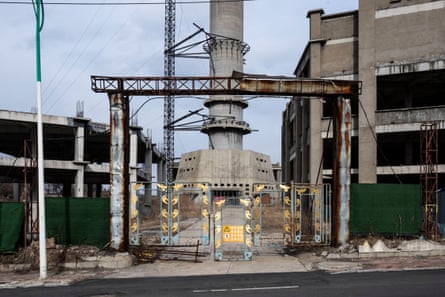
As the first place in China to allow the use of rubles as legal tender, Suifenhe has long been home to a large community of Russian businesspeople and visitors, boosted by the introduction of a visa-free regime for Russian tourists in September. It is just two hours from Vladivostok by train. And according to local businesspeople, Russians are the only ones spending.
Ning Qiang, who runs a beauty salon catering exclusively to Russians, says the number of customers has increased by about 50% since the visa-free policy was introduced. By 5pm on a Tuesday, he had received three clients. “When China-Russia relations are good, life is better for ordinary people,” he says. “Locals in Suifenhe don’t buy much.”
Heilongjiang got a more than 60% boost in visitors from Russia in the first six months of the visa-free policy, according to Chinese state media. Gabuev says the difficulty in procuring European visas is pushing more Russians to travel eastwards. “And they come back mostly really fascinated and willing to come back again. It’s a net positive for the Chinese,” he says.
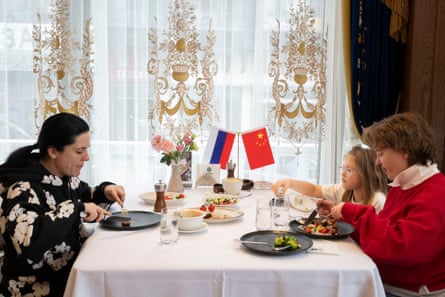
One of the Russians spending her money in China rather than Russia is Mariia Publichuk, a 36-year-old from Vladivostok living in Suifenhe with her eight-year-old daughter. Publichuk moved to Suifenhe last year so that her daughter could study Chinese. The pair spend their mornings at a local primary school surrounded by the chatter of Chinese children. Evenings are spent singing and dancing in Suifenhe’s central square, which echoes with competing soundtracks from speakers dotted across the plaza. “English is the first most useful language in the world,” Publichuk says. “And the second is Chinese.”
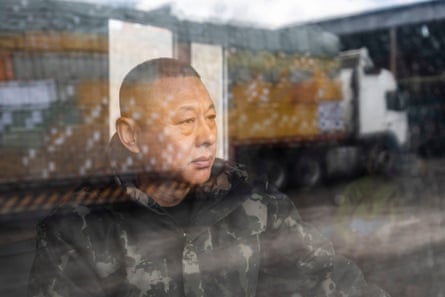
But for anyone whose livelihood depends on yuan rather than rubles, times are tough. The manager of a local logistics hub which handles cross-border and domestic freight says it has been his worst year since he started the job six years ago. The war in the Middle East has pushed up fuel prices for his trucks, and orders are down. “Even during the pandemic … it wasn’t like this,” says Wang, who declines to give his first name. “This year, in every industry … demand in China is decreasing. It’s simply that people don’t have money in their pockets.”
National statistics tell a similar story. Despite the US-China trade war which pushed US tariffs on Chinese goods as high as 145% last year, Chinese goods continue to be shipped overseas at astonishing rates. Last year China’s trade surplus reached a record $1.2tn. In the first three months of 2026, exports were up almost 15% compared with the same period last year, while domestic retail sales in March grew only 1.7% compared with 12 months earlier.
The US president, Donald Trump, left Beijing last week after a two-day summit full of pageantry with promises of “fantastic trade deals”. But there has been little by way of public announcements on tariffs. On Saturday, China’s ministry of commerce said the two sides would establish a board of trade to discuss “tariff reductions” but did not provide further details.
China’s long-term goal is to make the economy less reliant on exports. In March, its premier, Li Qiang, said China “must adhere to the strategic basis of expanding domestic demand”.
Structural problems such as an ageing population, a depressed real estate sector and a lack of consumer confidence after the pandemic all make this transition hard to execute. Exporting goods, whose prices are kept low in part because of China’s discounted energy supplies from Russia, is a lot easier.
Despite the economic slowdown, Beijing still holds the cards in the China-Russia relationship. China has options for international trade that Russia does not. Bloomberg recently reported that 90% of Russia’s sanctioned technology is imported from China. And with Trump in the White House, Xi is under less pressure than ever over his relationship with Putin. The war in Ukraine barely featured in last week’s US-China summit. Trump’s “ask to Xi Jinping to contribute to the peace effort in Ukraine is not a very serious push”, Gabuev says. “Not that Xi Jinping feels that he’s on the hook for that.”
In Suifenhe, even the most ardent Russophiles see Russia as a country in decline, notwithstanding their own city’s beleaguered economy.
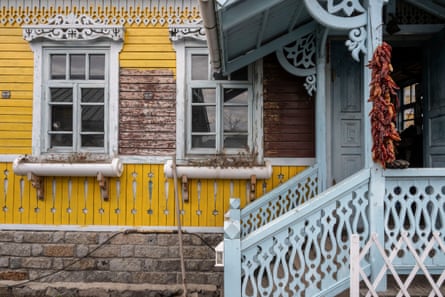
On the outskirts of town, in a crumbling, barely populated village, a house built in the style of a Russian wooden cottage, painted in bright blue and yellow, stands out from the grey. Its inhabitant is Song Lu, a 67-year-old retired artist whose family has lived in Suifenhe for generations. An enthusiast for Russian arts and crafts, he builds models of traditional Russian wooden carriages in his spare time, and has even built a blue tubular sauna in his front garden. “Russians might find it hard to admit, but in reality, China has already become the big brother,” he says.
Additional research by Lillian Yang