.png) 2 months ago
55
2 months ago
55
Desperation seeps out of Peter Shaffer’s 1973 tale of sex, gods and horses. Lindsay Posner revives Equus with precision, as absolute power shifts, homoerotic desire grows and the muscular allure of a stallion becomes irresistible.
Noah Valentine is taut and stringy as Alan Strang, the disturbed 17-year-old who, while working weekends at a stable, blinds six horses. Having refused to explain in court why he did it, Alan winds up in therapy with Toby Stephens’ rumpled psychiatrist Martin Dysart. Alan gets hooked on the attention as their sessions progress, savouring the rush of retelling his story, while Martin begins to lose his power over the boy and his own sense of self.
At the back of the stage stands a line of six silent men, their bare chests streaked with black. These are our horses, their strength shimmering as they roll into position to form one powerful animal under the care of James Cousins’ swirling movement direction. There are no metal horse heads here – a tradition productions of the show often follow – but Paul Pyant’s lighting shines off the men’s bodies in a physicalisation of Alan’s sexual reverence of these creatures. The boy watches the shiftings of their bodies with awe as he rubs down their flanks and leaps, naked and nimble, on to the shoulders of Ed Mitchell, our majestic head horseman.
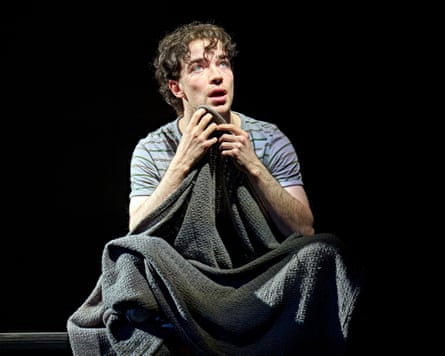
Performed on a thrust stage, with no bad seat in the house, Posner’s production is as solid as its satisfyingly plotted script, but there is no doubt the show flies highest in its most intense moments of beastliness. The ensemble of horses make this possible, but it’s Valentine who convinces. His performance contains both the maturity of intense devotion and the foolish imaginings of a lonely child looking for something to believe in.
How the play came about is worth repeating. Having learned the bare bones of this real-life crime, Shaffer imagined how and why it came to be. Posner’s production leans into the question of where we place blame, with Colin Mace’s stoic father lumping it into the lap of Alan’s mother, a downtrodden Emma Cunniffe. But in Stephens’ shrink we see something deeper and more destructive as he worries about ridding Alan of his demons: a question of what a life is worth if it is lived without a world-burning devotion.