.png) 1 hour ago
4
1 hour ago
4
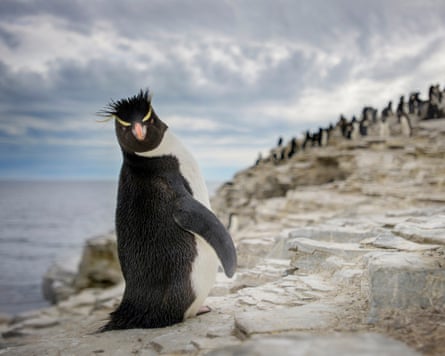
It is among the world’s last pristine wildernesses, with unique coastal waters rich in krill and squid that attract sea lions, elephant seals, dolphins and whales, and where penguins, of which there are five different species locally, outnumber people.
But plans to make the Falkland Islands, one the most remote and furthest-flung British overseas territories, a new frontier for salmon farming has split the 3,500-strong population. Now, people opposed to salmon farming are calling for a referendum because they have lost confidence in a consultation process they claim is biased towards the industry.
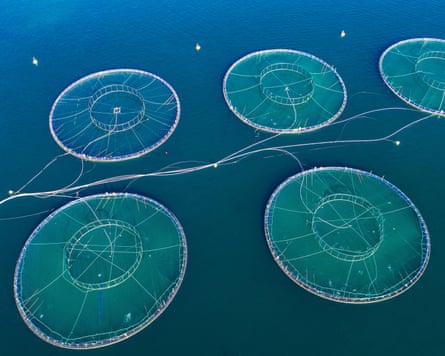
Unity Marine, a joint venture between Fortuna, a local fishing company, and Danish firm F-land ApS, want to farm 50,000 tonnes of salmon annually in 16 locations, in what would be the largest industrial inshore development in the archipelago’s history.
Farming 30,000 tonnes annually could add £35m a year to the territory’s economy, equivalent to 11% of GDP, and provide 133 jobs, according to an assessment commissioned by the Falklands Islands government.
Salmon Free Falklands (SFF), set up by local people to oppose the proposal, said that a referendum will allow residents to decide once and for all, without fear of further challenge.
“It is then the people who will get to decide what happens in their own country,” said Sally Poncet, of SFF. She says she has lost confidence in the consultation process, which began on 7 August and will run until 30 October.
Reports commissioned by the Falklands government as part of the consultation are based on unverifiable data provided by Unity Marine, Poncet claimed. There is “insufficient information” on the impact that the industry would have on the islands, she said. She is also concerned, from researching the impacts of farms elsewhere, that salmon waste would affect the kelp, a spawning ground for squid, a commercially important species and other wildlife, she added.
The government has made clear its reports are at present looking at a number of different scenarios for the proposed farms before it commissions full environmental impact assessments.
Louise Cherry, a former member of the environmental protection authority in Tasmania, Australia, who now runs a consultancy and is providing advice to SFF, claimed the reports, one of which determined the estimated value of the proposal, were “bordering on worthless”.
“The carrying capacity has not yet been determined by a rigorous scientific process,” said Cherry. This refers to how many farmed salmon the area can support. “The regulation and impacts have not yet been costed, so it is not a cost-benefit analysis that the Falklands Islanders can make an informed choice on,” she added.
Missing from the environmental report, for instance, is how any mass mortalities of fish, common in the salmon industry elsewhere, would be disposed of on the remote islands, she said.
Dr Tom Appleby, the head of legal affairs at the NGO Blue Marine Foundation, said: “It is extraordinary that the Falklands Islands government have got themselves in a position where they are providing reports to the public in this consultation that do not use independently verified primary data. The reports are so littered with disclaimers as to the sources of information as to be meaningless.”
Initially, in 2022, the government had said no to the salmon farm. Then, Unity Marine asked for – and was granted – a judicial review challenge on the basis that an island-wide consultation should have preceded the original decision. Both parties then agreed to a consent order which quashed the 2022 decision and outlined the consultation process that is now under way.
James Wallace, the managing director of Fortuna, said: “Unity Marine did not apply for a licence to operate, but rather allowed the Falkland Islands government the time requested to investigate the feasibility of commercial-scale salmon farming in the Falkland Islands, which included determining the social, environmental and economic impacts. The government also requested an indicative business plan from Unity Marine to help provide an idea of what may be possible from the company’s perspective.
“We are now in that investigative process, with independent preliminary reports published and public consultations happening.
“It is our expectation that an informed decision-making process about whether salmon farming at scale is right for the Falkland Islands must include a robust environmental impact assessment, that can answer the specific questions raised by local residents in public consultations to help determine if the risks can be successfully mitigated and that the benefits are truly realised.”
A representative of the Falkland Islands government said that it was “neither advocating for nor opposing salmon farming”.
The reports it had commissioned were “to inform public discussion by examining possible outcomes and impacts under different assumptions, rather than to provide final approvals for any specific project”, the spokesperson said.
The government rejected suggestions that the environmental impacts of salmon farming had not been clearly presented. The carrying capacity report, it said, had been commissioned “purely for demonstrating how the modelling process would be applied to a potential project”, and was not a determination of the carrying capacity of the Falklands. A third report, on socioeconomic impacts, did not quantify future regulatory costs, it said, because they “cannot be accurately estimated” at this stage.