.png) 2 hours ago
7
2 hours ago
7
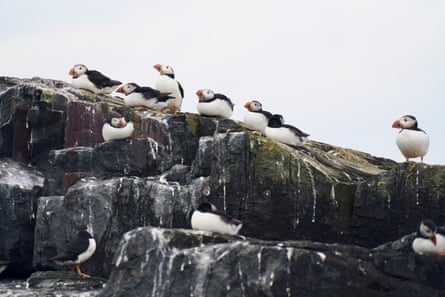
The Farne Islands off the Northumberland coast have long drawn fans of the natural world keen to catch sight of the resident guillemots and puffins.
But as recently as last week, another much bigger black-and-white animal has been delighting wildlife spotters. Orcas have been appearing more regularly than ever before.
In the past, fishers working on these waters may have caught a glimpse of orcas far out to sea, but this year and last, sightings have been more regular, and much closer to the shore, with dolphins also becoming much more common.
Cetacean experts have said it is too difficult to say why orca and dolphin sightings off the Northumberland coast have dramatically increased, but said it could be a welcome sign that the marine ecosystem is becoming healthier.
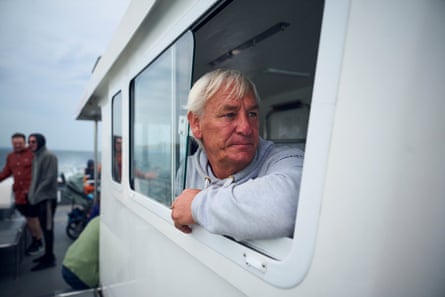
When Andrew Douglas, who owns Serenity Boat Tours, first saw the orcas last year, he said he “was like a little child … excited as hell.”
“And I looked around at everybody else,” he said, “and the smiles are just beaming, and you just think to yourself, that’s what it’s all about.
“The big dorsal fins on the males are just absolutely huge, it just makes you smile, it’s really cool.”
Since then, he and members of his crew have spotted pods of orcas a handful of times – previously, he had only ever seen orcas once, back when he was 20 years old.
Now participants on his tours often ask the same question: “When will we see the orcas?” But, he said, “they’re just unpredictable, so you never know.”
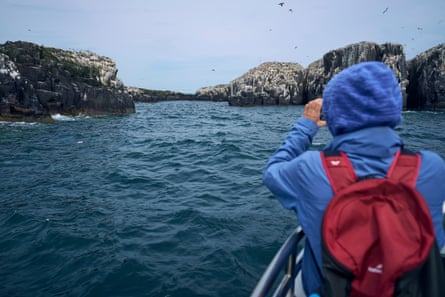
While he said the Farne Islands are an attraction in themselves, he has seen “spurts of it getting a lot busier” since the orca sightings. “Having the orca, it doesn’t half boost things,” he said.
While he is unsure exactly why the orcas are being spotted more often, he thinks a government ban on sandeel fishing may have helped.
“That’s the best thing the government’s done so far,” he said. “They banned it about two years ago, and that’s made a massive difference straight away.
“Not just from the orcas, but from dolphins and other things, you don’t pinch from the bottom of the food chain, you need that bottom of the food chain to get the rest of the stuff working, and it’s made a massive difference for the birds as well, so I think that’s one of the big things.”
Sandeel, he said, are the “tiny, tiny fish” that feed those at the bottom of the food chain, and when you take that away, animals higher up the chain struggle to survive.
“Things have just started to come back,” he said. “So you’re starting to see a lot more mackerel now, a lot of herring now, so I think these orcas are attracted to all that food.”
Crewman Aaron Fordy, who was born and raised in Seahouses, where the boats operate from, has seen the orcas four times now – and he can list the specific dates off the top of his head.
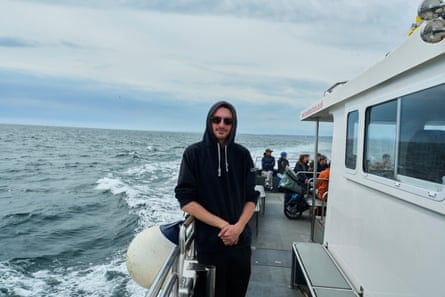
“You’re used to dolphins and porpoises and things which are a lot smaller,” he said, “and then you get an orca which is massive, big dorsal fins, they stick out like a sore thumb as well, just black and white in a blue sea, it’s really cool.”
The first time, he said, he and his crewmate “were both ecstatic”.
“We’re just jumping about, really excited to see them, because of course it’s a first experience for us too,” he said.
They have sent videos of the whales to researchers in the Shetlands, who have said that rather than the same pod returning, the sightings have been of several different pods.
Dr Conor Ryan, an honorary research fellow at the Scottish Association for Marine Science, said there was “not really a clear picture” to explain the increase, and said it could be due to a range of factors, including better publicised sightings, orcas moving inshore, or growing populations.
However, he cautioned that orca have struggled to breed in polluted British waters, and the Shetland population is on the verge of dying out.
He also said the sandeel fishing ban was “a very logical place to look for an explanation”.
“By removing the bottom of the food chain, what we do is we decrease the biomass of the whole system so there’s less energy, less calories available for everybody in the ecosystem, and usually top predators are the ones that really suffer from that,” he said.
He added that studying whales was a good “litmus test for how the ecosystem is doing”.
“And in general,” he said, “if you’re getting big predators returning to an area, that’s a good sign of a healthy ecosystem.”
Julia Sutherland, a researcher at the University of St Andrews, said orca are “highly mobile animals” and “it could be a combination of increase in presence, but it also could be a slight increase in reporting as well, thanks to social media”.
However, she added: “What we know about killer whales here in the UK is we’re lacking so much knowledge in comparison to elsewhere in the world, so it’s quite hard to draw really concrete conclusions at this stage.”
Dr Luke Rendell, also from the University of St Andrews, said “the population of orca around the UK is actually one of the most polluted in the world and so they don’t have a great reproductive potential,” but, he said, “they are exploratory and curious animals.”
“Some of it could just be exploration and expanding their knowledge, some of it could be a reduction in the food resources where they were before and needing to explore more.”