.png) 7 hours ago
9
7 hours ago
9
Duane Michals, who has died aged 94, was a pioneer of the “directorial mode” of photography, known for staging his tableaux and for posing his subjects in a range of roles from an angel to an everyman. The results were a mixture of the profound, the profane and the puckish, tilting at issues of life and death. As Michals was fond of saying: “I think that if you’re a very serious person, it’s very important to be very silly.”
He was inspired by imagery from his Catholic childhood and by surrealism. In Paradise Regained (1968), a man and woman in a sitting room are gradually, in a series of six photographs, divested of all their clothes and possessions (save a clock), as their room becomes filled with pot plants. This Garden of Eden-cum-garden centre is typical of his wit and wisdom, with the plodding story-boarding and seemingly profound engagement offering a sort of “photo-cartoon” philosophical inquiry.
The grim reaper in Death Comes to the Old Lady (1969) wears a suit and whisks her away. Take One and See Mt Fujiyama (1976) culminates in the comedy ending of a man confusing the vision of a snow-capped summit with a stiff lump in his Y-fronts. The Fallen Angel (1968) alights in the room of a sleeping woman whom he seduces – then, plunged into remorse, he sheds his wings and slumps off as an ordinary mortal in a shabby jacket.
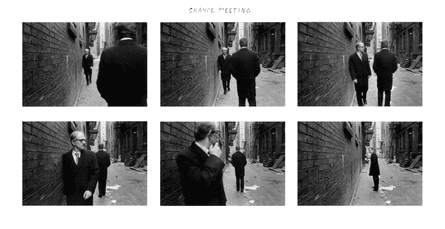
A Letter from My Father (1975) has an earlier portrait of his younger brother standing in front of his parents, coupled with Michals’s writing in despair of his relationship with his father. A Failed Attempt to Photograph Reality (1975) does not even feature a photograph – simply a few lines written on blank photographic paper asserting photography’s inability to do more than record appearances, a dominant theme in Michals’s work. “Photographers are always describing the package very well, but they never talk about the content,” he said. “They show me the what of things but they don’t show me the why or how of things.”
Michals was born in McKeesport, Pennsylvania, a steel town near Pittsburgh, to a family of Czech origin. His father, John, worked in the steel mill and his mother, Margaret (nee Matik), was a housekeeper. Theirs was not a happy marriage. “They pretended to be a family, like actors pantomiming two different plays on one stage at the same time,” Michals said. He revisited his troubled childhood frequently in his work; both at a distance, by looking at his relationship with his remote father, and by returning in later life to his by-then-abandoned family home.
Although raised as a devout Roman Catholic he subsequently rejected religion. At 14 he took a weekly watercolour class at the Carnegie Institute in Pittsburgh, later graduating from the University of Denver with a BA in art, before studying graphic design at the Parsons School, New York.
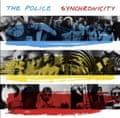
In 1958 he went on a three-week trip to Russia and, with a borrowed camera, took a series of portraits and cityscapes. After the portraits were included in a group exhibition alongside work by the emergent street photographer Garry Winogrand, Michals dropped graphic design and took up photography, working initially on a series of publicity stills for a long-running Broadway musical, which subsidised his early artistic development. He continued commercial portrait photography for much of his career, working for Vogue magazine and undertaking other high-profile commissions, including the cover of Synchronicity, the 1983 album by the Police.
His next series, Empty New York (1964-65), featuring deserted lobbies, vacant bars and bare buses, echoed Eugene Atget’s images of a depopulated Old Paris, the celebrated documentary photography admired by the surrealists.
In 1965 he visited the surrealist artist René Magritte in Brussels and spent a week with him, during which he made portraits using double exposures. Apparently, Magritte showed him home movies and at dinner they would watch the television western series Bonanza dubbed in French. The influence of the surrealists led to Michals disavowing documentary photography, and declaring that “to photograph reality is to photograph nothing”.
He began making sets of charmingly ham-fisted (dramatically and technically) staged photographs to form a narrative or sequence, using double exposures and rudimentary printing techniques.
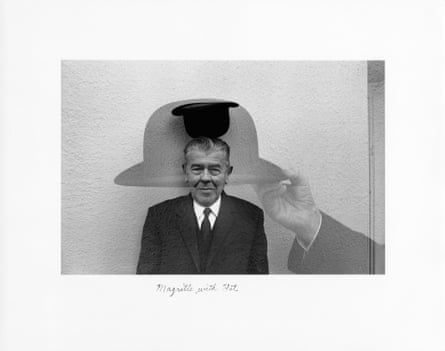
He would also write in ink alongside or on the pictures, grateful that his lack of photographic education freed him from its prevailing strictures: “I didn’t know that you weren’t supposed to write on a photograph.”
Late in his career, when he was 70, and his parents dead and gone, Michals returned to McKeesport to photograph the remains of their home, the house where he was born. The House I Once Called Home is a set of pictures – often in pairs – featuring old prints juxtaposed with images of the house’s overgrown, derelict state. Double exposures show portraits of his parents superimposed on the ruined house. The weight of family and history seems to bear down on the pictures and text, Michals’s memories overpowering his imagination in work that is less playful and spirited than usual.
Michals maintained a polemical attitude towards the photographic establishment. His later work incorporated painting, and several pictures consisted of him painting over the prints of photographers such as Henri Cartier-Bresson. “People believe in the reality of photographs, but not in the reality of paintings,” he said. “That gives photographers an enormous advantage. Unfortunately photographers also believe in the reality of photographs.”
His long-term partner, Frederick Gorree, an architect, whom he married in 2011, died in 2017.