.png) 2 months ago
68
2 months ago
68
Olga Braga’s stark new play, the winner of Theatre503’s international playwriting award, is a grim portrait of war in Ukraine. This smartly wrought and tightly packed production clings to the moments before Russia’s full-scale invasion of the Donbas in 2022, as Braga conjures a bleak microcosm of war in a cramped Ukrainian home.
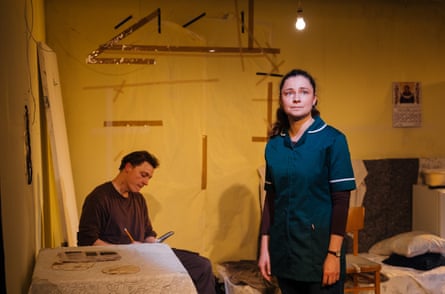
Every element of this sometimes overloaded show works hard, with already high tensions within the household increasing as the external threat of Russian occupation creeps closer. Director Anthony Simpson-Pike makes ambitious use of the small stage in his first show as artistic director, while Niall McKeever’s set feigns simplicity only to rip itself impressively apart when invasion strikes.
Dreams are already shattered when we meet our cast. Jack Bandeira stalks the stage as Sashko, a young man with hungry eyes recently released from a Russian jail. Desperate not to give an inch to the invaders, he clashes with his coiled father Seryoga (Philippe Spall), who is willing to stick to Russian rules if it means getting to live. In a play of machismo and squared shoulders – which on occasion devolve into shouting matches – the finest moments are those of small tendernesses. When Sashko asks his father’s Moldovan girlfriend Marianca (played with appeasing warmth by Sasha Syzonenko) to teach him how to correctly pronounce her name, their shoulders sink into each other in a rare moment of intimacy.
Heritage matters in this house. They speak of “pure-blood” Ukrainians, of neighbours not being welcome because of where they were born, rather than where they have always lived (a jolly Steve Watts and a flirtatious Liz Kettle give a too-brief and much-needed reprieve as kindly neighbours). The play’s urgency is slowed by Sashko’s folkloric stories to calm a neighbour’s silent, watchful granddaughter, while nearby, a gun is trained on the family’s street as Bandeira and Spall double up as soldiers keeping watch in an abandoned house. These secondary characters expand the scope of the play but also stretch its heart; they are somewhat thinly drawn to pack in all the action, with not enough time given to feel individual agony.
In Sashko’s stories, he explains what it means to have a good death rather than a wasted one. By depicting the random ugliness of war, Donbas reminds us that this meagre hope is just another story we tell ourselves to get by.