.png) 1 month ago
60
1 month ago
60
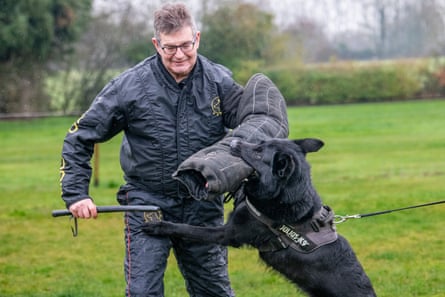
Even if you’re not afraid of dogs, you might be a little intimidated by Butch Cassidy. His tail may be wagging, but the Belgian shepherd weighs 40kg and moves with awesome agility. Even a casual brush of his body could knock you off your feet if you weren’t expecting it. “I don’t for a minute think he’s going to bite anyone,” said his owner Grahame Green earlier. “Although he would, if I asked him to.” Now Green’s about to demonstrate.
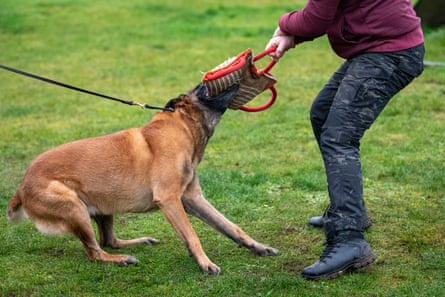
He brings Cassidy to heel, and gets him to sit. Facing them is another man, Florin, already braced and wearing a protective arm sleeve. The dog is visibly quivering with excitement, so keen is his anticipation for what comes next. Green gives a one-word command, in German. Cassidy darts forward, an auburn arrow, and in that split-second clamps on to Florin’s forearm. Florin is engaging every muscle to remain upright, but Cassidy does not let go until Green gives the word.
Both men are experienced dog handlers, and Cassidy is under control. Still, it is not hard to imagine how even a highly trained animal such as this might misfire in an unpredictable situation, or less confident hands – and chilling to imagine the outcome.
Yet “personal protection dogs” like Cassidy are bought, sold and trained every day in the UK. At the top end of the market, purpose-bred animals trained to bite, hold and release on command are sold for tens of thousands of pounds, marketed as family pets that double as live-in security solutions. Demand for these dogs, once the preserve of the ultra-rich and security professionals, seems to be growing, fuelled by celebrity endorsements, social media and widespread anxieties about crime.
This is also a largely unregulated corner of dog ownership, raising difficult questions about public safety, animal welfare and where responsibility lies when a dog trained to protect ends up causing harm.
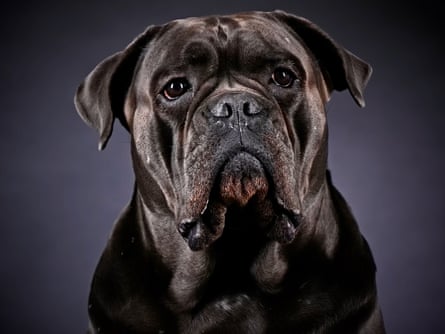
The premium tier of protection dogs are purpose-bred German shepherds, Belgian malinois like Cassidy, dobermans, rottweilers and cane corsos, trained to respond to perceived threats, deter intruders and even physically restrain them on cue.
Among those who have bought such dogs in recent years are former pop stars Rochelle and Marvin Humes, reality TV personalities Molly-Mae Hague and Katie Price, actor Barry Keoghan and a number of footballers, including John Terry, Rio Ferdinand, Marcus Rashford and Raheem Sterling. Many were motivated by recent burglaries or other security threats. Australian fitness influencer Kayla Itsines, who acquired two dogs from a UK-based company after being stalked for months, said in a promotional video that she had “never slept more soundly”.
These high-profile endorsements seem to be driving mainstream interest. “Demand has increased, without a doubt,” says Alaster Bly, founder of the company K9 Protector, which has supplied dogs to Olympic athlete Mo Farah, singer Alexandra Burke and a former prime minister Bly won’t name.
While most of his clients are wealthy or in the public eye, Bly says he has seen growing interest from people who aren’t obviously either, wanting “to make an investment in security”. K9 Protector breeds and trains its own dogs, selling between 40 and 60 animals each year. Most are German or Belgian shepherds, or Bly’s own “chimera” hybrid: a “very specific genetic combination” he developed for higher-risk environments. Pricing depends on the dog’s level of training and the buyer’s threat profile, but chimeras start at £32,000.
At the other end of the market, trainers advertise “personal protection” courses for existing pets. The result is an expanding spectrum of animals marketed as protection dogs – with next to no consistency in training standards, oversight or expectations of the people handling them.
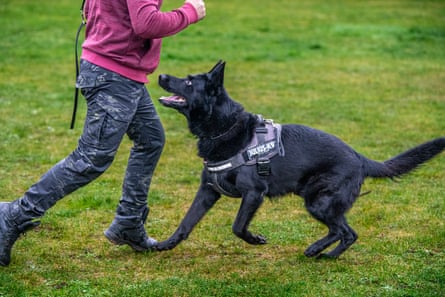
Personal protection dogs are legally ambiguous. They do not fall under the Guard Dogs Act, which governs working guard dogs used to protect commercial premises or security personnel. “Legally, they are treated in exactly the same way as any other dog,” says Sunjay Versani, a criminal defence solicitor at Duncan Lewis Solicitors. “What matters is the dog’s behaviour and level of control exercised by the owner, not how the animal is marketed or labelled.”
Dog attacks have continued to rise in recent years, though protection dogs aren’t distinguished within official statistics. Premium suppliers often argue that their dogs are highly socialised and disciplined to attack only on command, and as such are safer than untrained pets. But whether someone has legitimate reasons for wanting such an animal, or the competence to control one, is largely left to the discretion of individual breeders and trainers.
Versani says training a dog for protection purposes can even increase an owner’s criminal liability, “because it may be treated as evidence that the dog was being used as a weapon, rather than as a pet”. Standard home and pet insurance policies typically exclude dogs trained to bite, exposing owners financially as well as legally.
And when any dog attacks, regardless of circumstances, it is often the animal that pays the price. In 2020, the Royal Society for the Prevention of Cruelty to Animals received two complaints about protection dogs; last year, that increased to 39. Most related to dogs being trained with force or coercion.
“We are worried that this is becoming an emerging trend,” said Dr Samantha Gaines, head of the RSPCA’s Companion Animals Science and Policy department.
Green, Cassidy’s owner and a professional dog trainer with decades’ experience, is already seeing the rise in interest. Most of his business at Norwich Dog Training School is obedience training for family pets and puppies. As a former security professional, he also has experience with guard dogs.
On his website, Green is forthright about the risks and responsibilities involved in owning a personal protection dog, and explicitly discourages members of the public who might be interested. His own passion (and his and Florin’s reason for training their dogs in protection) is for Schutzhund, a specialised (and regulated) working-dog sport developed in Germany.
But even in suburban Norfolk, Green receives regular inquiries from local people wanting him to train their dogs to protect them, and even to bite on command. “Most of them are idiots,” he says. “They’ve just got no clue as to the work involved. And why would you want one in the first place?”
The breeds most commonly used for protection work are not prohibited under the Dangerous Dogs Act; they are, however, large, powerful animals and potentially challenging for inexperienced owners. Since the XL bully ban, cane corsos in particular have reportedly become more popular, showing how demand for “status” dogs can shift in response to regulation. Protection training offers another outlet for owners wanting a dog to intimidate others, or project power and control.
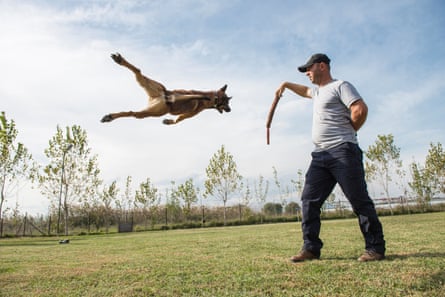
Green blames the growing mainstream demand on social media, spreading performative displays of canine power and aggression. Online, he says he’s seen dogs trained to bite areas other than the forearm, framed as sport or self-defence. In the US, canine “protection sports”, a modern and more extreme evolution of Schutzhund, are gaining popularity.
Green links that to people who have contacted him about protection training and boasted about their dogs’ alleged power and “bite pressure”. “They want to look big and tough and macho … It’s all an ego thing.”
He will occasionally agree to teach dogs to bark on command, as a relatively safe way of increasing peace of mind. But many of the animals he’s asked to consider are clearly unsuitable candidates and may already pose a risk to public safety. More often than not, he argues, people seek out a protection dog as a status symbol, overlooking the very real risks. Once a dog undergoes protection training, “it’s no longer a pet”, he says.
None of Green’s dogs has ever bitten someone outside training or demonstrations, but he says he has had some close calls with strangers taking them by surprise or behaving in ways the dog could have construed as a threat. “With a few choice words to the individuals and to my dog, I was able to manage the situation safely.” But, Green adds, the same couldn’t be said of all protection-trained dogs in similar situations.
Alaster Bly of K9 Protector does not deny there are potential risks to protection dogs, but says that his pose no greater threat than the average pet. A former police officer, Bly established his business 17 years ago. Personal protection dogs were already “big business” in the US and Bly saw an opportunity in the UK.
Most of his clients approach him after experiencing a burglary, stalking or other traumatic event, Bly says.
K9 Protector has clients across London and the home counties as well as overseas. Bly says he has placed 20-odd dogs within a five-mile radius in north London, after a spate of burglaries. He has also just sold a dog to a Formula One driver who was informed by police that his home was being targeted by an organised crime gang.
The uptick in inquiries he has received this winter alone has led Bly to review his offering. K9 Protector is now breeding and training what he calls “high-threat-environment dogs”, capable of taking on multiple intruders and responding to weapons. The company markets its animals as “the sword at your side”. “We try to prepare the dogs for any eventuality,” Bly says.
He believes it is “just a matter of time” before one is injured or killed in an altercation. “Ultimately, they are being bought with the viewpoint that they may have to place themselves in harm’s way.” At the same time, Bly downplays the risks they pose outside that worst case scenario. The training they receive to bite, hold and release on command is “more of an obedience exercise”, like recall, than it is “forward aggression”, he says.
Bly estimates that 1% of the dogs he sells each year will bite and hold or fight with an individual within the first 12 months of ownership. “The barky, bitey bit is [only] a percentage of what we do,” he says: equally important is that his K9 Protectors are stable, “thoroughly sociable, and able to be taken anywhere”. The vast majority of the time, they serve as deterrents and often cherished family pets. Every dog sold undergoes annual top-up training, while owners are offered ongoing support.
Responsibility, in Bly’s view, lies less with the concept of protection dogs than with who is breeding, training and selling them. “Any dog that isn’t trained in the right way, be that a pet or a protection dog, is potentially a threat to the public.” K9 Protector carries out basic searches on potential owners, and sometimes enlists an external company to do further checks. “If we’re not happy with the individual’s character, we can go a little bit deeper,” says Bly. One prospective client was revealed to be a “career criminal”: “We refused to sell him a dog, and that was the end of that.” But, he allows, there is no guarantee that someone else didn’t.
Not long after founding K9 Protectors, Bly says he tried to gather others in the industry to establish a regulatory body and minimum standards for welfare, training and breeding. “I couldn’t get everybody on the same page.” Back then, there were only a handful of protection dog providers; now there are dozens. Some are not “morally correct”, says Bly, selling unhealthy or unstable dogs to people who might be afraid for their safety or otherwise vulnerable. He supports greater regulation to protect consumers. “The only thing people have got to fall back on is trading standards … It is a bit of a minefield.”
Yet even the most robustly trained protection dog remains an animal, with instincts and unpredictable impulses. For Samantha Gaines of the RSPCA, it raises the question of whether dogs should be used for “personal protection” at all. “The real concern here is that you have dogs who are being treated, ultimately, as security equipment or tools for defence. Dogs are sensitive beings; they’ve got their own emotions, preferences, wants and needs,” she says. Dogs are also individuals and change over their lives. “This idea that they will consistently and reliably behave in accordance with how they’ve been trained is actually misguided … They’re not robots.”
The demand also risks incentivising irresponsible breeders and trainers, and further commodification of animals. “Even if people had realistic expectations about what it means to bring this type of dog into their home, we would still have concerns, just because of how the industry is operating … It’s incredibly difficult for anyone to navigate,” says Gaines.
The RSPCA supports introducing licensing for dog owners; Gaines suggests a tiered system could be one way to keep track of those with protection animals, and dissuade others from taking them on. Greater regulation of breeders and trainers could also better ensure welfare.
But in the bigger picture, Gaines says, the RSPCA would be inclined to argue against using dogs for protection at all. “There are alternative security measures that are much, much easier.”