.png) 2 hours ago
9
2 hours ago
9
The number of deaths recorded in France surged by nearly 30% during the hottest week of the record-breaking heatwave that scorched much of Europe last month, the public health authority has said, adding that it expected the toll to rise further.
Public Health France said on Friday there had been “an increase of 29.1%, corresponding to 2,025 additional deaths compared with the previous week”. It said the figure was probably an underestimate and “mortality will rise further”.
The new and still incomplete figures doubled the preliminary estimate of at least 1,000 additional deaths given by the authority last Sunday. That earlier estimate covered just three of the hottest days of extreme heat.
Belgium’s health ministry said excess mortality totalled about 1,200 between 18 and 29 June, with 530 of the deaths among people 85 or older. The Dutch government said the heatwave had led to about 480 excess deaths, mainly of elderly people.

The updated French tally covers the week of 22 to 28 June, during which France registered its hottest-ever days, with previous day- and night-time highs shattered in cities and towns across the country. Hundreds of records also fell in other parts of Europe.
Public Health France said it had counted 8,973 deaths so far for that week but cautioned that the number was still only partial. It said the preliminary total was 29% more than the 6,948 deaths registered for the previous week of 15-21 June.
It said the increase was concentrated almost entirely among people aged 45 and over, with the over-65s worst-affected. “Although we are seeing a clear rise among 45- to 64-year-olds, people aged 65 and over account for the largest share of deaths,” it said.
Deaths in the home recorded the biggest increase, nearly doubling within a single week, and Paris was the worst-affected region; the number of deaths recorded in the capital rose by 62% week on week, Public Health France said in its weekly report.
Nicolas Revel, the director general of the Paris public hospital system, has said he expected the death toll from the June heatwave to be lower than that of 2003, but “probably” higher than an extreme heat episode last year that claimed 5,700 lives.
after newsletter promotion
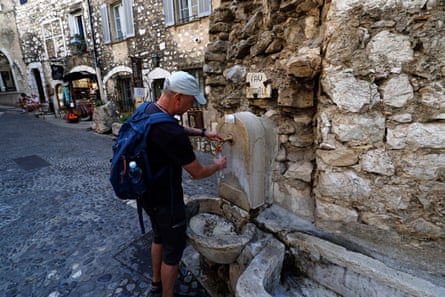
More than two-thirds of Europeans experienced 35C-plus temperatures during the June event, AFP said, basing its calculations on temperature data from the European Drought Observatory and population figures from the Joint Research Centre.
The environmental consequences of the extreme heat have been felt across Europe. In Italy, droughts have left several waterways in a “critical state”, according to the Po River Basin Authority. Lake Maggiore, at the foot of the Alps, is only 48% full; elsewhere, dry sections of the Po riverbed have been left exposed. In response to the drought, the Veneto region declared a state of emergency on Thursday.
The heat has also caused a Glacier Loss Day on 29 June on Switzerland’s Rhône Glacier, causing excessive melting of decades or centuries-old snow. The resulting water could have filled an Olympic-sized swimming pool every 6 seconds for two weeks, Matthias Huss, director of Glacier Monitoring Switzerland, told Reuters.
Elsewhere, all-time temperature records were broken in Germany, Poland, Slovakia, Czechia and Hungary, as well as June records in the UK and Switzerland, while France’s average temperature measured across the country also hit an absolute high. These temperatures would have been virtually impossible in June without climate change, say climatologists from the World Weather Attribution.