.png) 3 months ago
73
3 months ago
73
Many musical instruments are basically bits of hollowed-out wood, and if you think of it that way then the four played here by the enduringly experimental Brodsky Quartet and William Barton – violin, viola, cello and yiḏaki, or didgeridoo – don’t seem such distant cousins after all. This programme, already widely toured outside the UK, is well run-in – a good thing, considering that Barton’s didgeridoo was stuck in airport baggage control and arrived at the venue barely half an hour before the concert. It mixes up the two hemispheres in unapologetically eclectic fashion. Barton’s opening didgeridoo monologue segues into a Purcell Fantasia, and Robert Davidson’s Minjerribah – a lyrical evocation of place in which the didgeridoo, although a later addition by the composer, seems an essential and persuasive voice – rubs up against the yearning spikiness of Janáček’s String Quartet No 1.
It was Barton whom we heard first, offstage. Through a soundscape of whistles and pulsing low notes, he conjured a sense of vastness that spoke to the feeling of space under the Temple church’s arches. Throughout, the building’s warm acoustic seemed to render everything beautiful even at moments when, in the Janáček in particular, the Brodskys might have been aiming for more harshness. And it helped carry viola player Paul Cassidy’s voice as he sang his own arrangement of She Moved Through the Fair, the other performers weaving atmospheric detail around him. This established a fitting folk-song context for Barton’s own, weightier Square Circles Beneath the Red Desert Sand, which followed with Barton as vocalist and player.
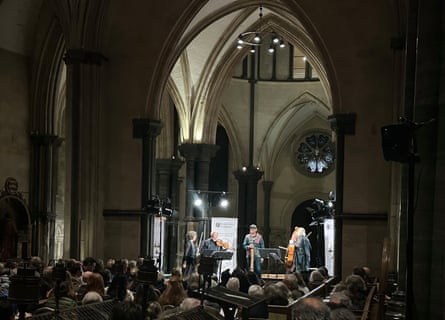
Barton had a long and fruitful association with Peter Sculthorpe, the most influential of composers in creating an Australian idiom in the concert hall. Sculthorpe’s Jabiru Dreaming was a highlight here, its restless propulsion subtly emphasised and deepened by Barton’s contributions. Salina Fisher’s Tōrino, for quartet alone, was a skilfully textured recreation of the sounds of the pūtōrino, a Māori wind instrument. Eden Ablaze, written for these players by Andrew Ford, lamented the bushfires of 2019-20 first through an otherworldly quotation of Handel’s Ombra mai fù – an aria hymning the shade of a tree – then in scurrying spark-like phrases, and finally in sounds evoking stillness and absence. The encore was a return to Sculthorpe. His song-like piece From Nourlangie found Cassidy, Barton and cellist Jacqueline Thomas providing the ethereal swoops with which Sculthorpe so vividly evokes bird cries, wheeling around the violin melody: brief, breezy and beautiful.