.png) 7 hours ago
6
7 hours ago
6
Midway through the largest British concert ever staged by a Latin-American artist, a giant cartoon toad appears on the big screens and admonishes those in the crowd who can’t speak Spanish: “You’re missing the message,” it warns. The giant cartoon frog has a point. Bad Bunny is given to lengthy between-song chat, delivered in his native tongue, which apparently cover everything from the recent earthquake in Venezuela to what seem to be subtly pointed remarks about the importance of people and places: his current world tour declines to take in the United States on the grounds that it might attract the attention of ICE, a not-unreasonable assumption given the tantrum thrown by Donald Trump over the singer’s headline appearance at the Superbowl half-time show (a tantrum, it’s worth noting, that helped propel Bad Bunny’s albums into the British Top 10 for the first time).
Equally, the cartoon toad needn’t have worried. For one thing, there are so many representatives of the diaspora in the crowd that his Spanish monologues are noticeably more warmly and loudly received than his solitary announcement in English. And, for another, if his show proves anything, it’s that you really don’t need to understand the lyrics to grasp why Bad Bunny has become one of the biggest stars in the world. It’s split into two distinct sections. The first presents Bad Bunny as a traditionalist, fronting a live band and, at one point, a platoon of salsa dancers: his take on the genre nevertheless takes in a lengthy – and surprising proggy – synthesiser solo at the start of Baile Inolvidable and an equally lengthy solo on a 10-stringed Spanish guitar that devolves into a cover of Hey Jude.
The second underlines his abilities as a beat-focused, tracksuit-sporting party starter of a noticeably different cast to the guy who’s just performed the ballad Turista in a cream suit and tie: the latter is ice-cool – between songs, he has a habit of staring impassively around the stadium and occasionally exhaling heavily, as if he’s pricing the place up for a redecoration – while the latter is a swaggering, kinetic performer, much given to grabbing his privates as he sings. It’s set in a replica of a Puerto Rican house at the rear of the stadium, complete with satellite dish and air-con unit on the roof where he will ultimately perform. Before that, he sings from within a chaotic throng of dancers on the house’s veranda, complete with an unexpected appearance from Novak Djokovic and a DJ who you can only describe as stoic, capable as he apparently is of seamlessly keeping the beats going while a lady vigorously twerks around his crotch.
In a sense, this staging is a risk – for lengthy sections, Bad Bunny is hidden from most of the audience, only visible on the venue’s screens, singing as he barges through the revellers – but it works incredibly well. The footage looks authentically like a party, chaotic rather than choreographed, while the rest of the stadium is strafed with lasers and lights, the stands are illuminated by flashing LEDs on the fake cameras audience members wear around their necks and fireworks continually shoot from the roof; the crowd on the pitch dance with each other rather than watching intently: it feels more like a being at a rave than a gig per se.
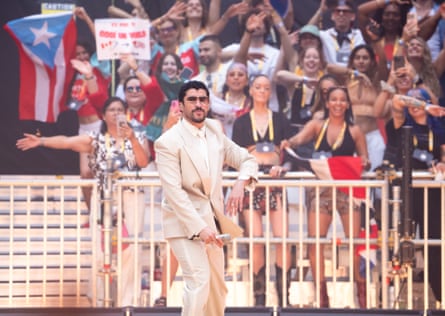
It helps that the music is uniformly fantastic. The electronic section has a relentless, urgent power, tracks breathlessly eliding into each other: the Get Ur Freak On-indebted Safaera, the light-speed Cybertruck, Monaco, with its warped sample of Charles Aznavour emoting his way through Hier Encore. But it’s no less thrilling than the set with the live band, who are spectacularly tight, but impressively exploratory. Watching them watching each other for cues as the musicians solo during NuevaYol, you’re struck both by the sense that you’re seeing a band actually playing live, in the moment, and the realisation that this is something you almost never see at a gig this big, stadium shows tending to be preordained, composed to the last second. You’re also struck by how little Bad Bunny has needed to adapt what he does for global success: this is resolutely not music you could freight with the kind of accusations of pandering to anglophone listeners that have recently been levelled at K-pop artists. Instead there’s a take-it-or-leave-it quality at its centre, which is both bullish and entirely warranted: who wouldn’t opt to take it if it’s this exciting?
At one point, he heads towards the front row and starts high-fiving and shaking fans’ hands at the crash barrier that’s almost obligatory at a stadium gig. But his approach is noticeably different: he keeps stopping and talking to people: frequently, the conversations seem to be remarkably in depth. The mid-show meet and greet thus goes on for a very long time, so long it should theoretically disrupt the flow of the gig, alienating the rest of the audience: who knows what he’s saying down there? Instead, it has the opposite effect: it feels genuinely moving, rather than performative, another example of Bad Bunny doing things his way, which, it transpires, is exactly the right way.