.png) 3 months ago
85
3 months ago
85
In the world of magazines, when someone announces they’re leaving a job, their colleagues will traditionally present them with their own personalised mock-up of the magazine’s front cover. Perhaps their face is superimposed on the body of a previous celebrity cover star. There are probably some witty cover lines referencing memorable office moments or their favourite snacks. It’s a rite of passage – and this week, Anna Wintour was bestowed with her very own cover. But instead of a jokey imitation bidding her adieu, it was the real, glossy deal, coming to a newsstand near you on 28 April.
In a somewhat surprising effort to promote the forthcoming The Devil Wears Prada 2, Vogue’s May issue sees Wintour share the cover with Meryl Streep, whose steely Miranda Priestly, editor-in-chief of the fictional title Runway, is said to have been inspired by Wintour. “Seeing Double. When Miranda met Anna” reads the cover line. While Wintour has fronted various industry titles, including Interview in 1993 and Ad Week in 2017, it’s the first time an editor has placed themselves as the subject. In another fun twist, both Wintour and Streep are wearing Prada.
First teased via Vogue’s Instagram on Tuesday, within seconds the image had gone viral, amassing, at the time of writing, more than 1.2m likes. “Maaj” commented the model Gigi Hadid. “Just so good” added the actor Mindy Kaling, while the 10k-plus other comments from the general public span everything from “Actually groundbreaking”, in reference to Priestly’s immortal florals line from the original film, to “Getting this framed”.
Rather than just plugging the highly anticipated sequel, though, Wintour’s newsstand appearance serves as something more significant (of course it does, this is Wintour we’re talking about): it’s her own personal power move, and a klaxon for the next phase of Anna Wintour. The cover comes just 10 months after she announced she was “stepping back” as editor-in-chief of Vogue and six months after she promoted Chloe Malle to head of editorial content. What better way to affirm that she is still very much in control of the magazine she has helmed for close to four decades than by appearing on its cover?
When Wintour first revealed she was relinquishing her editor-in-chief title, many misconstrued it as a step down. Her cover appearance now hammers home that it was no such thing. Her current role as chief content officer for Condé Nast and global editorial director for the magazine allows her to retain the ultimate authority while leaving the day-to-day running to Malle.
Mark Borkowski, a press consultant and author, describes Wintour’s appearance on the cover as “a hell of a smart move”. “This is very much about Wintour not letting go of her power,” he says. “A lot of people in these types of jobs recognise they are sitting in a chair that has power. Wintour doesn’t believe that. She believes she is the power. She’s not a personality that’s going to fade away into the background.”
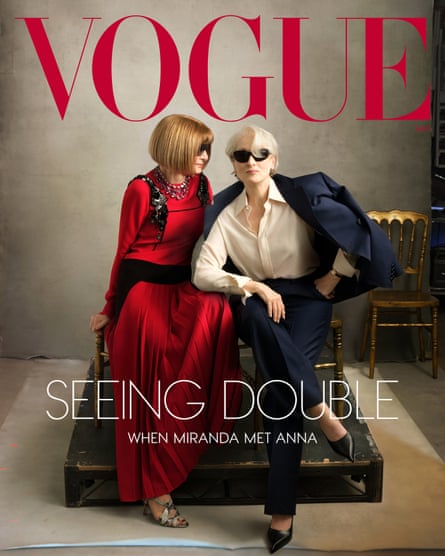
Even the ideation of the cover hints at the authority Wintour still wields. Writing in her editor’s letter, Malle outlines how it came about. She was in the backseat of Wintour’s personal town car (a nice power play by Wintour, and reminiscent of the first film) running ideas for the next batch of covers past her (a tacit hint that all the big decisions still need to be approved by Wintour) when Malle first suggested the idea. Wintour initially shot it down, saying: “That’s very flattering, Chloe, but it’s not really my style.” It then, so the story goes, fell to Streep to persuade her. Wintour called the Hollywood star directly (another not-so-subtle power move).
Wintour was dismissive of the first film when it came out in 2006. Although she did attend the premiere – wearing Prada, no less – she was cagey about her reaction. In 2024, at the opening of the musical version in London, she told the BBC that it was “for the audience and for the people I work with to decide if there are any similarities between me and Miranda Priestly”.
However, more recently she has seemed happier to engage, suggesting that Priestly is very much “a caricature” and a highly enjoyable and very fun one at that. The various social media videos that accompany the shoot drive this idea home. Streep stays in character, while Wintour plays herself. We see her fumble her lines and get the giggles. She is warm and witty, a sharp contrast to the icy Priestly.
We first saw her toy with the idea at the Oscars in March, where she jokingly referred to Anne Hathaway as “Emily”, a nod to Emily Blunt’s character in the film. Meanwhile, the next read in the Vogue Book Club is the novel by Lauren Weisberger that inspired the film. Borkowski suggests these stunts hint that Wintour is beginning to separate herself from brand Vogue. “Her life has been defined by Vogue,” he says. “Back in the day she was recognisable by a very distinctive haircut and a pair of dark glasses. She was a cypher. But now it’s all about the narrative of the personal brand.” She is, he says, “getting involved in the film because she sees it as something that can establish Anna Wintour, the brand”.
Amy Odell, the author of Anna: The Biography, also suggests it allows Wintour to alter her legacy. In her Back Row newsletter, Odell writes: “Anna is a visual editor above all else – a brilliant one – who understands that these images and viral moments have the effect of washing the other stuff away.” She compares it to “the way Hillary Clinton’s 1998 Vogue cover served as a corrective around the time of her husband’s scandal. Or the way Kim Kardashian and Kanye West’s cover in 2014 made audiences forget about Kim’s tackiness, anointing her – to great personal profit – as a fashion person.”
While Wintour is keen to separate church and state, there are still some overlaps between the film and her reality. “Truth is, there is no one who can do what I do,” quips Priestly in the first film. Twenty years later, with everyone talking about her Vogue cover rather than the final trailer that came out the same day, perhaps the same could still be said of Wintour.
To read the complete version of this newsletter – complete with this week’s trending topics in The Measure and your wardrobe dilemmas solved – subscribe to receive Fashion Statement in your inbox every Thursday.