.png) 1 month ago
53
1 month ago
53
Who was the best Brazilian player of all time? Pelé comes the answer. Argentina? Maradona or Messi. Hungary? Puskas. Holland? Cruyff. Germany? Beckenbauer. Portugal? Eusébio or Ronaldo – take your pick. France? Zidane? England? Perhaps Bobby Charlton?
What about the best Jewish footballer ever? Gotcha! That’s one to send even a group of the most historically literate Jewish football nerds into a prolonged silence. Not even a semblance of a suggestion is likely to emanate from their lips. Maybe they will break into a smile to indicate that we Jews are not very good at football, so choosing the best is probably a pointless exercise anyway, because the best would be rather bad in the broader scheme of things.
If you had asked me that question several years ago, I would also have drawn a blank and produced the same sardonic grin. But having now read a considerable number of contemporaneous press descriptions of top Jewish players, I can attempt an educated selection, even though the task is difficult because the standard is in fact extremely high and the competition intense. In the end, it boils down to a choice between two outstanding talents – Kalman Konrad and Jozsef Braun, both right-sided attacking players from Hungary.
My instinct would be to plump narrowly for the latter. Braun was the youngest of 12 siblings from a very religious Jewish family from the small town of Putnok in the north of Hungary, on what is now the border of Slovakia. Such was his immense ability that at the age of 17 he was selected for the national team of Hungary, then and for several decades afterwards among the elite footballing nations in Europe. Lightning quick and technically gifted, his displays of footballing genius and glittering international career were cut short in his mid-20s by a succession of injuries inflicted by vengeful defenders.
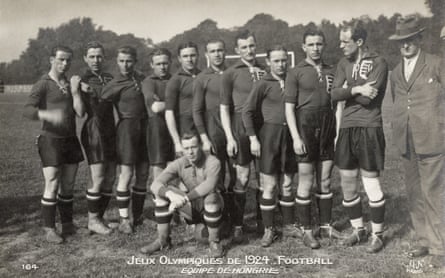
By the age of 41, Braun had been murdered, beaten to death as a slave labourer in the snow of a brutal Russian winter by Hungarians who, less than two decades previously, had perhaps spent evenings with their friends talking excitedly about his feats on the football pitch. The last image we have of Braun is of those same Hungarian guards crouching over his lifeless body, prising open his mouth to extract gold teeth.
Braun was not serenaded by tributes after his death like Eusébio, Johan Cruyff and Diego Maradona were. No public announcement of his death was broadcast. Proud Jews have never lauded his memory, as Hungarians born long after Ferenc Puskas retired may wax lyrical about his talents, or as old Brazilians may tell their young grandchildren that nothing will ever quite beat watching Pelé. Most of the people who might have gone all dewy-eyed about Braun left this earth pretty much around the same time that he did, along with their children or grandchildren, and the latter’s dreams of having their own children and grandchildren. Thus, the story pretty much stopped in its tracks.
This is what genocide does. It eliminates not just the people, but the stories of those people among those who continue to live. The European Holocaust did not only account for the murder of six million Jews, but also shattered the chain of Jewish collective memory to such an extent that if you throw up the name of Jozsef Braun as a quiz question to those aforementioned Jewish football fanatics, they might well hazard a guess that he was the man behind a famous electronics company, an enemy of five o’clock shadow rather than bewildered full-backs.
Several years ago, I wrote a book about Bela Guttmann, one of the greatest coaches that football has ever produced. I loved discovering the story of Guttmann, a highly charismatic and influential Jew from Hungary who recovered from the trauma of the Holocaust to reach the top of his trade.
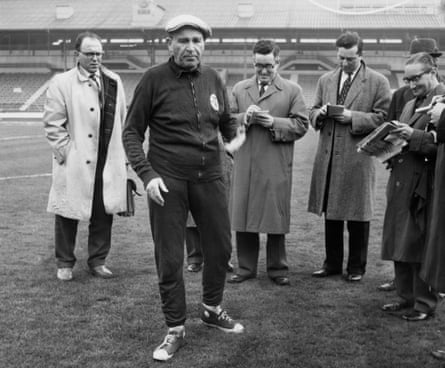
Guttmann’s story was breathtaking enough, but I was even more transfixed by the remarkable wider story that hit me between the eyes as I ploughed through the research. Namely, the huge role European Jews played in football in the years before the catastrophe – the panoply of top players, the innovative coaches who revolutionised training and on-field tactics, the extraordinary personalities, the proud network of Zionist teams, the ubiquitous club presidents and investors, the administrators who played a key role in professionalising and internationalising the sport, the hordes of passionate fans, even the elite referees. I felt as if I was on an archaeological expedition, digging deep to reveal a few vestiges of a destroyed society, in particular its fascination for a game in which so many of them excelled.
After the book was finished, I started to think of an entirely separate subject to research and write about. After all, had I not already written about the European Holocaust and the Jews devastated by it? But the problem is, when you have entered the subject of the Holocaust in any depth – its bestiality and heroism, the sheer scale of the mass murder right in the middle of supposedly civilised Europe – then little else can compete. I was also mesmerised by the vision, denied to my generation in the real world, of a Europe with millions of highly productive and creative Jews, whose subsequent absence has completely and irrevocably transformed the continent’s character.
In my spare time I started writing and collecting biographical summaries of Jewish footballers and coaches, with often big question marks at the end querying an eventual fate still shrouded in mystery 80 years on. I also read up as much as I could about Jews in other sports, such as the boxer Salamo Arouch from Salonika in Greece, who won 200 bouts in Auschwitz on pain of death just to provide entertainment for the guards and who then lived out his life as a manager of a shipping company in Tel Aviv; or the world-record-holding swimmer Alfred Nakache, a French-Algerian Jew who emerged from the camps at Auschwitz and Buchenwald weighing 42kg (about six and a half stone) and mourning his murdered wife and two-year-old daughter, only to break another world record the following year.
There are enough similar jaw-dropping stories about Jewish sporting personalities and the Holocaust to fill a good number of bookshelves, many of them barely known. My own attention, however, became especially and increasingly drawn to the many among them who did not live to tell the tale. The against-all-the-odds stories of Guttmann, Arouch and Nakache, and of the other remarkable survivors we see or hear in now rapidly declining numbers on Holocaust memorial days, may offer hope and generate supreme admiration.
But I began to feel that, for all the school courses, films, books and television programmes, what many people understood by the Holocaust did not reflect the widespread reality, one often of almost complete obliteration. The Guttmann story represented the exception; I now felt a strong compulsion to write about the rule.
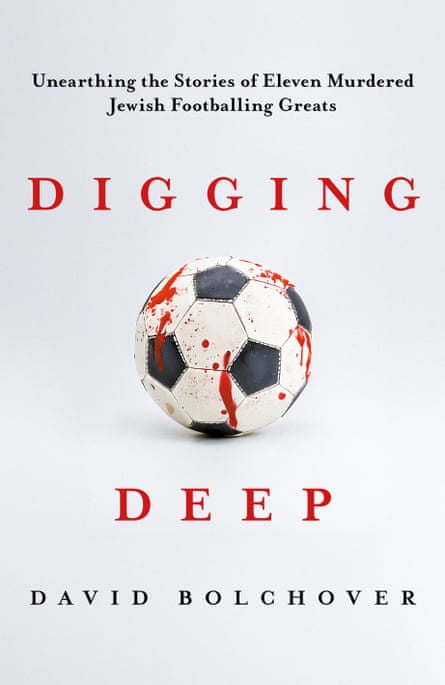
This is an edited extract from Digging Deep: Unearthing the Stories of Eleven Murdered Jewish Footballing Greats (Biteback, £22) by David Bolchover. To support the Guardian order your copy at guardianbookshop.com. Delivery charges may apply.