.png) 1 month ago
59
1 month ago
59
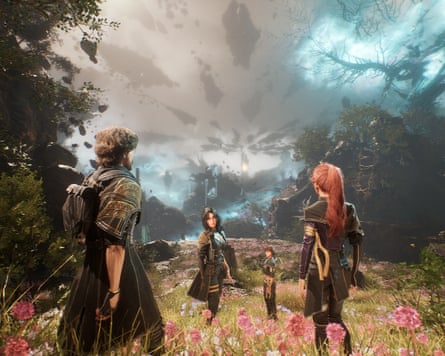
Video games are in a funding crisis. Investor money flowed freely during the pandemic gaming boom, but now the well has run dry. It is increasingly difficult, for indie developers especially, to get the capital to make games. It is extremely unusual, then, to hear of a developer returning an investor’s money. Yet that is what Speculative Agency, developers of All Will Rise, have just done.
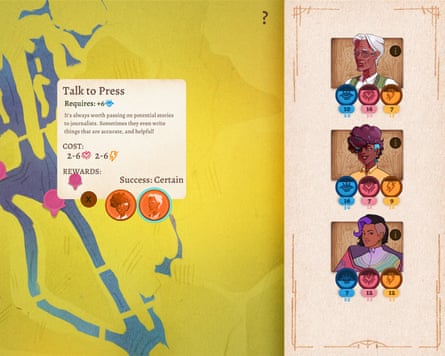
Last year, All Will Rise, a deck-building game about a team of activists fighting for the future of their oligarch-run city, received money from Microsoft as part of a developer acceleration programme. In late-2025, however, the team became aware of No Games for Genocide, a collective of developers, journalists, union organisers and others that came together as a result of Israeli assault on Gaza to protest against “material and commercial ties between the games industry and enabling genocide, war crimes, and the military industrial complex”.
No Games for Genocide has urged the games industry and players to boycott Microsoft and Xbox because of the US tech giant’s ties to Israel’s Defence Force and the technology it has provided during Israel’s war on Gaza, which a United Nations commission last year declared a genocide. As the Guardian reported last August, the Israeli spy service had been using Microsoft’s Azure cloud to carry out mass surveillance on Palestinian civilians. (Microsoft responded by terminating the Israeli military’s access to this service, though the IDF remains a client and still uses other Microsoft services.) The company’s continued relationship with the IDF has driven widespread protests, including from its own employees – some of whom were fired – and Microsoft is on the Palestinian-led Boycott, Divestment and Sanctions (BDS) list.
“This decision felt to right to us – the game we’re making is about making people feel powerful, and acting, and not giving into cynicism and hopelessness,” says Meghna Jayanth, narrative designer on All Will Rise. “It wasn’t an easy decision, but it’s worse to live in the feeling of powerlessness. We’re not naive – we know that our action on its own won’t move the needle much. But if enough developers and studios join us in this boycott, [we] do have the power to pressure Microsoft to end its complicity in Israeli genocide.” (Microsoft did not respond to a request for comment on having their funding returned.)
There is strong anti-war sentiment evident in the gaming community. Game developers have raised more than $1m for Palestinian aid in the past few years through charity game bundles such as Play for Peace and the Palestinian Relief Bundle, and gamers have raised money through charity streams – such as those under the Streamers 4 Palestinians banner, who have raised a collective €1m, according to Streamlabs. But the biggest companies in games have stayed silent on this issue, and many of their employees regard it as risky to speak out. No Games for Genocide’s signatories are mostly individuals and small developers and companies.
“About four months since launching, we’re nearing 2,800 signups to our pledge. This includes nine organisations, three of which are studios that have agreed to refuse or return funding to Microsoft as long as they remain complicit in Israel’s genocide of the Palestinian people (and their ongoing attacks on the people of Lebanon and Iran),” a No Games for Genocide spokesperson told the Guardian. “We’re working with these studios to support them in navigating the challenges and risks of taking a stance like this, and we’re very proud of them for doing so.”
Jayanth says the the response to All Will Rise’s boycott, from developers and gamers, has been immense. “ We’ve also been glad to see games press covering the reality of Israeli genocide with clarity, in talking about this. I think people are sick of hypocrisy, and are ready to embrace people sticking to their consciences and principles.”
The No Games for Genocide campaign won’t begin and end with Microsoft. “The BDS list includes Intel, the processor in most of our computers, Amazon, who own Twitch, and Dell and HP … Gaming is also deeply tied to the US Department of Defense and even with the military in the UK, in the use of video games as military training simulators and their increasing integration into military recruitment pipelines. There’s a lot of work to do.”
The nature of globalist capitalism means it can feel impossible to divest oneself from companies and governments that are involved in wars and human rights abuses. No area of entertainment is untouched by corporate and government influence – EA will soon be owned by the Saudi Arabian sovereign wealth fund and, in part, a private equity firm owned by Jared Kushner, the son-in-law of Donald Trump. And thanks to its run of acquisitions over the past decade, Microsoft specifically now owns a huge proportion of the western games industry, from Minecraft to Call of Duty, World of Warcraft to Fallout. But doing something, say the organisers of No Games for Genocide, feels better than doing nothing.
“We feel hopeful, based on the initial response to our campaign, that there are many people in the games industry who care about this and want to do something – and we hope to empower people to do just that,” No Games for Genocide says. “None of us can do it alone, but all of us can do it together.”
What to play

Games correspondent Keith Stuart gave the Greek-mythology-themed match-three puzzle game Mythmatch a glowing review this week and, oh my goodness, it’s so very cute and compelling.
You play Artemis auditioning for the role of Goddess of the Hunt, making herself indispensable to the mortals by sorting out their town and their problems, while taking on frantic merging puzzles as Olympian trials by night. It’s beautifully drawn, written and animated – one of those games that promises 20 minutes of fun, then ensnares you for hours.
Available on: PC, Mac
Estimated playtime: 10-12 hours
What to read
-
The last week has just been one L after another for gaming executives and companies. First up: after buying Subnautica developer Unknown Worlds, the head of publisher Krafton, Changhan Kim, ousted the founders in an alleged attempt to avoid paying them a $250m bonus. Now a judge in the US state of Delaware has compelled Krafton to reinstate their jobs and honour their contractual right to the payout. Court documents have revealed that Kim was following the legal advice of… ChatGPT. In a statement, Krafton said it disagreed with the ruling and was evaluating its options.
-
Meanwhile, Nvidia unveiled a new AI tool that “improves” game visuals… by making their characters look like completely different people, and adding a bunch of extra lighting. Developers in my timeline have called this “garbage”, “yassified trash”, “a creative travesty”, and, well, racist, because it drastically alters the facial features of non-white characters in the example screenshots. Nvidia has called this criticism “completely wrong”, insisting that developers will still have control over their own art direction.
-
In better news, the Bafta Game awards nominations are out. Unsurprisingly Clair Obscur: Expedition 33 features heavily, with 12 nominations, followed by the animated superhero narrative game Dispatch with 9. Clair Obscur has already won all of the other four major Game of the Year awards, so a Bafta statue would make it a clean sweep. The ceremony is on 17 April.
-
I was on the Guardian’s Today in Focus podcast last week talking about my new book about the history of Nintendo, and why video games matter. Give it a listen!
What to click
-
A petri dish of human brain cells is currently playing Doom. Should we be worried?
-
Less respawning, more re-rolling: six of the best board games based on video games
-
Marathon is a stylishly merciless video game built for cut-throat times
Question Block

Reader Joe asks:
“I am 45 and continue to play online multiplayer FPS games (mainly Battlefield) while most of my friends have given up for more sedate gaming experiences. Military shooters really come alive when playing with a coordinated team over voice comms. However, I’m deeply saddened and angered by the disproportionately high level of racist, misogynistic dickheads playing these games, so I tend to play with voice comms off. Can you recommend a friendly and inclusive community where I can find decent folks to play with?”
I have not played games with general voice comms on since 2003, when I played aerial combat game Crimson Skies on the new Xbox Live network and was interrogated about my age and gender by a lobby of American men. Alas, much of the behaviour of people on voice comms, especially in military shooters, has not improved much, so your only option is to find a friendly clan or Discord server with people who aren’t the worst, and play with them instead. I did a little Battlefield 6-specific research and found the Battlefield Elders, a clan for “mature gamers 25+” (!!??) – but I can’t vouch for them as I don’t play games online often.
Readers: are you part of a friendly shooter-oriented community that would welcome Joe? What are some non-toxic clans/servers that Pushing Buttons readers might enjoy participating in? Is it finally time for our own Pushing Buttons Discord?
If you’ve got a question for Question Block – or anything else to say about the newsletter – hit reply or email us on [email protected].