.png) 4 hours ago
7
4 hours ago
7
King Charles is on the throne, there’s anxiety around the power-brokers of Whitehall, and an age of deep political division and conspiracy obsession is under way.
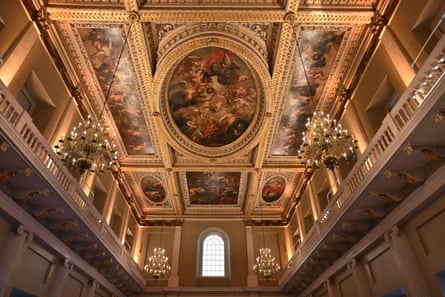
That’s right, I’m referring to the middle years of the 17th century, a period I’m immersed in as I’m putting together a Jacobean-Carolean Classical DJ set, where the beats are to be dropped beneath one of the UK’s most awesome works of art: the Rubens painted ceiling at the Banqueting House in Whitehall.
After a period of restoration and conservation, the ceiling is on view again – and this weekend you’ll be able to feast your eyes on cherubim, goddesses and James I ascending to the celestial realm while listening to music that matches the visuals.
The DJ set will see us segueing between music first performed in the Banqueting House four centuries ago, with lute songs and choral anthems employed as testament to the pioneering and introspective spirit of the age. This was an era in which amateur musicians had access, for the first time, to printed manuscripts; it was an era of heightened melancholy perfected by the Morrissey of his day, John Dowland; when the lute ushered in musical improvisation that John Coltrane and Jimi Hendrix would have relished. It was also an era of masques.
Masques were the 17th-century equivalent of a VIP ticket to Glastonbury, Glyndebourne and a Killing Kittens sex party. Banqueting House’s architect, Inigo Jones, was also the set and costume designer of these masques, which encompassed opera, theatre, ballet and balland were always allegorical affairs, with mythological gods and goddesses parading around in outrageous costumes. These extravagant performances reinforced the divine right of the Stuart monarchy, and the audiencecourtiers, aristocracy dignitaries and diplomats – was seated according to status and rank. Masques also involved plenty of bad behaviour, with reports of performers in outrageous costume sometimes so hammered on stage that they vomited, and a chaotic tradition of the audience smashing up the refreshments table at the end of the show.
Music was intrinsic to the power play at the Banqueting House, and much of it was wildly experimental. Jacobean music specialist and lutenist Elizabeth Kenny showcases some of the best of it on her album, The Masque of Moments. Masques would generally have featured three groups of instruments, she says: “A brass group, which often represented the underworld; a big band of violins, which accompanied the dancing that went on for hours; and a group in the middle made up of voices, lutes and viols. That group experimented with coloratura singing – cascades of notes – that would have blown people’s minds at the time.”
The aristos were fully in on the action. Charles I’s wife, Henrietta Maria, danced the lead role in the masque Tempe Restored, in which she was lowered from the ceiling on a jewelled chariot. Strong Beyoncé energy. She was also rumoured to have been romantically involved with a star lutenist of the day, Jacques Gaultier – who obtained rock-star status for the way he played the treble lute, a tiny instrument that became a major element of the masques. (The lute section ranged from the teeny treble all the way through to a new-fangled beast of an instrument from Italy: the theorbo, a bass lute with an enormously long neck.) Importing musical ideas from Italy was de rigeur in the early 17th-century. Inigo Jones is said to be the person who brought the first theorbo to England. Apparently he was detained at the Jacobean version of customs because officials thought he had smuggled in a “popish machine” with which to assassinate the King.
It was a lutenist, Robert Johnson, who composed music for the first ever performance of Shakespeare’s The Tempest at the Banqueting House in November 1611. Johnson wrote the song settings for Where the Bee Sucks and Full Fathom Five, music we still use today. Ruby Hughes performs Full Fathom Five on her recent album, Amidst the Shades; her pared back purity of tone perfectly captures the sense of an otherworldly, mournful spirit.
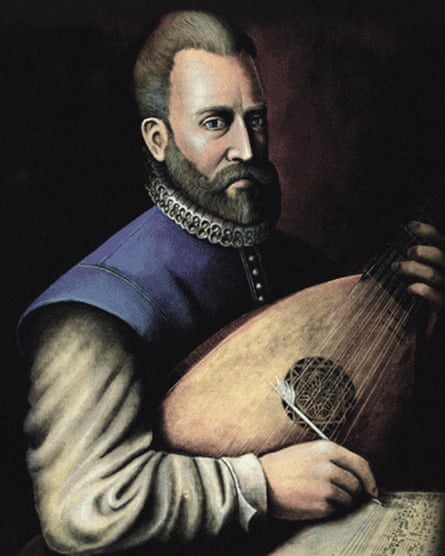
Dowland was another contemporary of Shakespeare’s. He was a lutenist, composer, singer and master of melancholy, opting for cheery titles to his songs such as In Darkness Let Me Dwell and Flow My Tears. His greatest modern-day interpreter is the countertenor Iestyn Davies.
“We have to really tune in to these songs,” Davies says. “We misunderstand this music as delicate and quiet, [but] it’s incredibly expressive. That’s why people like Sting get so hooked on it.” (Sting released an album of Dowland’s music in 2006.) Listen to Davies sing Flow My Tears to experience what sadness meant in this era. “You need melancholy to cure your melancholy,” explains Davies of the belief at the time. “Songs were a way to access a deep sadness, and then get through it.”
A year before Dowland’s death, Charles I ascended to the throne, an altogether different kingly creature to his father, James. Charles’s absolutist tendencies led to the schism with parliament, the civil war and, eventually, his death on the scaffold erected just outside the Banqueting House, where he was beheaded on 30 January 1649. Rubens’ epic painted ceiling was one of the last things Charles saw on this earth.
Charles’s favourite composer was William Lawes, who fought and died for the king as a royalist soldier. Lawes’ Royal Consort Sets are written for viol consort, accompanied by a bass line of two plucked string instruments. They have a shadowy depth to them, flitting between dance forms of the day and a soulful solemnity that make for a poignant underscore to Charles’s final words: “I go from a corruptible to an incorruptible crown, where no disturbance can be.”
Lawes also wrote some exquisite sacred vocal music. The French early music ensemble Près de votre oreille (Close to your ear) recorded an album of it called Lighten Mine Eies last year; the opening funeral elegy, Music, the Master of thy Art is Dead, is surely some of the most ethereally lovely music ever written about death.
A new era at the Banqueting House dawned: that of the Lord Protector himself, Oliver Cromwell. I was surprised to discover that the man who led the Puritan government, which banned Christmas carols and shut down theatres, made the lavish environs of the Banqueting House his primary hall of audience in 1654.
The Lord Protector was, in fact, a music lover who had his favourite organ from Magdalen College, Oxford, installed at his lavish apartments at Hampton Court, and employed various musicians to perform there. As Cromwell biographer Paul Lay puts it, there’s a “spectrum of puritanism” and, ironically enough, Cromwell was at the milder end of it.
And yet, thanks to the zealots, the theatres were shut and many musicians of the era found themselves forced to make a living playing in taverns and alehouses – the inspiration behind the hugely enjoyable Alehouse Sessions album by Norwegian early music ensemble Barokksolistene. It’s thought that these musical meetings during the Commonwealth era were the earliest public concerts in Britain.
England’s republic was not destined to last anywhere near as long as Rubens’ ceiling, and the Interregnum officially ended on 29 May 1660. That same day, on his 30th birthday, Charles II made a triumphant return, processing through London and arriving at the Banqueting House to have his hand kissed by the gathered parliamentarians. This king had a taste for the theatre, and for actresses, and under the Merry Monarch the playhouses returned with ever more spectacular restoration entertainment.
The 17th century closed with the destruction of almost all of the old palace at Whitehall in a massive fire. Banqueting House was left standing – but there were no more masquesthere – under the Georgians it became a chapel and under Victoria a military museum.
As we prepare to return this music to the gloriously opulent space where it would have been heard 400 years ago, I’m reminded of lines from The Tempest, a play all about the power of theatre and the thin walls between fantasy and reality. Those ascendant Rubens paintings of a divinely ordained monarch will once again resound, as Prospero and Caliban’s island did, a place: “full of noises, Sounds and sweet airs, that give delight, and hurt not”.