.png) 7 hours ago
5
7 hours ago
5
Ozzy the four-month-old goldendoodle isn’t normally allowed on the sofa. But today he has been granted special privileges because I’ve come round specifically to watch TV with him. We’re not watching Paw Patrol, Scooby-Doo, or even Crufts. We’re watching Sealook, the Netflix kids’ cartoon about a colony of seals that dogs and cats online are supposedly obsessed with. But is this really a thing? And will Ozzy care?
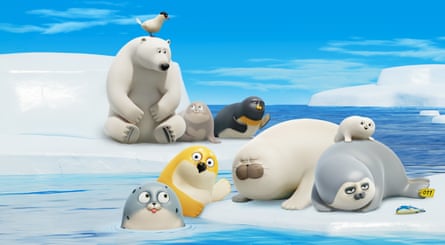
I hit play. A gang of wide-eyed pastel-coloured seals are in a slapstick scrape. There’s no dialogue: they mostly lie around on the ice, and try to annoy each other by doing silly things like making funny noises, throwing snowballs or keeping each other awake. Ozzy seems more interested in chewing his pizzle stick – which I discover, slightly too late, is the dried penis of a bull. Then again, perhaps this is just canine second-screening: Sealook on the telly, bull penis in the mouth.
Ozzy may be playing hard to impress, but he’s in the minority. Search #sealook and there are loads of dogs pawing at the TV and cats batting at the characters. “They do watch television, but not this intently,” says Jessica Blumen from Oregon, who has had nearly 10m views for an Instagram video of her two goldendoodles’ reaction. Benny, nearly one, and five-month-old Myrtle, certainly seem to be converts, judging by their reaction to watching a group of animated seals banging on the ice. “The minute the seals started drumming, Benny sat up and Myrtle had these subtle head tilts.”
It’s even become a sort of doggy mindfulness regime. “Last night Benny was getting a little wild – goldendoodles get zoomies at night – so I turned it on and he immediately settled. Even when an episode ends and flashes up a yellow bar saying ‘fin’, that still keeps his attention.”
Allow Instagram content?
This article includes content provided by Instagram. We ask for your permission before anything is loaded, as they may be using cookies and other technologies. To view this content, click 'Allow and continue'.
Švepsė, a one-and-a-half-year-old rescue cat in Lithuania, is already a TV fan, enjoying animal documentaries and having previously been fascinated by a Lithuanian strongman competition. But Sealook produced an even stronger reaction. “She became very focused on the screen and tried to catch the characters with her paws. Sometimes, she simply sat there watching very carefully without taking her eyes off the screen,” says owner Erika. “We’re used to her watching animal documentaries, but seeing her try to catch the characters in Sealook was something we hadn’t seen before.”
Rio, a six-month-old golden retriever owned by Melly Roman in Houston, Texas, is another fan. “We have the TV on for background noise and he never normally watches,” she says. “But he started barking when one of the seals came really close to the screen. We tried again later and he sat and watched a couple of episodes.” The clip helped take Rio’s Instagram following from about 115 to nearly 4,000.
Allow Instagram content?
This article includes content provided by Instagram. We ask for your permission before anything is loaded, as they may be using cookies and other technologies. To view this content, click 'Allow and continue'.
This, I tell Ozzy, is exactly the sort of behaviour that could help boost his own Instagram following of 137. Watching television is a far better party trick than barking at his own reflection or stealing hair scrunchies from his human mum. I’d offer to become his social media manager, but I don’t have any interest in freebies from Bonio.
Still, before I write off Ozzy as a hopeless influencer, what are cats and dogs seeing when they watch Sealook? One possible reason is the colour palette: it’s all white snow, pale-blue ice and brightly coloured seals. Cats and dogs see blues and yellows particularly well, which perhaps makes Sealook about as easy to ignore as a bowl of Whiskas or Pedigree Chum.
Dr David Williams, an associate lecturer in veterinary ophthalmology at the University of Cambridge, thinks movement may be just as important as colour. “Cats and dogs are particularly interested in movement because they’re interested in chasing a mouse or another prey item,” he says. “They’re also crepuscular – most active around dawn and dusk – so movement in low light matters particularly to them.”
Sound may matter too. Dr Emily Blackwell, a companion animal behaviour expert at Bristol Veterinary School, says the seals’ “high-pitched squeaking noises may mimic the sounds of prey species – rodents – and also sound very similar to the squeaky toys that many of our pets have”.

Dr Freya Mowat, an associate professor of veterinary ophthalmology at the University of Wisconsin-Madison who studies how dogs watch television, says dogs seem particularly drawn to animal-like movement. “My own research has shown that dogs prefer watching dogs to humans,” she says. “Seals? I don’t know, but they are closer to dogs than people! Cartoons are great content for dogs: high contrast, lots of movement, nice fun music – it’s the whole package.”
Was any of this deliberate? Apparently not, says Leah Yeon, communications lead at The Pinkfong Company, the South Korean co-producer of Sealook. “Seeing cats and now dogs as well becoming so absorbed in Sealook has been a fun and unexpected surprise.”
The show’s simple snowy landscapes, vivid colours and short, repetitive movements were designed for audiences of children, although the team suspects the same ingredients may help explain its appeal to pets. The trend began with cats, then dogs jumped on the bandwagon. “We didn’t set out to make a show for animals,” says Yeon, “but it continues to be fascinating – and very amusing – to see it connect with this new audience.”
Which leaves one final experiment. Williams suggested turning the sound off to see whether Ozzy’s interest changes. Right then, Ozzy. Volume down.
Nothing. I turn the sound back on and, finally, Ozzy looks up. A seal slides across the ice; his ears prick up. Another squeaks and he edges towards the screen. At last! I grab my phone, visions of 4,000 followers dancing before me. But seconds later, Ozzy wanders off in search of a hair scrunchie or bull penis. Sealook, it seems, has yet to earn his seal of approval. Doggy stardom will have to wait.