.png) 5 hours ago
6
5 hours ago
6
The discovery of the bodies of seven women around Johannesburg’s international airport, including five in the past week, has prompted an outpouring of fear, grief and anger over a lack of progress in tackling femicide.
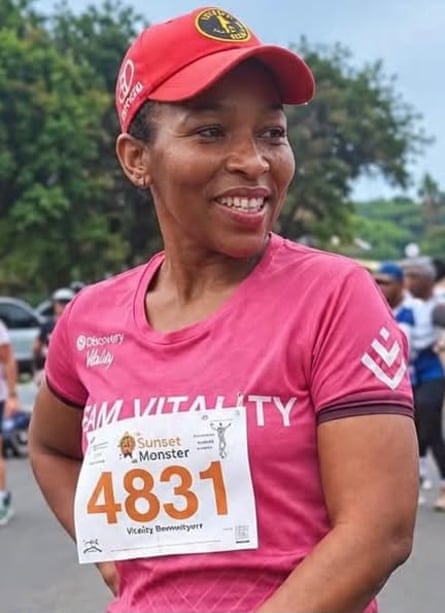
When Elizabeth “Tsontso” Moselakgomo did not return after going for a run on 9 September, her eight-year-old daughter alerted relatives, who contacted police. The 38-year-old’s body was found on Saturday and identified by relatives on Monday. The news of her disappearance had gone viral.
Police said in a statement on Saturday that four women’s bodies had been found since 15 July in Kempton Park, across the highway from OR Tambo international airport. All were half-naked and with visible bruising.
On Monday and Tuesday, two more bodies were found in Olifantsfontein, about 15 miles north of Kempton Park. On Tuesday, police said another woman’s body had been found 25 miles to the south-east, naked and decomposed.
“In this country we are prey,” Sakane Mokoena posted on Instagram after confirmation of the death of her friend and fellow runner Moselakgomo.
South Africa has one of the highest rates of femicide in the world. In the year to 31 March 2024, more than 27,600 people were murdered, 5,578 of them women, according to the latest police data.
For years, women have called on the South African government to take gender-based violence seriously. After hundreds of women protested on the eve of the G20 summit in Johannesburg in November 2025, President Cyril Ramaphosa declared it a national crisis.
However, the lack of a concrete plan or action has frustrated campaigners – and women keep being killed.
The latest deaths are being investigated by specialist officers, who said on Saturday: “Women in and around Kempton Park are urged not to walk or run alone, particularly in isolated areas. They should avoid secluded spaces, remain vigilant and, where possible, travel or exercise in groups.”
South African women responded with anger at the idea that they had to be responsible for their own safety, with many runners noting they already took precautions, such as sharing routes. “We are tired of being told to be vigilant when women are already doing everything possible to stay alive,” said the advocacy group Women For Change.
“It should not take a missing woman, a desperate family, runners and communities searching, and a case going viral, before an area is searched with this intensity,” the group said.
Detectives said on Saturday that they were examining a serial killer angle. However, on Monday, a police spokesperson, Athlenda Mathe, told reporters: “For now, nothing tells us that we’ve got a serial killer.”
Mathe added that a suspect in the killing in July of the first woman, her boyfriend, was in custody.
Ramaphosa said on Tuesday that he had directed police authorities to prioritise the ongoing murder investigations.
Although the gender of the suspect or suspects in the other killings has not been confirmed, campaigners called on men to take responsibility for violence against women and children.
after newsletter promotion
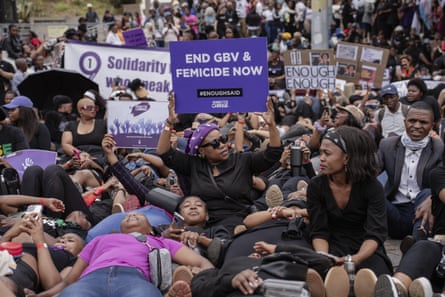
“When some of these things happen in our presence, most of us men tend to look the other way,” said Bafana Khumalo, a co-executive director of Sonke Gender Justice.
“You have excuses like ‘No, it’s not my business’. We feel strongly that violence against women is our business. We need, as men, to begin to face each other squarely and hold each other accountable.”
The identification of Moselakgomo’s body has triggered an outpouring of grief.
Mokoena met her about two years ago, when Moselakgomo joined a running club so she did not have to train alone on Saturdays.
“She’s an amazing woman,” said Mokoena. “She always spoke about her daughter. Tsontso always said ‘Bye guys, I have to go, I have to go to my child’.
“That’s just an example of how close she was with her baby girl. And she was a really light-spirited, funny and joyful woman, who was kind – very, very kind.”
Running clubs around South Africa organised events to remember Moselakgomo and Mokoena said she hoped this would help push the government and police to do more to protect women.
She added: “I’m just happy that the world, or at least our country, was standing still for a moment to acknowledge what is happening. Let’s get this out there and figure out exactly what is happening to women.”