.png) 2 months ago
57
2 months ago
57
Most parents remember the first time their baby smiled or when they took their first steps. Eve Stevenson recalls different milestones. “Watching my daughter, Madison, deadlift 35kg at the age of six was pretty cool,” she says, grinning with pride from her living room in south-west London.
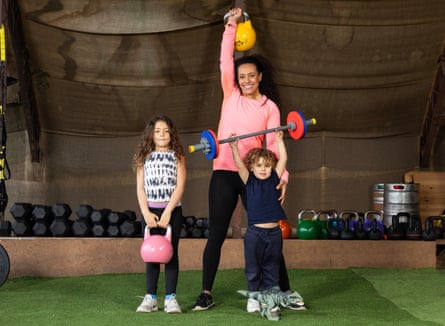
As a personal trainer (PT) and former British weightlifting champion, her daughter’s achievements shouldn’t really be that surprising. Still, Stevenson has been on the receiving end of some harsh opinions about her daughter and three-year-old son, Beau, doing resistance training with her. “People tell me it will stunt their growth or that it’s dangerous,” she says. She is also often accused of forcing her children to train, when actually it all started the other way round. “What child doesn’t look at their parents and want to do what they’re doing?” she asks. And although to many people the idea of a small child strength training or competing might feel jarring, Stevenson is among a growing number of parents who see value in helping their children build muscles.
Strength training is having a moment. In recent years, there has been a growing awareness of its benefits: it supports our health and mobility as we age and, according to one study published by the British Journal of Sports Medicine in 2022, even helps us live longer.
This explosion of interest is reflected on social media. Where once strength training content was considered fairly niche and for a mostly male, aesthetics-focused demographic, now a new generation of “fitfluencers” is promoting #Gymtok and #strongnotskinny. According to data from the health body UKActive and the fitness business Les Mills, it’s a trend that is having a positive impact, particularly on younger generations, with 75% of gen Z lifting weights twice or more a week, followed closely by millennials at 74%.
Perhaps unsurprisingly, Gladiators – a television show that celebrates peak physical performance – has not only been back on our screens since 2024, but is booming, clocking up 8.3 million viewers in its first rebooted series. Stevenson and many other parents I spoke to believe this has helped motivate their kids to get strong and made resistance training seem fun.
Despite this, there is still a queasiness over children taking part. When Joe Wicks (AKA “the nation’s PE teacher”) shared footage over Christmas of his six-year-old son learning how to do a chest press and a bicep curl, some of the comments questioned the safety of what he was doing. This echoed previous criticisms of his children’s presence in the gym, but he insists that their training sessions are healthy. A quick scroll on social media shows thousands of videos of young children lifting, most featuring similar comments from concerned people. So is it actually dangerous for kids to strength train? And if not, why do so many people find it so difficult to watch?
Jon Oliver, a professor in applied paediatric exercise science at Cardiff Metropolitan University, says most of it is down to outdated thinking: “A lot of myths surrounding the negative consequences of children taking part in resistance training and weightlifting have been around for decades. Particularly the idea that it stunts growth, which has held strong.”
For the most part, he says, these ideas derive from early 20th-century studies and case reports that have since been updated with better research. Indeed, in 2014 alongside numerous colleagues, Oliver contributed to an international consensus statement on youth resistance training, published in the British Journal of Sports Medicine, which attempted to address these enduring misconceptions.
“There is now a compelling body of scientific evidence that supports regular participation in youth resistance training to reinforce positive health and fitness adaptations and sports performance enhancement,” the report states. It goes on to say there is even stronger support for youth resistance training when it is “supervised by qualified professionals and consistent with the needs, goals and abilities of children and adolescents”.
Oliver points out that this advice is mirrored by NHS guidance for physical activity in five- to 18-year-olds, which recommends that children “need to do two types of exercise each week: aerobic and exercises to strengthen their muscles and bones”. It further states: “Young people can use weights for resistance exercise if a qualified adult trains … and supervises them.” This chimes with World Health Organization (WHO) recommendations for five to 17-year-olds, which say activities that “strengthen muscle and bone should be incorporated at least three days a week”.
Alex Reader’s two children, Atticus, four, and Ottilie, 12, both showed an interest in lifting when they saw their dad doing it. As a gym owner in Devon, Reader spends a lot of time in a training environment, so his children do too. “They come into the gym and they kind of just like to see the dumbbells,” he says, “and they want to try to lift them, even if they’re quite heavy!”
His kids’ interest pushed him to put on parent and child classes, which have been popular. In his opinion, lifting weights isn’t that different from the physical burden children put on themselves in other ways, and in fact supports their play. “You wouldn’t stop a kid sprinting, jumping or climbing up a tree,” he says. “The forces involved in those activities might be similar to lifting a 10kg kettlebell, and by training you might actually stop them getting injured when they carry their brother across the room or build a den.”
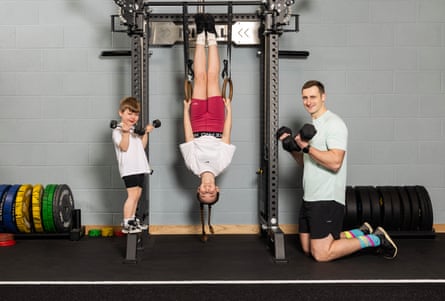
Oliver agrees that building strength can help children throughout their life, but you can start small. “That doesn’t have to be through using weights initially – it can be using body weight, resistance bands or medicine balls.” If children are quite active, though, there will probably come a point where the stimulus needs to be adapted so they keep reaping the benefits, and this may involve using barbells or kettlebells, he says. “When you start young, it should be all about technique and building things up slowly,” he says. “There’s no rush to get lifting anything very heavy very quickly. It’s one of the reasons for starting younger, because then they’ve got a long time to develop their skills and strength, so they can safely progress in a gym environment.”
Steph Morris, a lecturer in strength and conditioning, also at Cardiff Met, and adviser to British Weight Lifting’s child and adolescent programme, advises consulting a qualified professional before embarking on weightlifting with your child. “Premature specialisation and the imposition of adult training volumes in youth training increase the risk of injury, in addition to psychological burnout,” she cautions. Parents should promote a sampling approach to sport, Morris explains, where children are encouraged to participate in a broad range of physical activities that build diverse motor skills and sustain enjoyment.
Oliver agrees: “We want it to be fun, because that is ultimately what will hold a child’s interest.”
Having fun and spending quality time with his four-year-old son, Saxon, is what motivated entrepreneur Rich Hawkins, who lives near Coventry, to start looking into children’s weightlifting. As a kid, he says, he always wanted to join in with his father when he was training, but his dad – like many others – never allowed it because of safety concerns. So when Saxon started showing an interest in lifting and begged his dad to let him come to the gym, Hawkins “went down a rabbit hole of research”. He found out not only was it safe, but that the evidence was “quite clear there are benefits if it is done in the right way”. He read research papers that showed when children are fitter and more active and participate in some form of strength training, their academic results tend to be higher and their ability to focus tends to be better.
As someone who had spent his career building fitness brands, it wasn’t long before Hawkins had a brainwave: in 2025 he launched Little Lifters, a fitness toy brand that sells lightweight barbells and kettlebells made of plastic that can be filled with water to adjust their weight as a child develops.
“Little Lifters was originally supposed to be a small way for Saxon to be involved with my work and to do something together … but it’s just gone absolutely nuts,” Hawkins says. The brand has already outperformed nearly all his others, with sales growing by 137% in the second half of last year. This may have something to do with Joe Wicks uploading a video of his son using Little Lifters weights – something Hawkins had no idea was coming. Since then, a national gym has bought sets so clients can bring their children to train alongside them. The demand, he says, is clearly there.
Despite the brand’s commercial success, Hawkins says the best part has been seeing how much it has increased Saxon’s commitment to strength training. “He’s very proud that he can do a pull-up at age four,” he says. “It’s the first thing he shows to everyone.” Hawkins says the most important thing is that Saxon is building a strong fitness habit at an early age, which his dad hopes will stay with him as he grows up: “He just sees it as a normal thing that everyone does to stay healthy. His dad works out, his big brother works out, his mum works out and so does his grandad.”
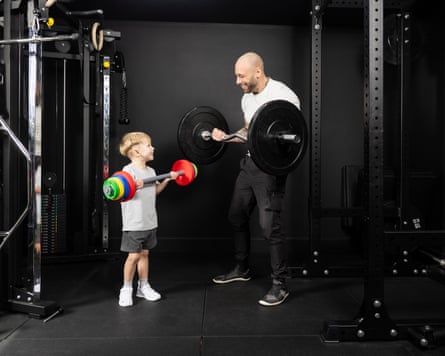
That children feel a desire to mimic their parents is a tale as old as time, says Dr Martha Deiros Collado, a clinical psychologist with a specialisation in children and parents, and author of How to Be the Grown-Up and The Smartphone Solution. However, she urges parents to ensure a child’s interest in weightlifting is coming from a place of genuine interest and not, for example, a perceived or real pressure to please. “When I am encouraging my child to do something new, I always give them a choice,” she says. “This might be as easy as saying: ‘Do you want to come and do this with me? It’s OK if you don’t.’ It is important to give kids the permission to say no, knowing that their parent won’t judge them or think of them badly.” She also says it is vital that parents model a healthy approach to weightlifting, especially around its links with body image: “For instance, emphasise how important it is to be strong for our health, rather than to try to influence our body shape.”
For other parents, such as Kate (name changed to protect her child’s privacy), the drive to instil healthy habits in her children by bringing them to the gym feels more urgent. “My eight-year-old has type 1 diabetes,” she says, “so we started with him a couple of years ago, to help him manage his health, and now the whole family (including his six-year-old brother) goes every Sunday morning.” This has proved a very positive experience, she says. “The whole gym has a family vibe and a lot of the PTs bring their kids.”
But Kate is aware some family members have made negative comments: “Making conscious choices for better lives for our children gets laughed and poked at because people think we are just trying to be different for different’s sake. But I can tolerate that, especially when the benefits for my children are so clear.”
A family friend who is a PT has advised them over what is and isn’t safe, and now the family often follows the same routine, with weights modified for the kids. “They do miniature versions of what we do,” Kate says, “including squats, deadlifts, press-ups and lunges.”
For those looking to get their children involved, Oliver says the NHS and WHO guidelines are a good springboard, but he urges parents to consider the overall amount of exercise a child is doing over the course of a week. “Children involved in sport, especially high-level sport, may end up in a situation where they are doing a lot of training,” he says, so it is important to keep an eye on that. “Training also needs a recovery period, so we should make sure children and adolescents are having plenty of time off from training and eating a healthy diet to support growth and development.”
Reader believes strength training in a controlled environment is much safer than a lot of “more socially acceptable” contact sports that children engage in. “The injury risk is probably higher doing some of those because there’s an unpredictable element to them, whereas moving a static object from A to B is extremely predictable,” he says.
Morris adds that weightlifting offers an inclusive option for young people who may not naturally excel in team-based sports that are heavily reliant on physical endurance and perceptual motor skills. None of this is to dismiss the numerous benefits children can gain from team sports, such as teamwork and social skills, and Morris encourages parents to try out many different types of exercise with their children in order to find out what they enjoy. “This can help sustain enjoyment in physical activity but also help holistic athlete development,” she says.
Stevenson thinks many people don’t like seeing kids weightlifting because they perceive is it as heavily linked to an aesthetic ideal and diet culture, which a lot of parents want to keep their children away from. But that image is changing, says Stevenson. “When I was competing 15 years ago, lifting was still dominated by men, but public opinion has changed enormously since then; it is now much more acceptable and aspirational to see a strong woman.”
Psychologist Deiros Collado recommends decoupling the idea of strength training from aesthetics by avoiding posting, or even filming, your children training. She believes the idea of posting this type of content links exercise too closely to how we look or are perceived by others, rather than it being something we do for ourselves. “It ends up being a performance rather than an effort to improve health,” she says.
Both Reader and Stevenson hope their children gain mental as well as physical benefits from lifting. Reader says: “When you’re doing fitness, the effort you put in is directly linked to your outcomes, and I think that’s a good lesson.”
For Stevenson, the gym is a great place to teach resilience: “I won’t be able to shield my daughter from what the world throws at her, but I hope the little lessons she learns in the gym give her some grit and, more than anything, an outlet.”
As someone who grew up around alcoholism, Stevenson says she was never taught a healthy way to deal with tough times. “I hope my daughter builds a relationship with strength training that isn’t about getting smaller,” she says, “but is about doing hard and uncomfortable things and getting through them. I hope she can take that mindset through life.”