.png) 1 month ago
42
1 month ago
42
The United Nations has voted to describe the transatlantic chattel slave trade as the “gravest crime against humanity” and called for reparations as “a concrete step towards remedying historical wrongs”.
The landmark resolution passed on Wednesday was backed by the African Union (AU) and the Caribbean Community (Caricom). It had been proposed by Ghana’s president, John Dramani Mahama, who said: “Let it be recorded that when history beckoned, we did what was right for the memory of millions who suffered the indignity of slavery.”
Voting in favour were 123 states, while Argentina, Israel and the US voted against. There were 52 abstentions, including the UK and members of the EU.
James Kariuki, the UK chargé d’affaires to the UN, said Britain continues to disagree with fundamental propositions of the text and was “firmly of the view that we must not create a hierarchy of historical atrocities”.
“No single set of atrocities should be regarded as more or less significant than another,” he said.
As the resolution went ahead in New York, the British MP Bell Ribeiro-Addy presented a petition to the House of Commons, pushing for a state apology by the UK for its key role in slavery and colonialism of Africans.
“So many of the intersecting global challenges we now face are rooted in the legacies of enslavement and empire: from geopolitical instability to racism, inequality, underdevelopment and climate breakdown,” the petition read. “To truly confront these issues, we must acknowledge where they come from.”
For four centuries, seven European nations including the UK enslaved and trafficked more than 15 million Africans across the Atlantic. The scale of the chattel slavery was such that 18th and 19th-century abolitionists coined the term “crime against humanity” to describe it. Historians have also linked wealth from enslavement to mass industrialisation in the west.
“When it’s framed as a trade, it distorts the reality,” said Jasmine Mickens, a postgraduate student of history and government at Harvard University. “It was not a consensual joint business enterprise.”
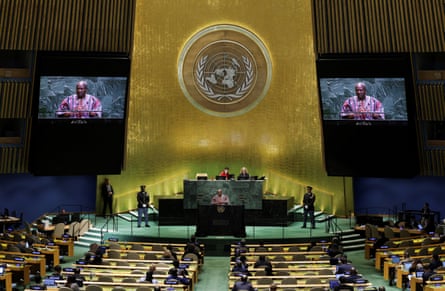
Ghana, which has been at the forefront of an effort across Africa and the Caribbean for reparatory justice, pushed for the terminology to be updated to reflect the lingering impact of chattel slavery.
Experts involved in drafting the resolution say it is an attempt to get “political recognition at the highest level” for one of the darkest eras in history.
“The main point is not to introduce a hierarchy of crimes,” said Kyeretwie Osei, the head of the economic, social and cultural council at the AU. “It is rather an attempt to properly situate that particular chapter in history … how it was so world-breaking in its impact that it essentially created the platform for every atrocity and crime against humanity that then followed.”
“[This] was the chattelisation of human beings which essentially reduces them to property that can be sold or inherited [and] the status of enslavement could be passed on through birth,” he added.
The UN first acknowledged that slavery was a crime in a 2001 conference against racism, xenophobia and related intolerance in Durban, South Africa.
Panashe Chigumadzi, a historian and rapporteur for the AU’s committee of experts on reparations for slavery, colonialism and apartheid, who drafted the framework, said that conference had had many limitations, including its framing of slavery as a “retroactive moral judgment rather than a continuous legal reality”.
“The AU framework … establishes that the inception of the trafficking in enslaved Africans during the so-called ‘age of discovery’ constituted the definitive break in world history, which inaugurated the break from localised feudal regimes to the modern world racial capitalist system,” she said. “This structurally transformed the fates of all peoples across the world through racialised regimes of labour, capital, property, territory and sovereignty that continue to determine relations of life and the land on which it is lived.”
While the resolution is not legally binding, it is now expected to pave the way for more progress in a fight that scholars and some politicians say has been hampered by the rise of rightwing movements in the west.
In recent years, the AU has been working to ensure the codifying of chattel slavery as a crime that requires not just apologies, but reparatory justice.
“Right now, the focus is on this particular moment [and] recognising that it is a culmination of many moments before this day,” Mickens said. “What people don’t seem to remember – due to all the efforts to erase history – is that black people, African people, have resisted the institution of child enslavement and the trafficking of Africans since the first hour the crime was committed on the shores of Africa.”
Before Wednesday’s vote, Mahama lamented the continuing erasure of Black history in the US through increasing censorship of teaching the “truth of slavery, segregation and racism” in schools.
“These policies are becoming a template for other governments as some private institutions,” he said at an event at the UN headquarters. “At the very least, they are slowly normalising the erasure.”