.png) 5 hours ago
8
5 hours ago
8
For years, US law enforcement officials blamed their failure to solve hip-hop star Tupac Shakur’s murder on the lack of cooperation from key witnesses, and on gang members’ “snitches get stitches” culture.
But testimony in a much-delayed murder trial, which concluded this week, almost 30 years after Shakur’s death, highlighted just how much law enforcement officials knew about the shooting, and how early.
On Monday, a Southside Compton Crips gang leader and drug dealer, Duane “Keffe D” Davis, was convicted for orchestrating Shakur’s killing. Davis told investigators in 2008 that it was his nephew, Orlando “Baby Lane” Anderson, who pulled the trigger. Anderson died in an unrelated shooting in 1998.
The lack of resolution in Shakur’s murder had resonated painfully not just with the artist’s own family and friends, but with many Black Americans.
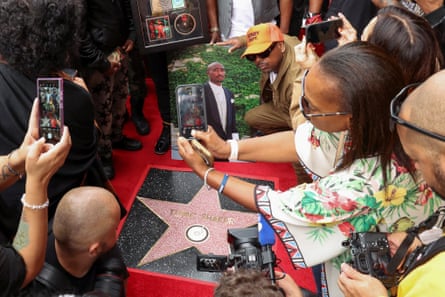
Even though Shakur was one of the most famous Black men in the world, a star whose movements attracted enormous media attention, his killing remained officially unsolved for almost three decades, said Jody Armour, a law professor at the University of Southern California. “If even he could be murdered on a major Las Vegas boulevard and the case could sit around and languish, one naturally wonders what happens when the victim is just a 19-year-old Black man in Compton, or South Central, or Chicago.
“Tupac spent much of his career insisting that America did not adequately value Black life,” Armour added. “His own homicide became another exhibit in that argument.”
The fact that the Las Vegas jury reached a verdict in the Shakur case so swiftly – after less than three hours – “suggests that the evidence that had existed for some time was persuasive enough for them to convict, and calls into some question why it didn’t happen sooner”, Mark Chutkow, a former federal prosecutor, said.
And indeed, witnesses in the trial put a new spotlight on allegations of police corruption and incompetence, the mixed motivations of investigators, and law enforcement turf wars that went on for years behind the scenes of the homicide investigation.
What the police knew, and when
Though it would take Las Vegas police 27 years before they made their first arrest in Shakur’s murder, testimony at Davis’s trial revealed that police received information almost immediately about what prompted the killing, and who might be behind it.
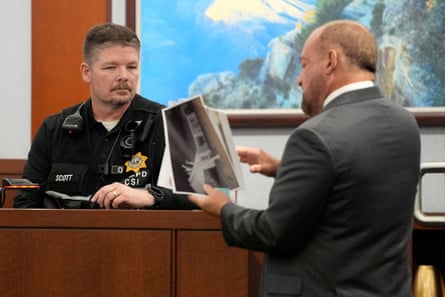
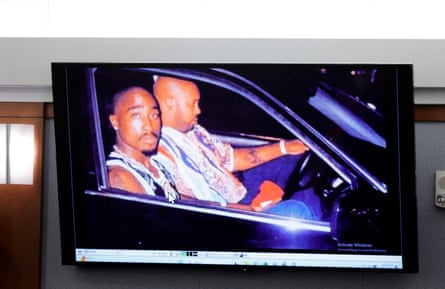
Surveillance footage played at the trial showed Shakur, the Death Row Records founder, Marion “Suge” Knight, and their associates, some affiliated with the Mob Piru Bloods, assaulting Anderson at the MGM hotel in Las Vegas, an attack that Davis would later say prompted him and his nephew to seek revenge on Shakur.
Reggie Wright Jr, the former head of security for Shakur’s record label, testified that in the hours immediately after Shakur was shot in Las Vegas, he made multiple phone calls to a police lieutenant in Compton, California, warning him that Shakur and Knight had “got into it at the MGM with some guys from the Southside Crips” and “There’s going to be trouble in Compton.”
The immediate communication between the Death Row Records security chief and the Compton police on the night of Shakur’s shooting was no surprise: Wright Jr had been a Compton police officer until he retired earlier that year, and he was calling his father, Reginald Wright Sr, then the head of Compton’s gang unit.
The elder Wright quickly passed on the information about Shakur’s Las Vegas shooting to then-Compton gang homicide detective Robert Ladd, who testified that police in Compton immediately braced for retaliatory violence on their streets. “We expected war,” he said.
The violence that exploded over the next 10 days – three killings and 10 attempted murders, including a shooting that left a 10-year-old girl in critical condition – left Ladd convinced that the information Compton police had received about who shot Shakur had been accurate.
“There was no doubt in my mind that the Southside Crips were responsible, because the Mob Piru had to retaliate, and they had 54 other gangs to choose from, but they went right after the Southside Crips,” Ladd testified.
In response to the violence in Compton, Ladd testified, police “rounded up” a large number of local gang members on both sides of the conflict in October 1996, including Anderson, Davis’s nephew. They also invited the Las Vegas police to interview the arrested men. The alleged gang members were “all the players that we heard about that were involved in the shooting of Tupac Shakur”, with the goal “to try to help Las Vegas PD with their investigation”, Ladd testified. Compton officers also collected a large number of firearms, hoping to find the weapon used to murder Shakur, he said.
While Las Vegas sent two detectives to Compton and they did interview Anderson, nothing came of the interview, Ladd testified.
The trial was not the first time the former Compton detective has spoken publicly about the Shakur case: Ladd went public about his frustrations with how Las Vegas police handled the case in a 2002 Los Angeles Times investigation, saying that Compton police had told Las Vegas police a week after the attack that they believed Anderson was the shooter, but that the Las Vegas police rejected the theory.
When Compton police gave Las Vegas police a chance to interview Anderson and other gang members they believed to be involved in Shakur’s murder, “Las Vegas expressed no interest whatsoever in talking to any of them,” Ladd said in 2002, saying that their interview with Anderson lasted only 20 minutes.
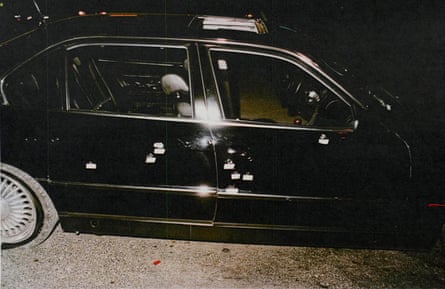
Anderson was publicly identified as a potential suspect in Shakur’s killing less than a month after the shooting, and was widely rumored within Compton to be the one who killed the hip-hop icon. Anderson, his lawyer and his family repeatedly denied he was involved in the killing, but those close to him told the Guardian after his death that the allegations that he shot Shakur shaped his daily life, and that strangers would sometimes recognize him as Shakur’s killer.
In 1997, while Anderson was still alive, Tupac’s mother, Afeni Shakur, filed a civil lawsuit accusing him of murdering her son.
In an audio recording heard in a Las Vegas courtroom 29 years later, Davis described Anderson as the one who fired the shots that killed Shakur.
Police mistrust, gang connections
There were reasons, of course, that Las Vegas police might be skeptical of Compton police, and particularly about information they were sharing about Shakur’s killing.
It wasn’t just that Compton itself had a reputation for political corruption, and that Compton’s police department, battered by scandals and conflicts with the city’s mayor, would soon be disbanded by the city council.
The fact that a former Compton police officer was in charge of security for Death Row Records, and that he had been paid to protect Knight, Shakur and the label’s other artists while they engaged in high-profile gang disputes, concerned Las Vegas detectives because they feared that his father, the head of Compton police’s gang unit, might pass information along to Knight. . Knight himself was known for associating with Mob Piru gang members. He would also continue to make headlines for his donations to Compton city officials.
At the trial, Wright Jr himself testified that he had grown up in a Compton neighborhood that was considered Mob Piru territory, had known many gang members since childhood, and that he had already been employed by Knight as the head of security for Death Row Records during “my last year or two of being a police officer”.
As his private security business grew, Wright testified, he would hire off-duty and retired police officers daily to provide security for Death Row Records’ studio and to accompany the label’s artists to events. He had “about ten officers working a day”, he testified.
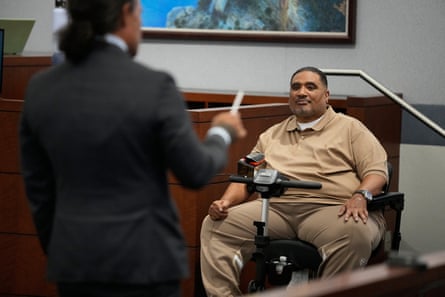
The testimony of “Mob James” McDonald, a 61-year-old who said he had done security and enforcement for Knight, reinforced just how closely Wright and the officers he employed worked alongside the Mob Piru gang members that surrounded Suge Knight.
“His security did, like, the right thing. My security did what they ain’t going to do. You get what I’m saying?” McDonald testified.
It was two Mob Piru gang members who first told Wright that Shakur had been shot, he testified.
In his memoir, Compton Street Legend, Davis accused Knight, the then Death Row Records executive, as having “police hitmen”, and “crooked ass police on his payroll”, and named Reggie Wright Jr and his father specifically. Wright and his father would later be indicted on federal drug-trafficking and money-laundering charges.
When it came to the Shakur homicide investigation, Las Vegas detectives had feared that Wright’s father, the gang lieutenant, or other Compton officers might pass along information to Knight, or try to protect him, the Los Angeles Times reported in 2002. Compton’s police chief at the time removed Wright Sr from the case and replaced him with another officer to address these worries, the Times reported, but it did not assuage the concerns.
As conspiracy theories flourished in the absence of any official narrative of Shakur’s death, the police, and Reggie Wright Jr himself, were regarded as potential suspects in the star’s death, something Wright denied on the stand this past month.
Hostile witnesses, law enforcement turf wars
Testimony in Las Vegas left no doubt that some witnesses to Shakur’s killing did not want to work with law enforcement to convict the hip-hop star’s assailant, and that they preferred to seek street justice instead.
Garry Dale, a former Las Vegas police officer, testified that Shakur himself, lying wounded inside the ambulance, would not identify his shooter when asked, saying only something to the effect of, “No, we’ll take care of it.”
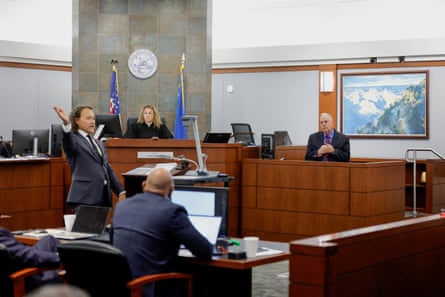
Other witnesses described a fear of being perceived as snitches, and even facing violent retribution, if they cooperated with police or prosecutors. “Mob James” McDonald repeatedly told prosecutors, “You better treat me as a hostile witness”, and refused to answer some questions, saying “Me or anybody else bringing up the dead is wrong.”
But as they investigated the ongoing conflict between the Southside Crips and Mob Piru, law enforcement officers also found themselves caught in their own bureaucratic turf wars.
One of the most outspoken retired officers on the Shakur case is former Los Angeles police detective Greg Kading, who served on the law enforcement taskforce that heard Davis’s 2008 confession to his involvement in Shakur’s killing.
The Los Angeles-based taskforce was originally set up to solve a different murder: the 1997 shooting of Christopher “Biggie Smalls” Wallace, which, like Tupac’s murder, languished for decades without any official resolution.
Wallace’s mother, Voletta, eventually sued the LAPD, alleging that police officers had been involved in the murder. “Desperately trying to cover its ass,” the LAPD set up a multi-agency taskforce to investigate the Wallace murder, Kading wrote in his 2011 memoir, Murder Rap: The Untold Story of the Biggie Smalls & Tupac Shakur Murder Investigations.
In an account that largely mirrors the one Las Vegas prosecutors brought to trial, the book describes how, in a 2008 interview with the taskforce, Davis unexpectedly confessed to his role in Shakur’s murder. The book also alleges a motive and a gunman for Wallace’s murder, which remains officially unsolved. The book ends with Kading’s removal from the taskforce, which eventually shut down without bringing the evidence it had gathered in either hip-hop killing to trial.
“It’s my belief that the LAPD carefully weighed its options and decided that, all things considered, it best suited them to let sleeping dogs lie,” Kading wrote.
It wasn’t that the LAPD wanted to hide the identity of the killers, Kading argued – it was that the specifics of the murder trials in the cases, and the accompanying media coverage, might be messy and difficult for the department’s reputation. In the end, it was more bureaucratic ass-covering, not conspiracy, that stood in the way of justice, he argued. “Rather than manning up to bring these killers to justice, it chose to hedge its bets, letting the investigation die an unnatural death rather than risk the potentially damaging, but ultimately insubstantial, flak that would surely come its way.”
Kading did not testify in the Las Vegas trial. Daryn Dupree, a career Los Angeles police detective who served with Kading on the taskforce, did, and suggested a different motivation for the apparent law enforcement priorities in the case: Davis was a relatively small fish to federal law enforcement officials involved in the taskforce, which had tried, and ultimately failed, to hook a much bigger fish.
After Davis’s initial confession in 2008, the taskforce focused on trying to verify allegations by Davis that Sean “Diddy” Combs, who ran the rival record label Bad Boy Records, had commissioned the hit on Shakur and offered payment, Dupree testified
Despite flying Davis to New York to attempt to verify his link to Combs, the investigators were unable to get the evidence they needed, Dupree said.
The higher-level officials overseeing the Los Angeles taskforce also made the decision to delay sharing intelligence from their investigation with Las Vegas police, Dupree testified. That choice would probably have “led to a lot of frustration” once Las Vegas learned about it, Chutkow, the former federal prosecutor, said.
At the federal level, law enforcement officials on the taskforce were “chasing the money”, and trying to build a racketeering case against both Suge Knight’s Death Row Records, which had signed Shakur, and Combs’s Bad Boy Records, Dupree testified. The FBI, Bureau of Alcohol, Tobacco, Firearms and Explosives and Drug Enforcement Administration were trying to solidify that both record companies had been originally funded by drug sales.
“I’m from the hood,” Dupree said. “Everybody knows that those record companies were started with narcotics. So the feds were looking at a Rico [a case using the Racketeer Influenced and Corrupt Organizations Act]. We cared about the murders.”
‘The defendant implicated himself’
In finally bringing Davis to trial for orchestrating Shakur’s murder, Las Vegas prosecutors relied heavily on two fairly old pieces of evidence: Davis’s 2008 confession to the Los Angeles taskforce, and his public description of the shooting in his 2019 memoir, Compton Street Legend.
In the end, the only reason the case was solved was “because the defendant implicated himself”, said Shirin Bakhshay, an assistant professor at UCLA law school. “This is not amazing police work that uncovered, after 30 years, the facts of the case. This was a guy who thought he was out of the window of any sort of danger – who didn’t understand the legal implications of what he was doing.”
When Davis was finally arrested and indicted for murder in 2023, Steve Wolfson, the Clark county, Nevada district attorney, told reporters, “In this case, justice has been delayed, but justice won’t be denied.”
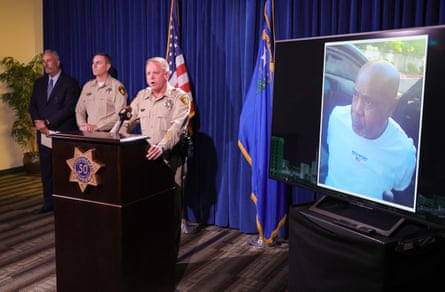
But the delay in securing any official justice in Shakur’s murder “festered for a long time”, Armour, the USC law professor said, and a guilty verdict after 30 years “isn’t going to repair America’s deplorable record of racial injustice in the criminal justice system”.
“It will give at least some sense of closure,” he said. “It will put to rest some of the conspiracy theories that have cropped up around this case.”
While Shakur’s killing had acquired an almost mythical status, and the theories around it were sweeping and dramatic, Armour said, the case prosecutors ultimately made in court was not: Shakur was “a 25-year-old artistic genius, who died largely because one group of young men beat another young man in a casino lobby, and the humiliation demanded retribution”.