.png) 1 month ago
68
1 month ago
68
What makes your life meaningful?
If you don’t really know, you’re far from alone. “We’re in the middle of a meaning crisis,” says Bill Burnett, executive director of the Life Design Lab at Stanford University.
Many traditional sources of meaning, such as religious faith and community, have been in decline for decades, creating a vacuum. Then the Covid-19 pandemic triggered a mass shift in priorities: “People were kind of adrift,” says Burnett.
Now an economic downturn, threats of AI-driven redundancy and future uncertainty may prompt you to wonder: what’s the point?
But finding meaning doesn’t have to be a lofty quest, Burnett says – you can start making your life feel more meaningful today.
Burnett and Life Design Lab co-founder Dave Evans, both mechanical engineers and former Apple employees, apply pragmatic “design thinking” to common life problems.
Their new book, How to Live a Meaningful Life, contains strategies for getting more out of your everyday experience, and finding purpose without upending your life.
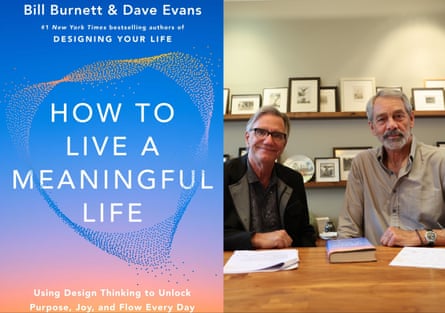
“The meaning of life is a big, philosophical question, and we’re not philosophers,” says Burnett. “But getting more meaning out of life, or living more fully – that, we can help you with.”
Lower the bar – and reframe the question
If you’re struggling to find meaning, you might be aiming too high.
The concepts of finding your purpose (implying there is only one) and self-actualising (or becoming “everything that one is capable of becoming”, identified by pioneering psychologist Abraham Maslow as the peak of human experience) are not just daunting, but broadly unattainable.
Instead, cultivate more meaning moment by moment. “Set the bar low, and accumulate small changes over time,” Burnett says.
In their book, Burnett and Evans identify four key components to “meaning-making”: wonder, flow, coherence and community. It can be quite straightforward to improve upon these, Burnett says.
“These notions that you’ve got to study philosophy, or meditate, or sit on a mountain for a month, or quit your job and do the Eat, Pray, Love thing … you don’t have to do any of that.”
Wonder: go beyond yourself
A better aim than self-actualisation is what Maslow and other psychologists call “self-transcendence”: feeling awe, wonder and connection to something bigger.
It is much more achievable than a “fully realised, fully optimised self”, Burnett says, and there is mounting evidence that it benefits mental health and wellbeing, as well as reducing stress and releasing oxytocin.
The key is to create opportunities for awe day-to-day, rather than wait for a special occasion or a staggering view.
“You can have a moment of transcendent love with your grandkids, or of transcendent beauty [looking at] a flower in the middle of nowhere,” says Burnett.
He and Evans support a regular practice of wonder and curiosity: “The more you do it, the more your mindset changes.” One way to do this: imagine you’ve donned “wonder glasses”, causing you to see the world around you anew. What catches your attention? What’s something wonderful you might have overlooked?
Flow: lose yourself in the moment
Most of the time, our energies are focused on what Burnett and Evans call “transactions”: ticking tasks off a to-do list, responding to unexpected snags in our day, and otherwise working to ensure smooth functioning.
“There’s nothing wrong with that,” Burnett says. But if we learn to shut out thoughts of what’s next and exist solely in the present moment, we can feel more fully alive.
Burnett likens it to the psychological flow state, “the place where time stands still and you’re really connected to the thing you’re doing”. With practice, it’s possible to achieve that total absorption and presence routinely, and escape the “transactional world”, he says. “You can learn how to ‘flip the switch’”.
Try losing yourself in a mundane chore like chopping onions, without a podcast or any other distractions, and imagining that your entire world extends only to the chopping board. Or sit and watch a tree for five minutes until you catch on to the tiny motions of all the leaves. Even going for a walk at half your regular pace can help.
If that sounds boring, increasing your tolerance for boredom is part of the point, according to Burnett and Evans, because it fosters a mindset of acceptance and availability.
Coherence: find your compass
Often, crises of meaning or identity arise when people realise their career and relationships are purely the result of doing what was expected of them, Burnett says.
“People just drift into these situations, then find themselves someday going, ‘Wait a minute, how the hell did I get here? This isn’t what I want’”.
In How to Live a Meaningful Life, Burnett and Evans write that in a coherent life, your actions reflect your values and beliefs. When those three elements are all aligned, meaning arrives more easily.
More from Why am I like this:
Figure out these values, they suggest, by responding to three prompts: What’s going on in your life right now? What does work mean to you? Finally, what do you think gives life meaning?
Your responses will show where your values might be at odds with your circumstances, and how to bring them into greater alignment.
Those insights can serve as a personal compass, helping you navigate change and uncertainty, Burnett says.
He recommends repeating the exercise whenever you are faced with a new challenge or life stage – he even did it himself after publishing this book.
It’s well established that relationships bring meaning, but some are more transformative than others, say Burnett and Evans.
The most influential social groups are what they call “formative communities”: people who share a common interest in getting more out of life and answering the big questions.
Instead of being organised around having a good time or achieving particular goals, formative communities foster a way of being, Burnett says. The only criteria are that members are motivated to lead more authentic, meaningful lives and support each other to do the same.
Try identifying between two and five other people who might be open to these sorts of conversations and meeting (online or in-person) every two or three weeks.“It’s hard to do this journey by yourself … You’re going to find the answer out in the world, with other people and interactions,” says Burnett. The benefits include strong, nurturing relationships, and new ideas and ways of thinking.
Try small steps – and embrace the process
Often, when people feel adrift, they can’t identify what they want or feel is missing, says Burnett – or they might have set their sights on a goal that won’t translate to happiness.
He and Evans suggest looking creatively at dissatisfaction, devising lots of potential solutions, and trying them out. “Again, set the bar low,” Burnett says. For example, if you are considering a career change, talk to someone who has that job. If you believe writing a book would make your life meaningful, try writing 500 words a day, just for a week.
These steps can themselves be meaningful, Burnett points out.
Rather than being an achievement, meaning is perhaps best thought of as a process of becoming that unfolds moment by moment. It also doesn’t have to be so serious. Often, Burnett says, living a meaningful life starts with simply trying “to have a better day”.
-
How to Live a Meaningful Life: Using Design Thinking to Unlock Purpose, Joy, and Flow Every Day by Bill Burnett and Dave Evans is out now in the US and published in the UK on 12 March