.png) 1 month ago
57
1 month ago
57
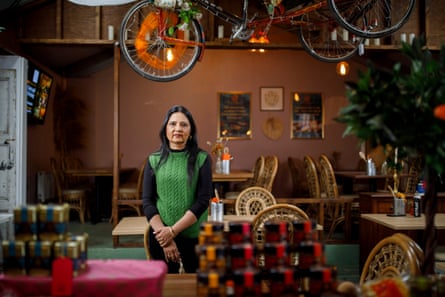
Diners were tucking into their upmarket Indian lunch when the Ice agents slid through the restaurant’s back fence. Armed with stun guns and clad in stab vests, the 11-strong unit blocked off every entrance before moving in on their target: Mandira’s Kitchen. This wasn’t a scene from California or Texas. It happened near Guildford, England, among the rolling Surrey Hills.
Before the Home Office’s immigration compliance and enforcement (Ice) officers stormed the restaurant in September, they came up with a codeword in the event they were attacked with any weapons that might be at hand in a kitchen. What they found were customers eating biryani and samosas in a converted barn decorated with plants and a rickshaw bicycle hanging from the ceiling. When they reached the kitchen, they found five junior members of staff cooking. The officers demanded to see their passports. “They didn’t explain. They didn’t ask for permission,” says the restaurant’s owner, Mandira Moitra Sarkar. That 11 officers could burst into her business with no warrant and question staff is “astounding”, she says. Moitra Sarkar was on holiday in Tanzania when Ice arrived; she was notified by a frantic call from a member of staff.
Moitra Sarkar made her name in the restaurant industry after being lauded by culinary giants including Nigella Lawson and Jamie Oliver. Her prepared dishes, which can be bought online for home delivery, were featured on a Channel 4 competition to find the country’s best ready meals for Aldi. But this wasn’t enough for the Home Office. Its crackdown on illegal working has left many business owners and employees reeling from its heavy-handed tactics.
The immigration officers – from South Central Ice, which covers a patchwork of southern England including Portsmouth, Plymouth and Surrey – were accompanied by two officers from Surrey police, who walked around the restaurant among the customers, watching the scene unfold, and then blocked entry to the toilets. Once the Ice officers entered the kitchen, the members of staff were separated and questioned individually. One employee was asked whether his name was really Shamriaz (officers insisted it was Shabbir); another was quizzed on his wife and his child; one was asked about their studies after showing a university ID. Moitra Sarkar says the officers asked questions such as: “When was the last time you went to university? What grades do you get? Do you get your assignments done on time?” She believes it was “completely ad hoc”.
After 37 gruelling minutes, having failed to find any wrongdoing, the Ice officers left the premises. To top it all off, Moitra Sarkar says, the Home Office vans left the restaurant car park without paying – non-customers are usually charged £2.
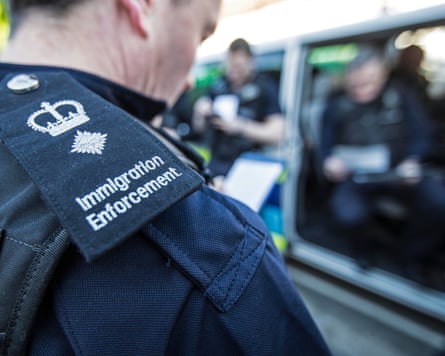
The raid is one of more than 17,400 on businesses carried out since Labour came to power in July 2024 – a 77% increase on the year before and almost as many as in the entire previous parliament. The government says the drive has led to the highest number of arrests for illegal working since records began, but critics say the crackdown goes far beyond the party’s manifesto pledge of a “fair and properly managed immigration system”.
While the UK’s Ice teams were set up in 2013 as part of Theresa May’s “hostile environment” policy, Labour has been using the increased number of raids to front much of the Home Office’s media output. In January, the Home Office set up a TikTok account, @SecureBordersUK, to show Ice officers raiding a market, a car wash and a nail bar. One video, which appears to show people struggling in open water during small-boat crossings, contains a stark message: “To the migrants who come to the UK illegally: you will face deportation or removal.”
Most businesses raided by Ice don’t know why they were targeted. Anonymous tipoffs, which can be made online, appear to be behind many of the raids (including the one on Mandira’s Kitchen). Kevin Barker, a former Ice officer and the director of the paralegal firm Immigration Compliance Ltd, says that while raids are always “intelligence-led”, a tipoff can be enough to trigger one.
There are steps between a tipoff being filed and a raid being carried out, Barker says. Surveillance is sometimes used, including “discreet drive-by surveillance”. Barker says Ice will also “see if there’s any other allegations or previous immigration raids to the business” and investigate if a name is given. But more often than not, he says, “there are no names mentioned – they just have a suspicion of illegal workers”. The nature of anonymity means a tipoff can relate to a personal or commercial grievance. Often, it’s “competitors within the local area” filling out the forms, he says.
Moitra Sarkar holds a sponsor licence, which allows her to employ students or workers who might not normally have the right to work in the UK. “It was all very intimidating. Oh, you’re brown and you’re running a food business? Of course you’ve got illegal immigrants. It’s guilty until proven innocent,” she says.
Racial profiling is a factor, says Seema Syeda, the advocacy and communications director at the Joint Council for the Welfare of Immigrants, which provides legal advice for those targeted by raids. She says the high number of arrests doesn’t paint the full picture. In 2025, Ice officers carried out 12,791 illegal-working raids and made 8,971 arrests. However, the Home Office’s figures show that only a quarter of those arrested (2,251) were detained and 12% (1,087) left the UK, either by force or voluntarily. Syeda says she has seen “many cases where people are raided, arrested and then released”. It is, she says, “very clear to us that this is a performative act”.
When I arrive at Facing Heaven, the owner, Julian Denis, looks hesitant. I’m wearing all black and, for a moment, he worries Ice has returned. His business, a trendy vegan Chinese restaurant near Broadway Market in east London, was raided in September.
It was Saturday night and the restaurant, decorated in bright pink and neon, was packed. About 10 officers made a beeline for the open-plan kitchen. They separated the staff before interrogating them individually, asking to see their IDs and payslips. Apart from speaking to the restaurant’s general manager, James Nolan, the officers didn’t speak to any white members of staff that night. They “singled out non-white, foreign-born workers for interrogation, scaring them with the possibility of being immediately jailed”, says Nolan.
The lead officer told Nolan they were there off the back of an anonymous tipoff that specified “illegal Bengali workers”. After failing to find any illegal workers in the kitchen, having carried out their interrogations in plain sight of diners, the officers asked Nolan if there were any more members of staff on the premises. He said there weren’t. He was then asked the question again, replying with the same answer. Upon being asked a third time, Nolan got frustrated and said not “unless they’re on the fucking roof”. At this point, the officer “gave up trying to catch me out”, he says. The officer told Nolan that they were looking for “five to six illegal workers”.
After about half an hour, with the dinner service halted, Ice left. Nolan asked an officer why they came during their busiest period, allowing customers to “look at this charade unfold”. The officer said they had to come at a “busy time when all staff were working”.
Denis is from the US, where Immigration and Customs Enforcement (ICE) has instilled fear in communities of colour by rounding up and detaining people – many of them legal residents or even US citizens – using aggressive and violent tactics. This feeling has been intensified by the filmed killings of Renee Good and Alex Pretti by federal agents. Denis describes the raid on his restaurant as “a wake-up call”. He says his employees, who are “legally employed and have the full right to work in the UK, should not have to come to work feeling fearful because of their country of origin”. Denis has a two-word message for the Home Office: “Fuck Ice.”
Mandira’s Kitchen and Facing Heaven were raided under the Licensing Act 2003, which makes restaurants particularly vulnerable to surprise visits. It allows Ice officers to enter a business when it is carrying out a licensed activity, such as serving alcohol or selling hot food or drinks after 11pm, without a warrant. In 2025, 28% of all raids were carried out on restaurants, takeaways and cafes, a proportion significantly higher than for any other type of business.
Barker claims that officers often go beyond the powers of the act, which allows them only to enter a business. Once inside, they treat it as though they have “carte blanche to speak to whoever they want to and search wherever they want to”. For example, Ice could enter a restaurant on the basis of concerns over someone without the right to work selling alcohol, but end up rounding up kitchen staff or delivery drivers, who “have no part in the sale of alcohol”.
Ice was given greater power to enter businesses in 2017 after amendments to the Licensing Act were passed. The changes had some notable critics, including the MP for Holborn and St Pancras, Keir Starmer, who told the Commons in 2015 that they would give officers a “much lower threshold than the usual threshold for entering premises”. Barker says the amended act has proved “very powerful” for Ice: “Quite often, I would argue that their intentions have not been anything to do with the licensed activity. It’s just used to give them the power to enter.”
In Surrey, Moitra Sarkar is still seeking answers. She sent freedom of information requests to the Home Office and Surrey police to find out why her business had been raided. The manager on shift at the time had overheard officers say they had received a tipoff, which has since been confirmed by documents she has obtained.
These documents also reveal that the Home Office contacted the council to ask whether it had “licensing concerns” (it didn’t) and invited council officers to join the raid, which Moitra Sarkar believes was an attempt to beef up the legal justification. The “pre-visit report” lays out how Ice used the Licensing Act to authorise its raid without a warrant. It cites the cafe’s website, showing a menu including alcoholic drinks, as evidence that a licensed activity was taking place, which, combined with the tipoff, gave officers the power to enter.
Officers are supposed to get “fully informed consent” from the business owner, which involves clearly saying why they are there and what they plan to do, as well as the potential civil or criminal penalties that could result from their visit. Businesses should also be told that they can refuse Ice officers entry and can withdraw their consent at any time. However, when Ice raided Mandira’s Kitchen, Moitra Sarkar says, the general manager asked the officer whether they could come back another day. The Surrey police officer told her: “No, that’s not how it works,” and pressed ahead anyway.
When the Guardian asked about the raid, Surrey police said Ice and officers from its modern slavery and organised immigration crime unit carried out a joint visit “to complete a routine licensing check under section 179 of the Licensing Act 2003”.
Fizza Qureshi, the CEO of the charity Migrants’ Rights Network (MRN), has spoken to a number of affected business owners, many of whom are from migrant backgrounds. She says many are “not fully informed of what their rights are” and have become resigned to raids being “part of their daily life”. The Home Office doesn’t record ethnicity data when carrying out raids or arrests (although it does record nationality), but research from MRN suggests they are carried out in areas that have large black and Asian populations. Qureshi has spoken to a car wash owner who says he is raided every three months or so, despite no illegal workers being found. The impact can be profound, she says, with raided businesses struggling to shake off the stigma.
A Home Office spokesperson said: “All enforcement operations are intelligence-led. Race and ethnicity play no role in operational decisions. Illegal working undermines honest employers, undercuts local wages and fuels organised immigration crime.”
Tanya Goldfarb, the head of business immigration at the law firm Bindman’s, says care homes, IT companies and hotels have also been targeted by Ice recently. Goldfarb says the raids “are frightening and intimidating” and that people may be handcuffed: “They are taken to detention centres. Sometimes they’re released and sometimes they’re not released. People often don’t know where their loved ones are. They don’t have a chance to make a phone call to anybody.”
While Ice has far fewer powers than ICE in the US, this may not remain the case. Reform UK and the Conservatives have announced plans to create agencies modelled on ICE, should they win power. However, the increase in raids hasn’t come without opposition on the ground. Anti-raid groups are “springing up”, says Syeda. In January, a group in Lewisham, south London, alerted people to a car wash raid. When protesters told those being approached by Ice officers of their rights, no one was arrested.
For Moitra Sarkar, the raid came during a particularly tough time. Days earlier, more than 100,000 people had marched through central London for “unite the kingdom”, a far-right rally at which racist conspiracy theories and anti-Muslim hate speech rang through Whitehall. Her daughter, who was born and raised in Surrey, was told not to go to work that week. “I’ve lived in Britain for 28 years and I’m the most optimistic person that there is,” says Moitra Sarkar. “But so many things happened that week.”
Aside from the personal impact of the raid, Moitra Sarkar thinks it was a waste of officers’ time and taxpayers’ money. “We really need to call it out for what it is,” she says. “Completely ludicrous.”