.png) 4 hours ago
6
4 hours ago
6
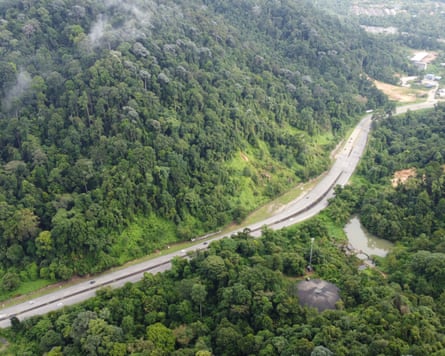
Dawn has broken, and the air is cool and still. It’s at about this time that gibbons usually erupt into song, wa-oo-ing and wa-ing from the highest branches and filling the tree tops with rich melodies. But in this corner of Malaysian forest, bordered by housing and roads, the resident white-handed gibbons are quiet. All that can be heard is the hum of traffic from a nearby highway.
This isn’t a rare occurrence for this group of gibbons, according to research, which found these particular gibbons, named Mambang and Walinong, appeared to be producing far fewer morning songs than others that are not exposed to the same level of traffic noise.
White-handed gibbons, arboreal animals whose calls can travel more than half a mile through dense forest canopies, are known for their complex songs and vocal techniques that have been likened to those of soprano singers. But as their habitats are increasingly fragmented by roads, industry and urban development, researchers say there is a growing need to understand how human-generated noise is affecting when and how they sing.
“Their songs are not just background noise or a way of announcing their presence. They play an important role in communication between groups, territorial interactions and social relationships,” says Nadine Ruppert, associate professor at Xishuangbanna Tropical Botanical Garden, Chinese Academy of Sciences, and a supervisor of the research. “So when we introduce persistent human-generated noise into their habitat, we are potentially interfering with a very important part of their lives,” she says.
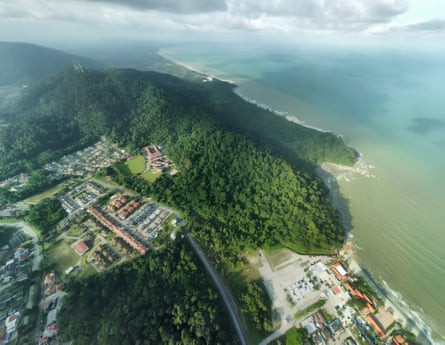
In 2023 and 2024, for a week in both wet and dry seasons, Benjamin Galea, a final-year PhD student at Universiti Sains Malaysia, and the author of the study, recorded and analysed the morning calls of white-handed gibbons living in three different locations that had varying levels of background noise. They included the spot near the highway, which had the highest level of continual noise pollution, a popular hiking trail, and a secluded beachfront location that was the furthest from human activity.
Galea’s research, which is yet to be peer reviewed, found that the greater the background noise, the less likely gibbons were to call. The group living close to the highway called in 36% of recordings – far less than the seaside group (71.4%), and the hiking trail group (84.6%).
Within sites, the estimated odds of calling also decreased as background sound increased.
Galea found that the hiking trail group sang in more recordings than the gibbons located at the beach, a quieter spot. Various possible reasons exist for this, including the hiking trail gibbons’ proximity to another gibbon group, which may have prompted them to sing more to demarcate their territory. The hiking trail group was also located towards the forest interior, so noise posed less of a problem, he says. “They seem to have been able to sing despite the acute noise from humans, but we found that they increase their bandwidth when vehicle noise becomes significant,” says Galea.
It is possible that the highway group avoided singing because the traffic was too loud, or that they were singing at an earlier time – before the study’s monitoring devices began recording, from 6am until 1pm, says Galea. On some days, the gibbons were already midway through their songs when the recordings started at 6am.
Singing earlier could help individuals overcome the problem of noisy cars, but it might introduce other problems, and potentially interfere “with resting, foraging, coordination between partners, or communication with neighbouring groups that are not active at the same time”, he says.
If background noise is driving gibbons to avoid singing, this could affect their ability to maintain their territory, attract mates or warn of predators – though further research is needed to understand if this would ultimately affect an individual’s ability to reproduce or survive.
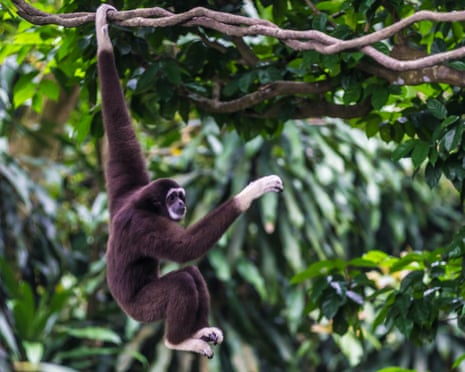
Notably, when the highway gibbons did sing, most of their “phrases” (93.3%) occurred in the context of a solo song, but it is not clear if this reflects normal differences between the groups. “We can only guess,” says Galea. “It’s possible that traffic noise may have made it harder for the pair to hear and coordinate with each other.”
The study adds to a growing body of research that is exploring how human-generated noise is disrupting animals’ routines. Noise pollution has been found to reduce the ability of mammals to hear their prey, with species such as the the greater mouse-eared bat less able to forage effectively when exposed to background noise.
Noise pollution has also been shown to have various effects on birds. One paper found that it reduced the survival of passerine birds by masking parent-offspring communication, while another study in Brazil found it reduced the diversity of bird species in urban parks.
Determining the exact effects of noise on gibbons requires further study. “One important question that we have to ask is how much calling is necessary for successful communication,” says Ulrich H Reichard, professor of anthropology at Southern Illinois University Carbondale, who was not involved in the Malaysia research.
“Even with sustained noise, do they have to call every day? Do they have to call every other day? Do they have to call for 20 minutes or 10 minutes or in order to achieve their goal?” Reichard says.
If gibbons were to issue fewer alarm calls, this might not necessarily put them at high risk of predation, given their ability to swing rapidly through the tree tops, Reichard says. Though it may be bad news for birds and squirrels, which appear to recognise and respond to gibbons’ warnings.
“If you have interspecies communication, even if one species shifts their common behaviour, then that will impact the others,” says Reichard.
Such questions are likely to become increasingly important as forests are more exposed to greater human development. The white-handed gibbon is listed as endangered by the IUCN, which warns that its population is believed to have declined more than 50% over the past 45 years, driven by habitat destruction, and the threat of hunting and capture for the pet and photo-prop trade.
In Malaysia there is no recent population estimate, though the number of white-handed gibbons is believed to have declined over recent decades. Unusually, gibbons remain in isolated plots of land in urban centres, including the capital, Kuala Lumpur.
“In Malaysia, for example, a forest fragment can still look like perfectly good gibbon habitat from a purely physical perspective, that is, it may contain trees, food and sleeping sites – but it may also be surrounded by roads, housing, industry or other sources of chronic noise,” Ruppert says.
As we increasingly recognise the conservation value of urban and peri-urban forests, we need to start thinking about habitat quality in a broader way, adds Ruppert. “It is not only about how much forest is left, but also about what the animals experience within that forest.”
Find more age of extinction coverage here, and follow the biodiversity reporters Rebecca Ratcliffe, Phoebe Weston and Patrick Greenfield in the Guardian app for more nature coverage.