.png) 4 hours ago
10
4 hours ago
10
It starts with drums, heavily reverbed: da-doom-ba-CHA, da-doom-ba-CHA, da-doom-ba-CHA, da-doom-ba-CHA-CHA. Cheap, chugging electric guitars kick in. A song plays, and although it’s an original composition it is at least 60% Blockbuster by Sweet. What in the Tony Visconti is happening? This is meant to be season three of Interview with the Vampire! Has it turned into a glam-rock musical?
Yes. Yes, it has. The show based on Anne Rice’s Vampire Chronicles books – a text it is serially unfaithful to while remaining loyal to the source material’s essence, a camp melange of the sinister, sordid and the deeply, sincerely emotional – was previously set in a lush vision of the past, starting in New Orleans in 1910. There romanced the vampires Louis de Pointe du Lac (Jacob Anderson) and Lestat de Lioncourt (Sam Reid), a sensitive pupil and wild, brittle master whose tumultuous relationship was remembered in a second timeline set in 2022 during an interview with Louis conducted by the journalist Daniel Molloy (Eric Bogosian). At the close of season two, Molloy published the titular book.
In this new series, the old theme music, an orchestral crescendo resolving menacingly into a dissonant scream, has been replaced by that hoofing glitter stomp. Velvet jackets and opera glasses are out; tight trousers and lines of coke are in. Lestat has responded to the salacious biography by forming a glam band, and recorded an album that channels his rage. Now touring it around the US, we join him in 2025 as he storms through a bloodily chaotic stopover in Detroit. A flashforward has taken us to the near future, where an elite auctioneer sells memorabilia relating to the project, including an extensive audio diary, committed by Lestat to vinyl and forming the show’s voiceover. The auctioneer refers, tantalisingly, to “the events of the 2025 album and supporting tour, and the global catastrophes that sprung from [them]”.
This has not come from nowhere: Lestat becoming a rock singer happens in the Rice books. But, as the critically panned 2002 movie Queen of the Damned and Elton John’s swiftly forgotten 2006 Broadway musical Lestat both demonstrated, the part of the oeuvre where vampires mesh with popular music is a tricky proposition.
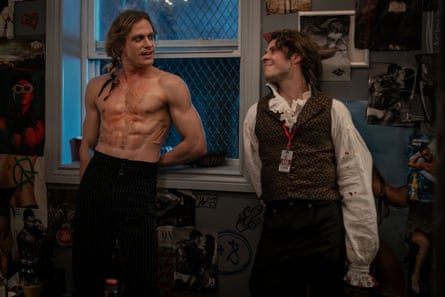
Canon or not, the wholesale shift of tone in The Vampire Lestat, as signalled by the show changing its name, is a risk. Although Lestat choosing 1970s-style guitar music as his route to fame in the 2020s, and doing so successfully, can perhaps be justified by his immortal powers transcending time and fashion, it still threatens to turn what was the sleekest, cruellest and perhaps best TV vampire drama into a bad mashup of Hedwig and the Angry Inch and Daisy Jones & the Six.
To be into it, you have to go along with Reid’s uninhibited performance as a Jim Morrison-style lizard king, while forgiving the retro cheesiness of the songs – pitched somewhere between Iggy Pop, Mott the Hoople and the Dandy Warhols – and the narration’s refusal to acknowledge a limit on how cringeworthy a rock frontman’s pronouncements can be. “I baptised them ‘The Beautiful Unwell’,” says Lestat of his fanbase, an identikit collection of freaks and rejects. Of his constant fraternising with women, whom the old-school pop stars he’s based on might have referred to as groupies, he explains that his undead status has given him “an immortal erection”. Reid’s chewy attempt at an aristocratic mid-Atlantic drawl adds an extra layer of spoofy irony.
Get past all that and The Vampire Lestat is roaring fun, from the man hired by the band’s management to impersonate Lestat on nights out after gigs, thus giving him an alibi for any killing he does while in town – the best doppelganger they can find is an Albanian gangster, also played by Reid – to the scene where Lestat nearly has an overdose because a fan’s blood is so rich in MDMA and LSD, which the tripping vampire bizarrely refers to as “the Torvill and Dean of hallucinogenics”.
More substantial are the easy but rewarding comparisons made between the famous artist and the undead bloodsucker, each of them hiding alienation behind hedonism, each of them elevated above regular society and sometimes yearning to return to normality. Vampires draining the blood of mortals has always been an obvious metonym for casual sex, and the show capitalises on a vampire celebrity taking that exploitation to another level. Lestat in particular is empty-hearted due to romantic disappointment, which heightens the loneliness of the platinum-selling singer.
The Vampire Lestat demands to be taken seriously and works to earn your solemn respect, before mercilessly mocking you with more silliness if you give it what it wants. Trusting it fully would be a mistake, but there’s something invigorating about a drama that never apologises and knows no shame. Let it in and surrender.