.png) 1 month ago
59
1 month ago
59
In the playground of the rich, nobody wanted this war. For decades, Dubai built itself up as a sanctuary of unadulterated consumerism visited by tourists the world over.
But now, the city in the United Arab Emirates faces an existential threat, as the war between the US and Israel and Iran has shaken the foundations of the “Dubai dream” that so many foreigners had bought into.
The UAE has borne the brunt of more than two-thirds of Iran’s strikes; the state targeted in part, say analysts, for its deep military and intelligence partnerships with western powers, and Dubai’s reputation as a favoured centre for global finance and western holidays.
“The shine has definitely been taken off,” said John Trudinger, a British resident of Dubai for 16 years, who is a headteacher at an Emirati school in Dubai. He employs more than 100 teachers from the UK and said most have been so “deeply traumatised and really struggling to cope” with the sudden arrival of war in Dubai that they have left and won’t come back.
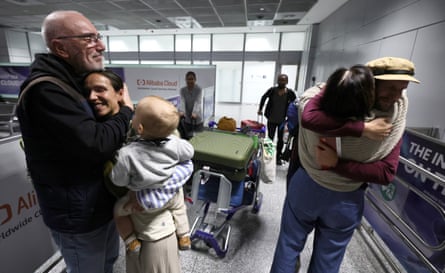
They are among the tens of thousands of residents and tourists that have fled Dubai since the US and Israel launched joint strikes on Iran almost two weeks ago. The city’s large population of migrant workers largely don’t have that option.
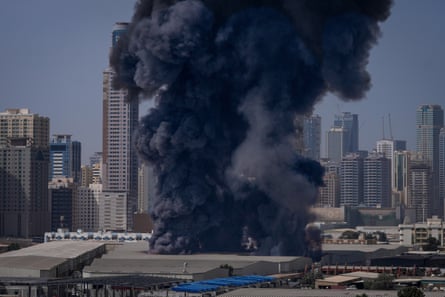
On a daily basis, alerts ping on everyone’s phones, warning of “potential missile threats” and telling them to seek safety and stay away from windows. More than 90% of the 1,700 Iranian projectiles have been rebuffed by UAE’s defence systems, but some have struck significant targets, including military bases, industrial complexes and Dubai airport, shutting down one of the busiest aviation hubs in the world. Attacks on two datacentres briefly left Dubai residents unable to use their phones for digital payments.
The Fairmont hotel, located on Dubai’s famed artificial palm tree-shaped island, home to mega-mansions, lavish hotels and upmarket beach clubs, was also dramatically hit.
Zain Anwar, a taxi driver from Pakistan, saw his car destroyed in the strike on the Fairmont after he had parked it while he went to pray.
“I am the luckiest person in the world to have survived,” he said. “But now my family are telling me to come home. I don’t want to be in Dubai any more, there is no business, we are earning nothing since this war, and I don’t see the tourism coming back. A lot of taxi drivers like me, we are thinking to go to a different country now. Everybody knows that Dubai is finished.”
The economic consequences of the conflict for the UAE are likely to be significant, but nowhere more so than Dubai, where tourism generates around $30bn every year. Over 90% of its residents are foreigners, including one of the world’s highest concentration of billionaires, savouring the lack of tax on income, capital gains and inheritance.
Unlike other Gulf emirates, Dubai does not have vast oil resources to fall back on. Analysts say the financial losses will be stark if the war drags on and the city’s reputation as a haven for tourism and western confidence in business, banking and real estate investments continues to erode. On Wednesday, Citibank and Standard Chartered bank evacuated their Dubai employees “due to heightened security concerns”.
“Already Dubai is losing out significantly,” said Khaled Almezaini, a professor at UAE’s Zayed university and co-author of An Introduction to Gulf Politics. “So far it’s bearable for the UAE’s economy, but if this goes on for another 10 or 20 days then the impact on tourism, on aviation, on expatriate businesses, on oil, will be very difficult.”
There has been a marked effort by the Sheiks that rule Dubai to control the narrative and maintain an image of calm and safety. After a series of panicked posts across social media, Dubai’s police force threatened to arrest and jail social media influencers who shared social content that “contradicts official announcements or that may cause social panic”. A chirpy messaging by officials reassures people that the “big booms” in the sky are “the sound of safety”.
Residents and tourists who remain in the city insist it has been remarkably easy to continue with life as usual, even though the beach bars, malls and five-star hotels remain eerily empty. Along Dubai’s Jumeirah beach, influencers in bikinis can be seen pouting at their cameras, as children frolic on giant sea-borne inflatables, and jetskis routinely cut across the horizon.
Ironically, many of the tourists said they had come here to escape war. “We’re from Ukraine so unfortunately we came from one war zone to another, but that’s life,” said Christina Hallis, 26, as she sipped a cocktail on a sun-lounger. “I still feel safe here, I’m happy to come to the beach and we’ve enjoyed life here. You wouldn’t know there’s a war.”
Collateral damage from the mass tourist and influencer exodus has included hundreds of cats and dogs, so favoured by Dubai’s famed stars of TikTok, Instagram and YouTube, which in recent days have been unceremoniously dumped at the city’s shelters, tied to lamp-posts or left in boxes on the streets as their owners hurriedly left the country. K9, a Dubai animal shelter, described the situation as “disgusting”.
Yet for millions of economic migrants who came to Dubai for labour, construction, delivery and driving jobs, the option of jumping on a plane home is simply not there. There are 2 million Indians, up to 700,000 Nepalis and 400,000 Pakistanis living in Dubai, many of them low-status and exploited economic migrants who are often not free to return as they please.
Of the four people who have died in the UAE since the conflict began, three of them were south Asian workers, including a Pakistani taxi driver, a Nepali security guard and a Bangladeshi water tanker driver. Drone strikes near Dubai airport early on Wednesday morning injured two Ghanians, an Indian and a Bangladeshi national.
In Muhaisnah 2, a district far on the outskirts of Dubai where most of the labour hostels are situated, Ebenezer Ibrahim, 29, a labourer from Nigeria, was one of the few who was informed of the conflict.
“We are all humans and we bleed so of course I worry about these missiles,” said Ibrahim. “But the government is doing a good job intercepting them for now. Coming from Africa, there are many problems in my own home too. I have my goals and I will stay here to work for them.”
Most in Muhaisnah 2 shrugged off concerns and said the war had nothing to do with them. But the family of Saleh Ahmed, a 55-year-old Bangladeshi driver who was killed by missile debris his worksite in Dubai, argued that the lack of information and clear warnings given to him and other workers about the conflict had proved fatal.
“I only understood the scale of what was happening when I came back to Bangladesh and saw the news here,” said his younger brother Zakir Hussein, 35, who also works in Dubai.
“Honestly, workers in Dubai are scared to talk – we were always given the feeling that we can’t say anything bad about the country because it would get us into trouble. If we had known what was really happening, my brother might have tried to get somewhere safer, or come home.”
Hussein said that after losing his brother, going back to Dubai, especially as the conflict continued, felt “unbearable”. “But Dubai is the only place we know how to earn,” he said. “Our families are depending on us.”
Redwan Ahmed contributed reporting