.png) 1 month ago
51
1 month ago
51
It’s here at last. The medical drama that took its native US by storm last year has finally crossed the pond. All 15 episodes of The Pitt’s first season, set in almost real time over a single shift in the overstretched emergency department of a busy Pittsburgh hospital, are being offered to tempt us all into subscribing to yet another streaming service – HBO Max, which also promises other baubles, such as the new Harry Potter series and the adaptation of DC Comics’ Lanterns plus rich pickings from its prestigious back catalogue, such as The Sopranos, Succession, Game of Thrones and Friends (which departed Netflix last year, giving many viewers the first insight into the true transience of life).
But The Pitt is the one that we older viewers, perhaps, have been waiting for. For it comes from much the same team that produced the then-groundbreakingly gritty ER, and it stars one of its most enduring talents, Noah Wyle. He arrived in the 1994 pilot episode as third-year medical student John Carter, and we followed him as he endured, then thrived under Dr Benton’s tough-love training, qualified in emergency medicine and moved up the ranks at Cook County before bowing out as a main character in the season finale in 2006. With many a literally heart-stopping moment in between, let me tell you. The show made a megastar out of George Clooney (as womanising paediatrician Doug Ross) but Wyle was never less than brilliant.
Now he plays Dr Michael “Robby” Robinavitch, bringing all the subtlety and intelligence to a part that could fairly be described as Carter all grown up, but is absolutely none the worse for that. Dr Robby is the senior attending physician in the Pitt, the name he gives the underresourced department, whose patients, unless in absolute medical crisis, overflow from waiting room to hallways and wait for hours and sometimes days to be seen. He is suffering from PTSD since the loss of his mentor in the pandemic – he has PPE-shrouded flashbacks to the department overflowing with Covid patients – but hasn’t yet lost his patience or compassion, even if he no longer has the energy to plaster on too bright a smile.
Each episode covers an hour of a single shift (the first covers 7-8am as Robby arrives, takes the measure of what has come in overnight and meets the batch of new interns that are going to help or hinder for the next 15 hours). There are bursts of activity – a gunshot wound, a woman who was pushed or slipped under a subway train – and occasional gory injuries (the opener has a “degloved” foot, the second episode a “floating face”. (If you are planning to Google these phrases to see if you can cope with watching, simply don’t. Either nothing ever bothers you and you don’t need to, or some things do and these undoubtedly will. You’re welcome.) It doesn’t, however, have the relentlessly frenetic pace of ER. It has more confidence than that, and seems to recognise that when you are working in so many issues of the moment a relatively traditional storytelling format is a good basis from which to proceed.
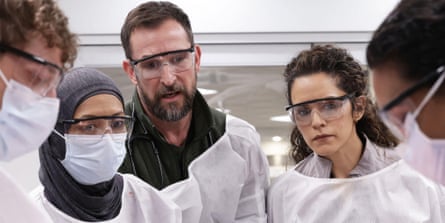
Thus as well as punchy, urgent scenes there plenty of long story arcs, such as the unstoppably vomiting woman who comes in with her teenage son, David – who turns out to be the real problem for the Pitt’s team, or the elderly man with dementia who arrives with mild lung problems, but deteriorates and whose children are in conflict about whether his directive for non-intervention should be obeyed. They are given time and space enough that nothing feels contrived. Similarly, whenever the medical bleeds into the social and personal (as with stories that dramatise the effects of state abortion laws, the vax/anti-vaxxer divide and the breakdown of trust the Trump administration drives, or which look at the disparity of outcomes between races and so on) there are no heroes or villains, just sorrows, impossibilities and medical staff having to make decisions about how much they can spare for one patient when they are responsible for so many others, too. And, of course, pulsing underneath always is the essential barbarism of the US health insurance system.
The rest of the large but not sprawling cast is just as strong. From intern to attending via all kinds of support staff, they have their own characters, backstories, needs, strengths and flaws. Showrunner John Wells handles it all with aplomb. But Wyle is the rock – the actor upon which Wells must know he can build any story, as large or small, as dramatic or quiet, as he wants.
-
The Pitt is on HBO Max now