.png) 2 months ago
62
2 months ago
62
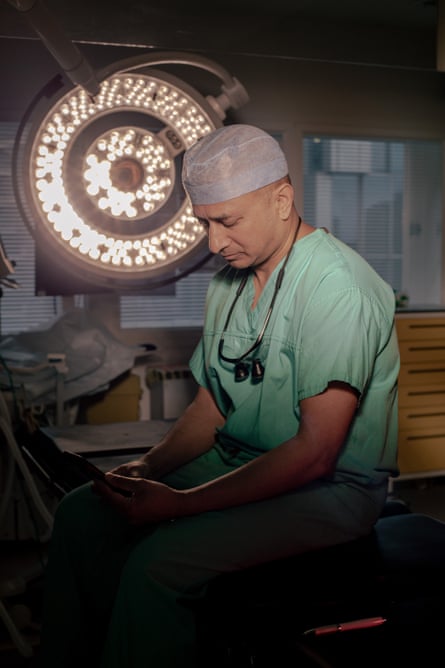
On 22 March 2017, trauma surgeon Shehan Hettiaratchy was running end-of-term exams for his medical students when his phone buzzed. There had been a terror attack near the Houses of Parliament. Three men had driven into pedestrians on Westminster Bridge, then started stabbing people on the street. Within minutes, Hettiaratchy was in a car with a colleague and heading to St Mary’s hospital near Paddington, west London, where he is the lead surgeon. Victims injured in the attack were due to arrive.
Though Hettiaratchy and his team were used to treating patients with life-threatening injuries – on paper, he says, what they were facing was no different from “a busy Saturday night” – this felt different. There was “a collective fear that we’re under attack – there are people on the streets of London trying to kill our fellow Londoners”.
On the day itself (documented in the BBC series Hospital) Hettiaratchy was in charge and had to think practically and methodically: “This is patient A, patient B, patient C; what are the injuries, what needs to happen, what needs to go on?” Detaching yourself is “probably why you can stay locked in”, he thinks – and ultimately how you get the job done. That day, staff at St Mary’s treated 15 people who had been injured in the attack, including the perpetrator, Khalid Masood, who, later died, having been shot by a police officer. While all of the other patients treated at St Mary’s survived, five of Masood’s other victims died.
But that evening, after all the patients had been seen and emergency surgery performed (Hettiaratchy himself was tasked with operating on Stephen, who had been out celebrating his birthday with his wife when he was hit by Masood’s car, damaging his leg, skull and chest), the trauma surgeon felt a “gut punch” of emotions. Hettiaratchy is passionate about making sure healthcare workers are equipped to deal with the emotional side of the job, as well as the clinical one. The “most important thing” he says to his medical students, he writes in his new memoir, The Careful Surgeon, “is that they should stay horrified by what they see – they need to stay shocked”.
If you’re able to detach from your feelings completely, “you’ve lost your humanity”, he tells me when we meet in a part of St Mary’s that was meant to be rebuilt “about 30 years ago”. It may finally get done in another 30 years, he jokes. But while he clearly sees the need for improved material resources in the NHS, “humanity is really the thing that we cannot afford to lose in healthcare”. To disconnect from what a patient has been through and how they must be feeling would mean to become “inhuman”, he says, which, in addition to not being “good for me as an individual”, is also bad for the patient. “If I’m not emotionally connecting to them, can I really understand what they need?”
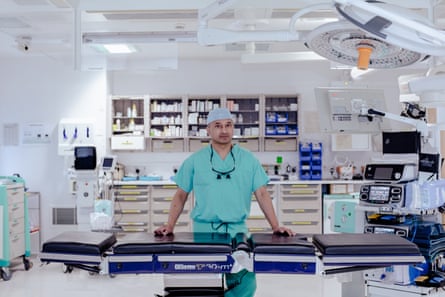
Clearly, it takes a certain kind of person to handle a job in which you are required to think compassionately and methodically in the face of horror. But Hettiaratchy has always been attracted to “life and death situations”, he says – as a teenager in Hampshire he narrowed his career options down to joining the military or following in his psychiatrist parents’ footsteps and becoming a doctor. In the end, he did both: joining the army for a year before starting medical school and, later, taking time out from his work in London to serve as an army doctor in Afghanistan. These days, as well as his work as a consultant surgeon in London, he is the national clinical director of armed forces healthcare, and has worked with the frontline medical aid charity UK-Med on surgical missions in Ukraine and Gaza.
“I’m not sure what I was trying to prove” by entering war zones, he says. “But it felt like something I needed to do for me.” He says that there was a certain amount of feeding his own ego involved, but to some extent working as a surgeon requires that anyway, he thinks. “You couldn’t walk into an operating theatre, take a knife in your hand and cut somebody open unless there was something a little bit wrong with you,” he says. “That’s a deeply unnatural act. Our brains are literally programmed against doing violent things and seeing violent things.” To overcome that natural revulsion and survival instinct, “you have to back yourself … Is that self-confidence? Is that ego? It’s a fine line.”
Though the calling requires, he believes, being a bit of a sociopath, after a patient has woken up “you have to be opposite. You have to be caring, you have to be empathetic.” Hettiaratchy is candid about the fact that not all surgeons are able to strike this balance. “I think we get it wrong,” he says. “We’re not trained to come and do that switch on, switch off, that change of emotion – we don’t even talk about it.” Often surgeons can do the “switch off” from the emotional side and perform surgery competently; “but sometimes they’re not so good at doing the second part, which is switching on human emotions again”. Things are getting better – you’re less likely to find “old style” surgeons these days, he thinks, whose attitude is “I’m always right” and who are “egotistical, arrogant, unemotional”. According to Hettiaratchy the need to be empathetic and honest about your own performance is acknowledged much more within the profession now, but surgeons should still “properly be critical about what we do”.
Hettiaratchy has tried to instil better communication within his own teams. After the Westminster attack, for example, he arranged a whole team meeting, led by the counselling team, to talk through what had happened. He also invited his patient Stephen and Stephen’s wife, Cara, to discuss their experiences. They finished the talk by thanking the staff for their help; for some it was the first time they’d ever been thanked for their work. “People often don’t say thank you,” he says. “It’s taken as read.” That experience prompted Hettiaratchy to ensure his team were discussing and reflecting on their work – whether it was thanking and praising one another, or addressing any mistakes. “That’s what people need,” he says, adding that the days of surgery being a “very technically focused profession” that encouraged a “stiff upper lip” approach must end.
Hettiaratchy had to contend with his own ego in 2012. He was faced with the decision of whether or not to perform complex surgery on Helena, then 12, who had severely injured her leg falling off a banana boat while on holiday with her family. The alternative was amputation – which some of Hettiaratchy’s colleagues believed was the safest option. At that point in his career, it “was the most difficult case I’d ever done”. Part of him wanted to do the operation simply to test his own limits, because it “would be a really exciting operation to do”. He had to keep those thoughts in check, he says, and asked himself: “Who are you doing this operation for? Is it for you or is it for the patient?”
He discussed the case extensively with colleagues, and with Helena and her family – who were keen to try the operation, knowing its risks. Ultimately, what “cut through” was thinking of his own children, who were a similar age to Helena. He asked himself: “If it was my daughter, what would I do?” He knew then that he had to give the surgery a try. After two long sessions in the operating theatre, with several dicey moments, Hettiaratchy and his team succeeded. When he told Helena’s parents the good news, he decided to put the proud speech he had prepared to one side. “In this moment, her parents did not need to know how close we had come, or thought we had come, to failure,” he writes in The Careful Surgeon. “The whole process was about making sure that Helena got the right result; it was about her, not us.”
Though there are remarkable success stories such as Helena’s in Hettiaratchy’s book, he also describes many occasions when he wasn’t able to save patients, or when a limb he attempted to repair ultimately had to be amputated. He says he only agreed to write a book in the first place because he had “had [his] arm twisted” – presumably because, ever since former doctor Adam Kay’s bestselling This Is Going to Hurt, medical memoirs have become a popular genre. When he started writing, he didn’t have a clear idea of what the book was going to be, and began, on the suggestion of his editor, to simply document his experiences. As he did so, he realised the thread running through the stories was one of hope. As a surgeon, “you see the very worst things, and you also see the very best”. While facing the horrors head on is important, the “lightness” of the job “will always outshine the darkness” – and that’s what keeps him going.
One of those “light” moments was working for the NHS during the Covid-19 pandemic, when, because surgery was restricted to emergencies only, he volunteered to help in the intensive care unit, where he was supervised by a nurse. Not being in charge for once “was weird” he says – but it was also “really eye-opening” to see the day-to-day care that nurses provide, which “in any other context, you’d say are acts of love”. Nurses “bore the brunt” during that challenging time, he believes. Hettiaratchy doesn’t think nurses are paid what they should be and is supportive of the strike action taken by nurses and resident doctors (formerly known as junior doctors) in recent years to try to achieve higher pay. When it comes to resident doctors, he says there needs to be an understanding that if you want “the brightest, the most able, the most talented, the most motivated, the most emotionally intuitive” young people to work for the NHS, then there has to be an incentive. “It’s not just about pay … we need to look at the conditions as well,” he says. “If we cannot make this workforce happy doing a job they were chosen to do, then we’ve got something wrong.”
Hettiaratchy is clearly passionate about the next generation of doctors. Likewise, he found a great deal of fulfilment training surgeons in Ukraine, a project he is still working on, and excited by. “We’re training them how to do reconstructive surgery post-conflict,” he says. There are plans to do the same in Gaza, too – though he and his team have only been able to visit for a few weeks. He is clearly nervous to talk too much about the conflict in Gaza, and doesn’t mention it in the book. “I didn’t feel I could really contribute to that conversation in a meaningful way,” he says.
Though his modus operandi is optimism – “there’s always a chance of resolution” when it comes to war, he says – he does “kind of worry” about the legacy of the conflicts in Ukraine and Gaza. What he realised in Ukraine was that, while the country had prepared for war militarily, it “had not prepared for the healthcare consequences of war” – which is something doctors around the world need to learn from. For him, healthcare systems need to be planning and training for how to respond to war in advance.
For Hettiaratchy, health services must be prepared for any eventuality – something that became particularly clear to him after the Westminster attack. “It will happen again,” he says. “That’s just the way it goes.” Whether it’s another terrorist attack, or a train crash, or another kind of emergency, “we’ll end up with that same kind of scenario of us being down at the bay, waiting for patients to come in who’ve been injured. But that’s kind of the job.”