.png) 1 month ago
50
1 month ago
50
This weekend, after the longest hyping up period for a British comedy in ages, Saturday Night Live UK finally launches on Sky. It arrives with a degree of divisiveness that most shows don’t usually attain until at least a few episodes in, with some people willing it on, others are convinced that it will fail. Already there’s been a note of pre-emptive schadenfreude online, with every last piece of promotional material – even a fairly innocuous advert with the letters S N and L spelt out in baked beans – pounced on as evidence that the show will be a complete bin fire.
And maybe it will. I’m hopeful that SNL UK will prove better than many expect: there are some good young comics attached; some shrewd people behind the scenes (it’s heartening to see a couple of members of the great sketch group Sheeps on the writing staff); and the steely presence of original SNL creator Lorne Michaels, keeping an eye on things as exec producer. But equally, this is a hell of a high-wire act. Putting on a live comedy show every week is a daunting enough prospect; but add to that the reputational weight of the original SNL – arguably the US’s most famous comedy export – and it becomes something else altogether.
And that’s one of the concerns about this new UK version: that it will be trapped between the comic traditions of its forerunner and those of the UK; a transatlantic mishmash that appeals to no one. So, how to avoid this? Well, SNL UK could take some pointers from another comedy airing the very same week: series two of Last One Laughing UK.
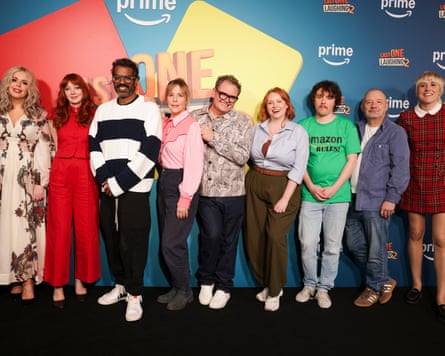
OK, in fairness, there’s probably not that much SNL UK can really learn from Last One Laughing: one is a scripted variety show broadcast once a week; the other is, in essence, a comedy reality show, largely unscripted and edited in post-production. It’s like comparing apples and ferrets. But something both shows share is that they are franchises that started out elsewhere: Last One Laughing is based on a Japanese format that has been exported to 30 countries. Each version has the same essential template: chuck a load of comedians in a room together for six hours, remove them if they laugh and the last one not to do so is the winner.
On to that template each version of Last One Laughing adds its own national comedic style: the Philippine version looks and feels dramatically different to the Canadian version, for example. Each iteration primarily exists for the audience of the country it is made in. “The Irish version is so Irish,” Graham Norton told the New York Times for a piece on the format’s success. “Lots of the references in the show are deep-dive Irish references, things that a UK audience wouldn’t even understand.”
The UK version of Last One Laughing, which is on Prime Video, has a specificity of its own, created by its cast of comics. In its first series, the crackpot surrealism of Bob Mortimer rubbed up against the eyebrow-cocked, literate comedy of Richard Ayoade or the raucous big-boss-girl humour of Judi Love (this time around, David Mitchell, Alan Carr, Diane Morgan and the like will create an altogether different comic chemistry). It feels telling that the biggest viral moment from series one was a mock presentation that Joe Wilkinson made about the RNLI: there’s no attempt to cater to some vague international audience, and the show is better for it.
That’s something SNL UK should be conscious of too, in order to create a bit of welcome separation from its namesake. Indeed, the last time that SNL was “adapted” for UK screens, in the form of Channel 4’s 80s series Saturday Live, it barely took anything from the original aside from the first and last words of its title. Instead, it lifted from British variety show traditions as well as the alternative comedy scene that was bubbling up at the time: its most successful weekly segment, Ben Elton’s five-minute burst of staccato, politically tinged standup, which made him a star, would have felt wildly out of place on the original SNL.
Advance word suggests that SNL UK won’t blow up the format quite that much. The Weekend Update segment will be ported over, though with a more British focus, and the presence of Tina Fey as host of the first episode will definitely make the through-line between US and UK clear. But there is a consciousness that British humour should poke through the SNL branding. We’re more “open to the absurd and maybe the trivial”, cast member Celeste Dring has said. “We’ll flirt with the darkness a bit more.” Here’s hoping they pull it off.
To read the complete version of this newsletter please subscribe to receive The Guide in your inbox every Friday