.png) 1 month ago
59
1 month ago
59
How do you solve a problem like Viktor Orbán? By crossing your fingers and hoping it disappears in just over three weeks’ time. But even if the European Union’s disruptor-in-chief is ousted in elections next month (which is far from certain), Europe’s Hungary problem is unlikely to vanish overnight.
EU leaders will gather in Brussels on Thursday and Friday for yet another summit that will be at least partly hijacked by Orbán, Hungary’s illiberal prime minister.
The US-Israeli attack on Iran and ensuing energy crisis have already derailed the original agenda. But the big unresolved issue hanging over the summit – and infuriating Orbán’s fellow EU leaders – is his decision to block a planned €90bn EU loan for Ukraine, which all 27 agreed on unanimously last December.
As Brussels correspondent Jennifer Rankin told me: “Reneging on a deal agreed by heads of state and government strikes at the heart of how the EU operates. And there’s no appetite for cobbling together an alternative financial plan for Ukraine.”
It is, of course, hardly the first time Orbán has threatened to stick a spanner in the EU works. Indeed, Hungary’s vetoes have become so common that diplomats suggest that the bloc is not even trying to table some proposals.
Hungary, the CSIS thinktank notes, accounts for just 1.1% of the EU’s GDP and 2% of its population. But Orbán’s assault on the rule of law, rejection of rights and values enshrined in the EU treaties and consistent opposition to EU foreign policy have caused the bloc a wholly disproportionate number of headaches.
Budapest has “repeatedly threatened to veto new sanctions against Russia or aid to Ukraine to extort concessions” such as unfreezing funds withheld by Brussels over democratic backsliding, CSIS researchers Donatienne Ruy and Maria Snegovaya say.
“It has continued to buy large amounts of Russian oil and gas. Orbán has met with Russian president Vladimir Putin at least four times since Russia’s full-scale invasion of Ukraine (and about 15 times since Orbán came to power in 2010).”
According to a Euractiv tally, Hungary is blocking not just the €90bn loan but also accession talks with Kyiv; a new sanctions package on Russia; sanctions on violent Israeli settlers in the West Bank; measures against Georgia’s ruling party, and more.
Orbán is also “the poster child for the illiberal movement in Europe”, stresses the German Green MEP Daniel Freund, assembling around him a wrecking crew of like-minded EU-critical leaders such as Slovakia’s Robert Fico, the Czech Republic’s Andrej Babiš and – perhaps later this month – Slovenia’s Janez Janša.
On 12 April, however, in what will almost certainly be the most consequential vote in (and for) Europe to be held this year, Hungarians are due to elect a new parliament and government – and for the past 15 months, Orbán has been trailing in the polls.
Polls, populist campaigns and policy shifts
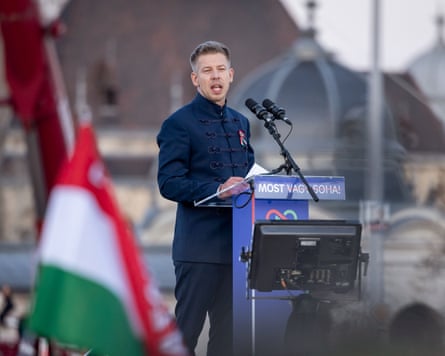
So will everything change? There are, unfortunately, several reasons why it may not. First, Orbán may not actually lose. Polling averages put his centre-right challenger, Péter Magyar and his Tisza (Respect and Freedom) party, between 9 and 11 percentage points ahead – sizeable, but not sizeable enough to rule out an Orbán win.
For one, the polls may not be reliable, in part because Orbán and his Fidesz party have had four governmental terms to tweak the system to their advantage, making hundreds of changes to electoral rules that, together, effectively exaggerate Fidesz’s majorities.
Wins in a small number of constituencies could have an outsized impact on the overall result: in 2014, Fidesz won almost 70% with just under 45% of the vote. Tisza may need a six-point lead in the popular vote simply to secure a parliamentary majority.
The 62-year-old prime minister is running a classic populist campaign, telling voters they can preserve Hungary as “an island of security and tranquility” by electing him, or drag it into chaos and war by choosing Magyar, whom he paints as an evil agent of Brussels and Kyiv.
In an increasingly bitter spat with Ukraine over the closure, following Russian attacks, of the Druzhba pipeline that transports Russian oil to Hungary, Orbán has accused Kyiv of threatening his family, impounded Ukrainian armoured bank vehicles and ordered extra security at critical energy sites, claiming they are at risk.
Four years ago, soon after Russia’s full-scale invasion of Ukraine, his scaremongering – along with generous cash handouts to selected voter groups – worked. It appears to be proving less effective this time round, but it may well work again.
Second, if Orbán does lose, especially by a narrow margin, he could simply refuse to step down, leaving the EU facing what the European Policy Centre thinktank calls “an unprecedented situation: an illegal and illegitimate government sitting at the table”.
“He could rely on captured courts and the outgoing parliament … to pass constitutional laws or obstruct a transition of power,” says European Policy Centre analyst Eric Maurice, urging the EU to make clear its “ultimate red line” – election manipulation and refusal to accept democratic outcomes”.
Finally, even if Magyar wins and Orbán accepts defeat, it is unclear exactly what the new PM will be able to do. “Orbán has been in power for 16 years,” says Freund, who returned last weekend from a fact-finding mission to Hungary.
“He has appointed everyone who is anyone in the public media, the courts, the state agencies, the central bank … If his appointees refuse, for example, to approve the new government’s budget, Tisza could be facing snap elections within a year.”
Poland’s prime minister, Donald Tusk, is having a hard enough time rolling back the previous nationalist government’s judicial and other reforms, Freund noted – “and Law and Justice (PiS) had only been in power there for eight years. Magyar faces a truly formidable challenge”.
Plus, says Freund, when it comes to Hungary’s dealings with the EU, though a Tisza-led government “will want to avoid isolation, it won’t want to veto” – nobody should expect “a complete policy shift” on hot-button issues such as Ukraine or immigration.
For the time being, Jennifer says, EU leaders appear confident that they will win Orbán over on Ukraine’s desperately needed €90bn loan. “A deal is a deal,” one senior EU diplomat said, and if Orbán doubles down on a course he clearly thinks will win him votes, he will cross a bridge never crossed before.
But, while the bloc’s relations with its most troublesome member may improve after next month’s election, there is no real guarantee that it will all suddenly become plain sailing.