.png) 1 month ago
58
1 month ago
58
There are ludicrously fast-growing sports – and then there’s padel. According to the Lawn Tennis Association, only 15,000 British players picked up a padel racket in 2019 … but by the end of 2024, that figure was more than 400,000. Of those, about 399,000 are probably mispronouncing it: think pah-dell rather than paddle. But get used to strange looks if you insist on saying it like that.
People love padel because it’s so easy to play. If you can hit a ball with a racket, you can play – and there’s something joyous about whacking any ball over any net. You don’t need to be incredibly fit either: while better players will be constantly on the move, casual players can get away with something akin to walking pace.
Padel isn’t as technical a game as tennis, but there are plenty of tactics and techniques to pick up. Good players don’t just whack the ball as hard as they can: in most cases, the ball will bounce back towards the middle of the court, perfect for a clever player to angle away. Padel is a game of subtlety and control.
All of this means that padel’s appeal is spreading across every age group, and with that comes difficulty finding courts to play at and, if they are available, at wallet-singeing rental prices. Local to me in Buckinghamshire, I hired a court for £28 an hour for these tests, which is considered low for peak rate in the UK. In some places, especially London, peak rates shoot up to £50 an hour. However, padel is a game for four players, so you can at least split the cost. The good news is that the number of UK courts is growing, as tennis clubs and even local authorities seize on it as a great way to make money.
Hopefully, by this point, you’re interested in playing. To do that, you’ll need a racket. The majority of venues provide a basic racket for first-time players, though it makes sense to invest in something that’s right for you – and that’s exactly why I wrote this buying guide.
At a glance
-
Best padel racket overall:
Babolat Counter Origin
-
Best padel racket for beginners:
Decathlon Kuikma PR Rental
-
Best for ‘control’ players:
Babolat Counter Veron 2025
-
Best for ‘power’ players:
Wilson Bela V3 Padel (2025)
-
Best padel racket for kids:
Babolat Alioth JR
Why you should trust me
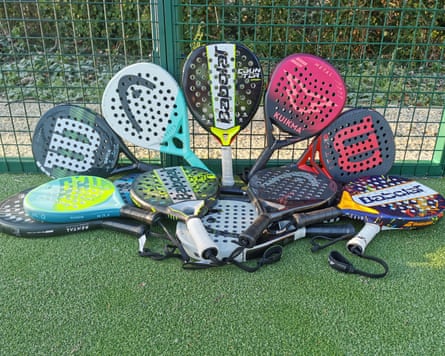
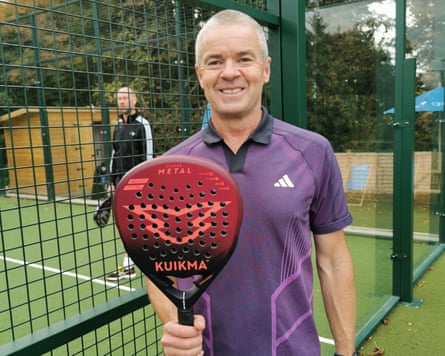
I have been reviewing products for more than 25 years, including for the Sunday Times, Which?, and technology magazine PC Pro (which I also edit. To say I love racket sports is an understatement: I am chair of my local tennis club and have played in matches. As with the rest of the UK, I’m a relative newcomer to padel, so I worked with a padel coach and four other players to put almost 20 rackets to the test – only the best made it into this guide.
How I tested
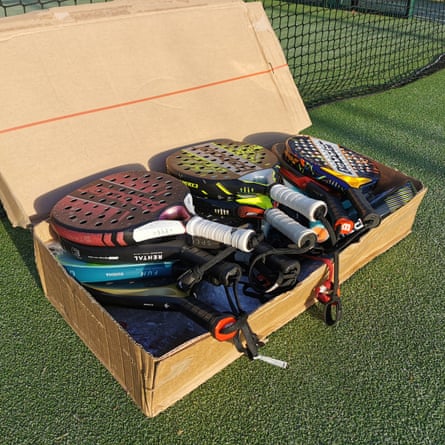
Here’s the formula: drive to a nearby padel court, haul a huge cardboard box of rackets out of my boot, struggle with them to the side of the court. Almost without exception, the eyes of every player I encountered lit up with desire. Some would say envy.
“That’s a lot of rackets, are you keeping them?” came the inevitable question, followed by my equally inevitable reply that they were all on loan from the respective companies and would be heading back to them as soon as I’d finished my tests.
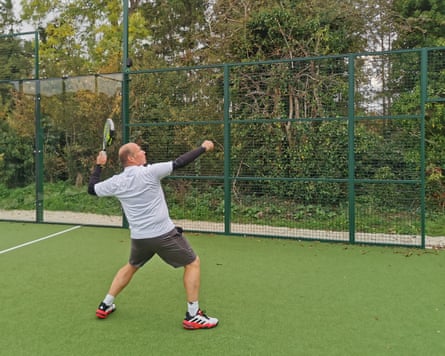
The other constant was my main fellow tester and player, Kevin, who also falls into the “beginner” category, but who is irritatingly good at racket sports and was immediately given the top possible rating by the UK Padel coaches. I was also lucky enough to work with UK Padel coach Andy Keeley, who also looked enviously at the boxful of rackets when we first met. “Bad timing for me,” he said, “I’ve just spent £200 on a new racket.”
I tested 19 rackets from six manufacturers: Babolat, Bullpadel, Decathlon, Dunlop, Head, and Wilson. All the comments are based not only on my own experience, but also on those of Andy, Kevin, Kevin’s 15-year-old daughter, Eveline, and two other players, Hannah and Ina.
The best padel rackets in 2026
Best padel racket overall:
Babolat Counter Origin
Babolat
Counter Origin
from £67.98
What we love
Big-brand quality for a low price
What we don’t love
You can’t whack the ball a little harder
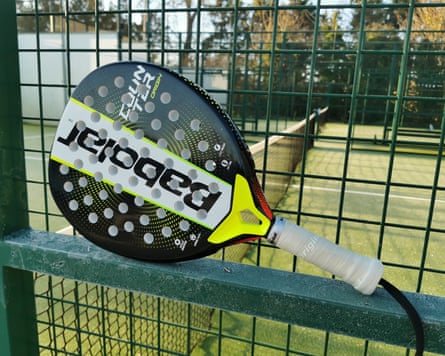
This is a fantastic first racket for players who have outgrown the rental rackets, but don’t want to spend more than £100 – which, as we shall see, is so easy to do.
Why we love it
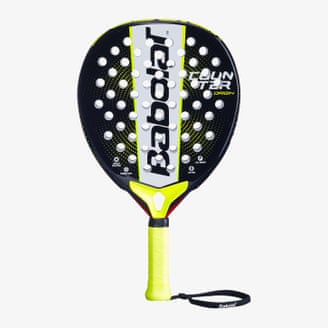
People often talk about compromise as if it’s a bad thing, but for me, the Babolat Counter Origin is the perfect compromise racket. You may be sacrificing the power with which you can hit a ball and how much spin you can apply, but you do so in return for all-round balance – and a great price.
It features a round head shape, which expands the amount of surface area with which you can hit the ball, without it going off in a wild direction – something Andy, the padel coach, commented upon too. He added that he could still add plenty of bite on volleys. That is, there was enough friction on the surface that he could add backspin when slicing, which helps to reduce how high the ball bounces when it comes off a wall. That’s often the difference between winning and losing a point.
The other big positive of this racket is its weight. There are lighter rackets still, but at 355g, few people will struggle with this. It also feels well-balanced.
It’s a shame that … there isn’t more power. This is arguably the biggest compromise that comes with round rackets, but when so much of the game of padel is about control, rather than power – angles, rather than aggression – I don’t think that’s a bad thing for a first racket. Some may also bemoan its lack of a roughened surface, but as mentioned, you can still add the necessary “bite” if you hit the shot correctly.
Weight: 355g
Shape: round
Balance: head light
Babolat
Counter Origin
from £67.98
What we love
Big-brand quality for a low price
What we don’t love
You can’t whack the ball a little harder
Best padel racket for beginners:
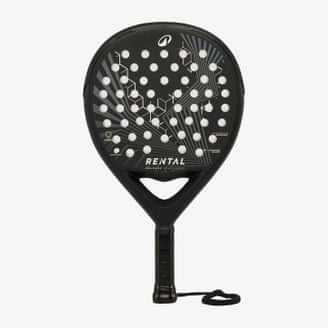
Decathlon Kuikma PR Rental
Decathlon
Kuikma PR Rental
£49.99
What we love
So much better than rival ‘rentals’
What we don’t love
The narrow grip could annoy
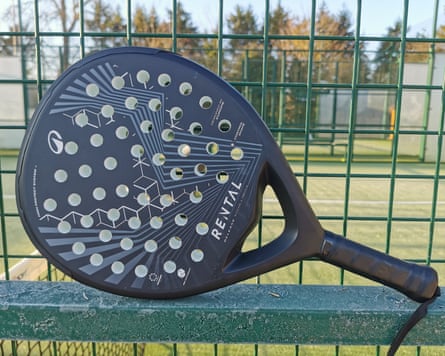
Ignore the price, ignore the name: this is a brilliant first racket for beginners. Every padel court I’ve been to has a few “Rental” rackets stowed away for padel newbies, and they’re typically cheap, almost throwaway models. So I was surprised by the quality of the Kuikma PR Rental, whose name references those rental rackets. It not only looks quite stylish – I’d be embarrassed to be seen holding most rental rackets – but was also great during play.
Why we love it
The first thing to notice is its rounded design. That means the sweet spot for hitting is right in the middle of the racket; but we found the Kuikma PR Rental more forgiving than most if you hit off-centre. At 350g, it’s also a light racket, which makes it a good choice for younger players or anyone looking for easy manoeuvrability.
The lack of girth means it won’t give you the same level of power as heavier rackets with harder EVA foam inside, and those who love to maximise the “cut” of their shots – adding backspin is often a good tactic in padel – should note the lack of extra friction built into the surface. But, as a starter racket, it’s a fantastic choice, with the benefit that it has extra protection at the end for when it’s smashed against the wall by accident.
It’s a shame that … the grip is so narrow. If I bought one of these, I’d immediately invest in an overgrip; but fortunately, that’s an incredibly easy task. And cheap, too: you can buy three overgrips from Decathlon for £3.49.
Weight: 350g
Shape: round
Balance: even (medium)
Decathlon
Kuikma PR Rental
£49.99
What we love
So much better than rival ‘rentals’
What we don’t love
The narrow grip could annoy
Best for ‘control’ players:
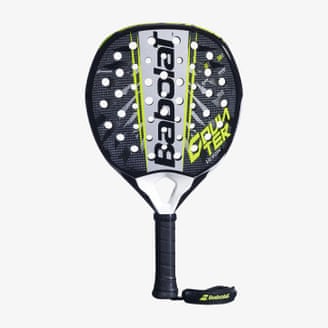
Babolat Counter Veron 2025
Babolat
Counter Veron 2025
£156.37
What we love
Astonishing levels of control
What we don’t love
You pay a high price
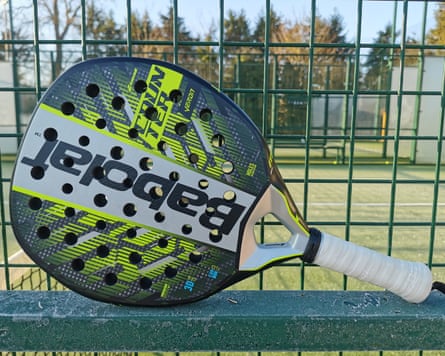
“From the first shot, it felt very comfortable,” said Andy Keeley. “Effortless is how I’d describe it.” A feeling echoed by all of our triallists, which shows Babolat has clearly got something right with this design.
Why we love it
Often in padel, you win points because the ball goes exactly where you want it to. That could be a volley with cutting backspin, a shot into the corner, or a shot that goes right down the middle, designed to split your opponents. Of all the rackets we tried, the Counter Veron excelled in all those areas.
This control stems in part from a roughened surface, common to many of the more expensive rackets. It allows you to add more spin when volleying, in particular – one of the most effective shots in padel is to slice the ball during volleys, as that means it bounces lower when it comes off the wall.
All three of Babolat’s Veron range use a mix of carbon and fibreglass, but if you want more power, then Babolat suggests you consider the Technical Veron, which has more carbon. We didn’t test the Technical, but the lighter Air (which has more fibreglass than the Counter Veron) also earned plenty of praise from our testers for its high level of control.
It’s a shame that … it’s so expensive, although that’s the only thing I can find to criticise. You shouldn’t be paying this much for a racket if you’re new to the game. Instead, look at our overall winner, for £100, or one of the budget options.
Weight: 365g
Shape: round
Balance: head heavy
Babolat
Counter Veron 2025
£156.37
What we love
Astonishing levels of control
What we don’t love
You pay a high price
Best for ‘power’ players:
Wilson Bela V3 Padel (2025)
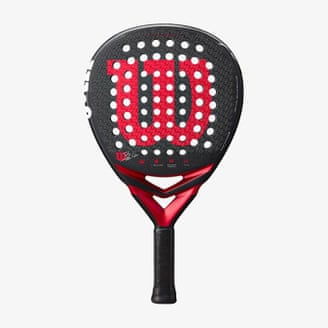
Wilson
Bela V3 Padel (2025)
from £171.57
What we love
Great balance of power and control
What we don’t love
Attention-seeking design – you need the skills to back it up
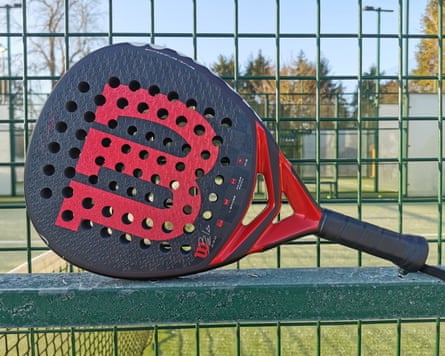
While the Babolat Counter Veron 2025 is a great choice for tactical players, some people like to dominate with power and aggression. For these players, I give you the Wilson Bela. It even looks the part, with the giant red W of the Wilson logo standing stark against the roughened black body.
Why we love it
As someone who loves to kill points dead with a flat, overhead smash, the Bela appealed to Andy, who praised the Bela for its power on all shots. Despite this, it’s not the heaviest of rackets at 365g, and because it uses a hybrid, teardrop design – as opposed to the diamond design you find on other “power” rackets – there’s plenty of control on offer, too.
Part of this comes from the roughened finish, which adds extra friction to shots, and Wilson reckons that the double V in the bridge area (between the grip and the racket face) enhances stability. But, as with so much when choosing padel rackets, I suggest you ignore the hype: much of the quality comes down to the materials used and that teardrop design.
It’s a shame that … all this quality comes at such a high price. To walk on to the court holding this racket, you need the skills to back it up. Just look at the colouring, the aggressive design, the signature of Argentinian pro padel player Fernando Belasteguín that gives this racket its name. The Wilson Bela V3 Padel definitely isn’t the choice for shy, retiring types.
Weight: 370g
Shape: teardrop
Balance: 265mm
Wilson
Bela V3 Padel (2025)
from £171.57
What we love
Great balance of power and control
What we don’t love
Attention-seeking design – you need the skills to back it up
Best padel racket for kids:
Babolat Alioth JR
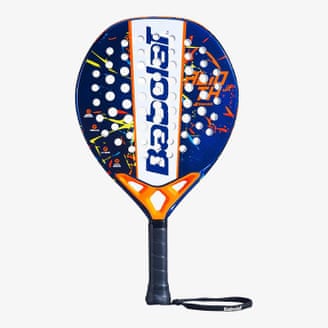
Babolat
Alioth JR
from £74.99
What we love
Sweet looks and generous sweep spot
What we don’t love
Tricky to add ‘bite’ to shots
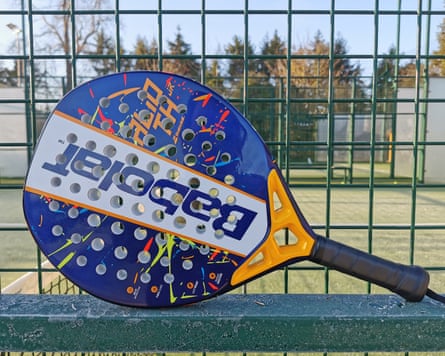
Babolat says it designed this racket for juniors aged eight to 12, but I think it will appeal to a far wider range – including anyone looking for a lighter racket.
Why we love it
First things first, I love the design. There’s nothing shy about the explosion of colour on this racket, which looks like it stumbled its way through a bunch of exploding paint pots, and even the bright orange bridge (between the handle and the main body) looks striking.
More importantly, it’s easy to manoeuvre because of its 320g weight, which is at least 30g lighter than most rackets I tested. That means it’s not as powerful, but when our testers leaned their weight into their shots, it still packed a real punch.
There’s a generous sweet spot on offer, so you won’t be penalised if you strike the ball away from its centre. As with the Decathlon rackets, the grip is narrow, so you will almost certainly need to add an overgrip – possibly even two.
It’s a shame that … it has the letters “JR” on the front, because this racket will have far larger appeal than Babolat’s target market. The other downside is that the surface is smooth, so you’ll have to work that bit harder to add “bite” to your volleys, to stop the ball from bouncing back too high.
Weight: 320g
Shape: teardrop
Balance: head light
Babolat
Alioth JR
from £74.99
What we love
Sweet looks and generous sweep spot
What we don’t love
Tricky to add ‘bite’ to shots
The best of the rest
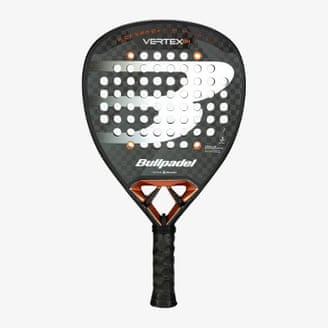
Bullpadel Vertex 04
Bullpadel
Vertex 04
from £137.70
What we love
Perfect for power players
What we don’t love
You need to be skilled to make the most of it
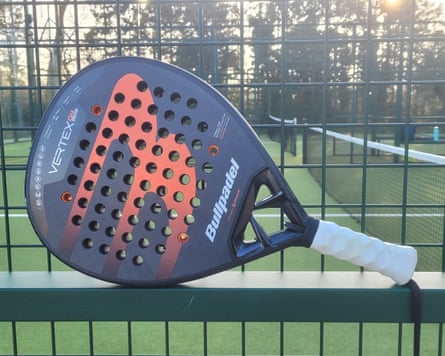
Best for: truly hard-hitters
This is the racket favoured by Andy, the padel coach, and it became obvious why when I watched him hit a few overhead smashes with it: the Bullpadel Vertex 04 packs an enormous amount of power. That is, so long as you hit the ball towards the top of the racket, which is where its sweet spot sits.
In the right hands, this racket also offers plenty of control, with a roughened top surface to add bite to sliced volleys. The other big factor in its favour is that the price is right, with it currently being sold for less than its RRP.
It didn’t make the final cut because … you need to be a top-quality player to take advantage of this racket’s undoubted skills.
Weight: 370g; shape: diamond; balance: head heavy
Bullpadel
Vertex 04
from £137.70
What we love
Perfect for power players
What we don’t love
You need to be skilled to make the most of it
Babolat Stima Spirit
Babolat
Stima Spirit
from £101.99
What we love
Lighter weight makes it easier to manoeuvre
What we don’t love
Narrow sweet spot means accuracy a must
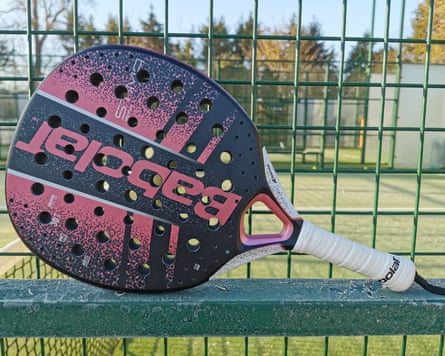
Best for: comfort
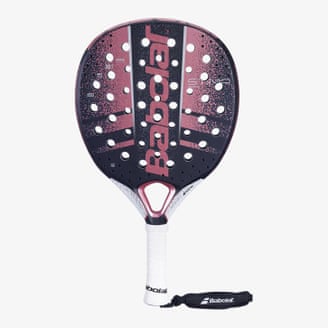
Sexism is alive and well in the world of padel rackets, with companies pushing not only lighter rackets at women but also different colours – this is the only one we recommend that has a hint of pink (others in the Stima range are even pinker).
We think a lot of people, no matter what their age and sex, will appreciate the lighter 335g weight of this racket, and its slimness: 36mm compared with about 45mm for many. This makes it super-easy to manoeuvre, which can be handy in tight corners
It didn’t make the final cut because … it’s more sensitive than other rackets, so you’ll get the most out of it only if you hit very accurately.
Weight: 335g; shape: round; balance: even
Babolat
Stima Spirit
from £101.99
What we love
Lighter weight makes it easier to manoeuvre
What we don’t love
Narrow sweet spot means accuracy a must
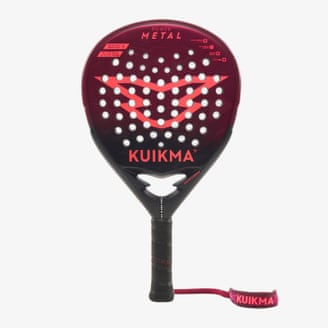
Decathlon
Kuikma Power Metal
£84.99
What we love
Ideal for hard hitters on a budget
What we don’t love
You’ll probably need an overgrip
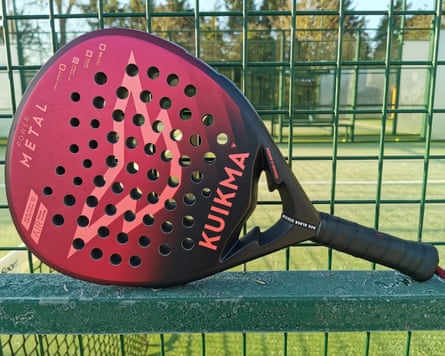
Best for: slicers on a budget
The Kuikma Power Metal is top quality for the money. If you removed all the branding, we suspect even an experienced player would struggle to differentiate the power on offer here from rackets costing twice as much.
As the diamond shape and name give away, Decathlon has placed the emphasis on power with this design; a sister model focuses on control. But don’t be fooled into thinking it can’t be used for control shots, with a roughened top surface adding bite to volleys.
It didn’t make the final cut because … some people will be put off by its weight, which is 365g. Despite this, it’s actually well suited to younger players, thanks in part to a narrow grip – something common to Decathlon’s designs. That means most adult players will need to invest in an overgrip, but that’s only a few pounds.
Weight: 365g; shape: diamond; balance: head heavy
Decathlon
Kuikma Power Metal
£84.99
What we love
Ideal for hard hitters on a budget
What we don’t love
You’ll probably need an overgrip
Head Gravity Motion (2024)
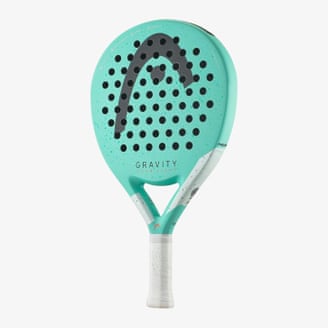
Head
Gravity Motion (2024)
from £109.92
What we love
Round shape is ideal for beginners
What we don’t love
Too expensive for what you get
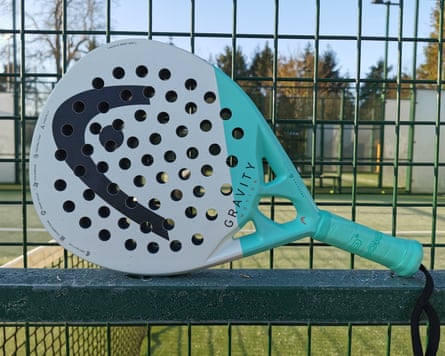
Best for: visibility
During testing, both Eveline and Andy picked up an interesting aspect of the Gravity Motion: that its striking colours made it easier to see the impact of the ball in your peripheral vision. Great for last-minute adjustments, perhaps.
Its round shape also means it’s more forgiving when it comes to making shots, and it’s more geared towards control than power – not necessarily a bad thing in padel.
It didn’t make the final cut because … it’s expensive for what it offers, but as this is one of the older models, you may be able to pick it up in a sale.
Weight: 360g; shape: round; balance: even
Head
Gravity Motion (2024)
from £109.92
What we love
Round shape is ideal for beginners
What we don’t love
Too expensive for what you get
What you need to know
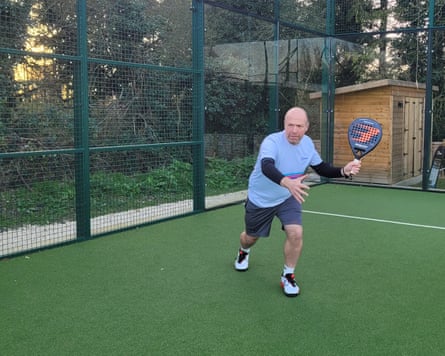
What head shape is best for your level?
There are three main types of head shape. Beginners will get the most immediate joy from a rounded style, which is the most forgiving, but your second racket is likely to be a teardrop shape. This puts more of the weight towards the top of the racket and means you can hit balls with more explosive power – but only if you hit them with the right part of the racket.
Absolute power players – and ones who can hit with a lot of accuracy – will lean towards the diamond-shaped rackets. The sweet spot is smaller still, towards the head of the racket, but that means you can get enough power on smashes to hopefully speed past opponents after the ball hits the back wall.
Do expensive padel rackets make a difference?
Yes, to a point. But don’t get sucked in by the hype. Speaking to Andy, a pro coach who had just spent almost £200 on his new racket, there is no need for beginners or intermediate players to spend as much as he did. You can find a great racket for less than £150, and don’t forget that almost all padel courts include rackets that you can try for free.
For most people, we suggest spending between £50 and £100 on your first racket. Work out exactly what sort of player you are – aggressive, counterattacking, spinny – before spending more on a racket that isn’t right for your game.
What other kit do I need?
Most courts provide padel balls, which are different from tennis balls: they’re slightly smaller and have a lower pressure, meaning they’re softer to hit and slower. But after a while, I’m pretty sure you’ll want to invest in your own.
You’ll also need a decent pair of trainers. Naturally, a whole industry of padel trainers has appeared, but the key thing is to have a decent grip – in the UK, the surface is almost universally artificial turf, and you may graze your skin if you fall over. I’ve also seen someone sprain their ankle while playing on an outdoor court, so be careful out there.
Unlike a tennis racket, you don’t need a racket cover to keep strings safe.
Is padel the same as pickleball?
No, padel is a very different game from pickleball, and they need different equipment. And courts. In particular, padel courts have walls for the ball to bounce against, much like squash, while pickleball is like a shorter version of tennis, except the ball has holes in it to slow it down.
How does scoring work?
Scoring in padel works exactly like doubles tennis. So, each player takes their turn to serve in a game. And then, assuming the serving team wins each point, it goes 15-love, 30-love, 40-love, game. To win a game, you must win by two clear points – so, again, like tennis, that means games go to deuce, after which the team must win two points in a row (for their advantage, then their game).
You also score sets and tie-breaks just like in tennis.
For more:
The best massage guns to relieve sore, tired muscles
The best fitness tech and gadgets
The best treadmills for your home
Tim Danton is a journalist and author who has written two books about the history of computing. His first sporting love is tennis, whether that’s watching it, playing it, or being on the committee of his local tennis club (where he serves as chair). As with many tennis players, he enjoys padel for its sociability and its different skill set