.png) 1 month ago
54
1 month ago
54
David Hare’s 1975 play Teeth ’n’ Smiles captured the melancholy mood of a generation as it looked back on the lost counter-cultural idealism of 1969. It is a play full of endings: a rock band teetering at the close of its platform-heeled life, frontwoman Maggie and songwriter Arthur packing up their relationship, and Europe and its music industry at the end of an era.
The hippy bubble of love, hope and revolution has most definitely burst as Maggie and the gang limber up for a gig at a Cambridge University ball. It is quite a comedown from the venues of their heyday but they are not about to go gently into that good night.
Rebecca Lucy Taylor, AKA Self Esteem, plays the dangerously unpredictable Maggie, who is catatonically drunk in the lead up to the first set but somehow still pulls it out of the bag once the lights come on. It is inspired casting to place the British pop star at the centre of this revival, bringing new relevance (and new audiences too). Helen Mirren, in the original cast, is said to have based her Maggie on Janis Joplin. The advantage here is that Taylor does not need to imitate in the singing scenes. She can hold an audience, and does so here with her vocal performance.
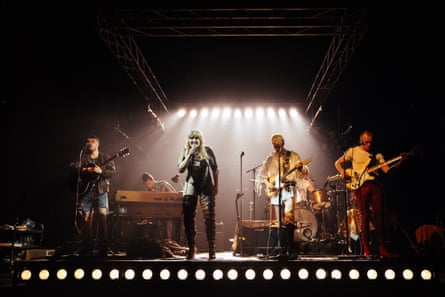
The songs by Nick and Tony Bicât, with some new ones by Taylor, are energetic, infectious and often sensational, from the throbbing 60s sound of Close to Me to the elegiac Last Orders, about a drowning generation. Alex Mullins’ costumes dazzle with their outre Jagger look (fringed tops, animal-print thigh boots, red leather trousers). Under the direction of Daniel Raggett, the band perform as if at an actual gig on Chloe Lamford’s set, which doubles as a backroom in which they lounge and fight. The show comes alive with every song. Taylor becomes magnetic. The sound, by Ben and Max Ringham, moves though you.
But the dialogue does not have enough meat on its bones. This seems like a play with no centre, though it has plenty of anarchic spirit and humour. Both the emotional intensity and intellectual focus are missing, the wandering script hopping from class commentary to fears around the loss of youth to the purpose of music (to make money or to rebel against the system?) – but with little follow-through. It is as if the script itself is waiting for the songs to arrive.
Maggie exudes an energy that foreshadows the punk movement, but her nihilistic rage is inarticulate and obstructs the other, unknown parts of her – including her relationship with Arthur which comes with little detail, so is not wholly credible. He is virtually a cypher, and the rest of the band are busy being types who take drugs, mess around and exclude their frontwoman with blokey talk of women and sex. The band’s oily manager, Saraffian (Phil Daniels), is an irritating cockney cliche. So is geeky medical student Anson (Roman Asde).
Comparisons with Stereophonic, David Adjmi’s drama about a 70s band – performed last year at the same theatre – may be unfair, but that show gave much more in its relationship complexities and emotional dramas. So come for the play and stay for the astounding music.
-
At Duke of York’s theatre, London, until 6 June